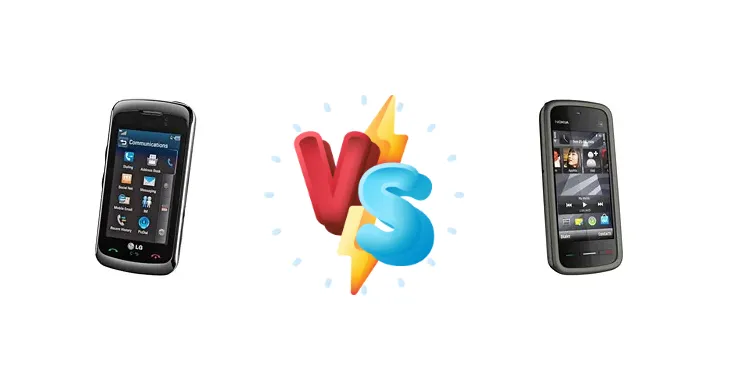
The late 2000s marked a transition in mobile technology, with feature phones attempting to bridge the gap to the emerging smartphone market. The LG GT550 Encore and Nokia 5230 represent this era, offering enhanced multimedia capabilities and connectivity compared to simpler handsets. This comparison dissects their strengths and weaknesses, revealing which device better served the needs of consumers at the time.
🏆 Quick Verdict
For the average user seeking a basic, reliable feature phone with a focus on music playback, the Nokia 5230 emerges as the slightly better choice. Its 434 MHz ARM 11 processor, while modest, provides a smoother experience than the LG GT550 Encore, given the Encore's lack of publicly available processor information, suggesting a lower-tier chipset.
| Network |
|---|
| 2G bands | GSM 850 / 900 / 1800 / 1900 | GSM 850 / 900 / 1800 / 1900 |
| 3G bands | HSDPA 850 / 1900 | HSDPA 900 / 2100 |
| Speed | HSPA 3.6/0.384 Mbps | HSPA 3.6/0.384 Mbps |
| Technology | GSM / HSPA | GSM / HSPA |
| | - | HSDPA 850 / 1900 - American version |
| Launch |
|---|
| Announced | 2010, October. Released 2010, October | 2009, August. Released 2009, November |
| Status | Discontinued | Discontinued |
| Body |
|---|
| Dimensions | 106 x 53.3 x 12 mm (4.17 x 2.10 x 0.47 in) | 111 x 51.7 x 15.5 mm, 83 cc (4.37 x 2.04 x 0.61 in) |
| SIM | Mini-SIM | Mini-SIM |
| Weight | 104.9 g (3.67 oz) | 115 g (4.06 oz) |
| Display |
|---|
| Resolution | 240 x 400 pixels, 5:3 ratio (~155 ppi density) | 360 x 640 pixels, 16:9 ratio (~229 ppi density) |
| Size | 3.0 inches, 25.6 cm2 (~45.3% screen-to-body ratio) | 3.2 inches, 28.2 cm2 (~49.2% screen-to-body ratio) |
| Type | TFT resistive touchscreen, 256K colors | TFT resistive touchscreen, 16M colors |
| | - | Handwriting recognition
|
| Platform |
|---|
| CPU | - | 434 MHz ARM 11 |
| OS | - | Symbian 9.4, Series 60 rel. 5 |
| Memory |
|---|
| Call records | Yes | - |
| Card slot | microSDHC (dedicated slot) | microSDHC (dedicated slot) |
| Internal | - | 70MB 128MB RAM |
| Phonebook | 1000 entries | - |
| Main Camera |
|---|
| Single | 3.15 MP | 2 MP |
| Video | 320p | 480p@30fps |
| Sound |
|---|
| 3.5mm jack | Yes | Yes |
| 35mm jack | Yes | Yes |
| Loudspeaker | Yes | Yes |
| Comms |
|---|
| Bluetooth | 2.1, A2DP, EDR | 2.0, A2DP |
| Positioning | A-GPS only | GPS, A-GPS; Nokia Maps |
| Radio | No | Stereo FM radio, RDS |
| USB | microUSB 2.0 | microUSB 2.0 |
| WLAN | No | No |
| Features |
|---|
| Browser | WAP 2.0/xHTML, HTML | WAP 2.0/xHTML, HTML, Adobe Flash Lite |
| Games | Yes | - |
| Java | Yes, MIDP 2.0 | - |
| Messaging | SMS, MMS, Email, IM | - |
| Sensors | - | Accelerometer, proximity |
| | SNS integration
MP3/WAV/eAAC+
MP4/H.264 player
Organizer
Voice memo/dial/commands
Predictive text input | MP4/H.264/WMV player
MP3/WAV/eAAC+/WMA player
Organizer
Photo editor
Voice memo/dial
Predictive text input |
| Battery |
|---|
| Music play | - | Up to 33 h |
| Stand-by | Up to 240 h | Up to 432 h (2G) / Up to 432 h (3G) |
| Talk time | Up to 3 h | Up to 7 h (2G) / Up to 4 h 30 min (3G) |
| Type | Removable Li-Ion 950 mAh battery | Removable Li-Ion 1320 mAh battery (BL-5J) |
| Misc |
|---|
| Colors | Black | Black, White |
| Price | About 60 EUR | About 80 EUR |
| SAR | - | 1.01 W/kg (head) 0.91 W/kg (body) |
| SAR EU | - | 1.08 W/kg (head) |
| Tests |
|---|
| Audio quality | - |
Noise -86.7dB / Crosstalk -84.0dB |
| Loudspeaker | - |
Voice 65dB / Noise 60dB / Ring 66dB |
LG GT550 Encore
- Potentially more durable build quality (based on LG's brand reputation)
- Simpler user interface for less tech-savvy users
- Likely lower price point at launch
- Unknown processor performance suggests slower speeds
- Limited feature set compared to the Nokia 5230
- Lack of detailed specifications makes a thorough assessment difficult
Nokia 5230
- 434 MHz ARM 11 processor offers a smoother user experience
- Larger screen size enhances multimedia consumption
- Stronger emphasis on music playback features
- Resistive touchscreen technology limits usability
- 2-megapixel camera delivers poor image quality
- Symbian OS was becoming outdated at the time of release
Display Comparison
The Nokia 5230 likely featured a larger display than the LG GT550 Encore, typical of Nokia's focus on multimedia. While specific resolution details are unavailable for the Encore, the 5230’s screen size was a key selling point. Both devices would have utilized resistive touchscreen technology, meaning accuracy and multi-touch support were limited. Color accuracy and viewing angles would have been subpar by modern standards, but adequate for basic tasks and media consumption.
Camera Comparison
Camera capabilities on both devices were basic. The Nokia 5230 likely featured a 2-megapixel camera, standard for the era, while the LG GT550 Encore’s camera resolution is unknown. Image quality would have been poor in low-light conditions, and features like autofocus were likely absent. These cameras were primarily intended for casual snapshots, not serious photography.
Performance
The Nokia 5230’s 434 MHz ARM 11 processor provided a modest level of performance for its time, enabling basic web browsing and application usage. The LG GT550 Encore’s processor remains unknown, but given its positioning, it likely featured a slower or less efficient chipset. This difference in processing power would have translated to slower application loading times and a less fluid user interface on the Encore. RAM capacity on both devices was likely limited, further restricting multitasking capabilities.
Battery Life
Battery life on both the LG GT550 Encore and Nokia 5230 would have been a significant advantage over early smartphones. Both devices likely featured batteries in the 1000-1500 mAh range, providing several days of standby time and hours of talk time. Charging times would have been relatively slow, requiring several hours to fully charge the battery via the included charger.
Buying Guide
Buy the LG GT550 Encore if you prioritize a potentially more durable build quality (based on LG's brand reputation at the time) and a simpler user interface, assuming it offers a less complex feature set. Buy the Nokia 5230 if you value a more responsive user experience thanks to its ARM 11 processor, and a stronger emphasis on multimedia features like music playback and a larger screen, making it ideal for users who consumed content on the go.
Frequently Asked Questions
❓ Was the Nokia 5230 a good phone for music playback?
Yes, the Nokia 5230 was specifically marketed for its music playback capabilities. It featured a 3.5mm headphone jack and support for various audio formats, making it a popular choice for music lovers on a budget.
❓ How did the Symbian OS on the Nokia 5230 compare to other operating systems at the time?
Symbian OS was a dominant force in the mobile market, but it was beginning to show its age by the time the Nokia 5230 was released. It lacked the app ecosystem and user-friendly interface of emerging platforms like iOS and Android, but it offered stability and a degree of customization.
❓ Is it possible to install apps on either of these phones?
Yes, both phones supported installing applications, but the process was significantly different than modern smartphones. The Nokia 5230, running Symbian, allowed for the installation of .sis files, while the LG GT550 Encore likely supported Java-based applications. The app selection was limited compared to modern app stores.