
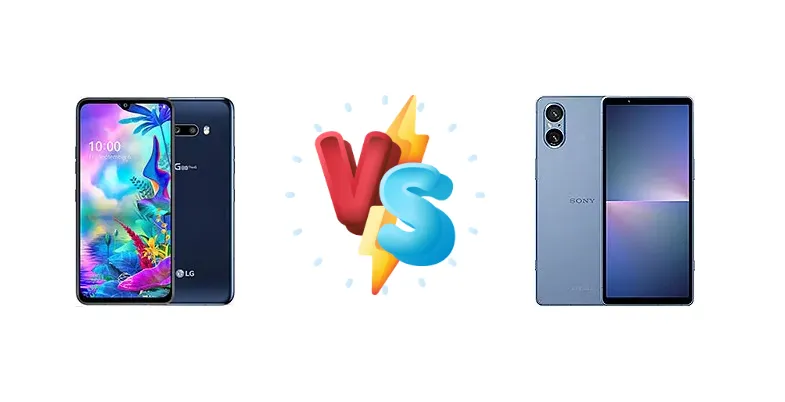
LG G8X ThinQ vs Sony Xperia 5 V: A Detailed Comparison of Two Android Contenders
| Phones Images | |||||
|---|---|---|---|---|---|
|
🏆 Quick Verdict
For most users, the Sony Xperia 5 V is the superior choice. Its Snapdragon 8 Gen 2 chipset delivers significantly improved performance and efficiency, coupled with a brighter display and faster charging. While the G8X ThinQ boasts respectable endurance, the Xperia 5 V offers a more modern and refined experience.
| PHONES | ||
|---|---|---|
| Phone Names | LG G8X ThinQ | Sony Xperia 5 V |
| Network | ||
|---|---|---|
| 2G bands | GSM 850 / 900 / 1800 / 1900 | GSM 850 / 900 / 1800 / 1900 |
| 3G bands | HSDPA 850 / 900 / 1900 / 2100 | HSDPA 800 / 850 / 900 / 1700(AWS) / 1900 / 2100 |
| 4G bands | 1, 2, 3, 4, 5, 7, 8, 12, 13, 17, 20, 28, 32, 38, 39, 40, 41 | 1, 2, 3, 4, 5, 7, 8, 12, 13, 17, 19, 20, 25, 26, 28, 29, 32, 34, 38, 39, 40, 41, 46, 66 - Europe |
| 5G bands | - | 1, 3, 5, 7, 8, 20, 28, 38, 40, 41, 77, 78 SA/NSA - Europe |
| Speed | HSPA 42.2/5.76 Mbps, LTE Cat20 1960/75 Mbps | HSPA, LTE, 5G |
| Technology | GSM / CDMA / HSPA / EVDO / LTE | GSM / HSPA / LTE / 5G |
| 1, 2, 3, 4, 5, 7, 12, 14, 20, 29, 30, 38, 39, 40, 41, 46, 66 - USA | - | |
| Launch | ||
|---|---|---|
| Announced | 2019, September 06. Released 2019, November 01 | 2023, September 01 |
| Status | Discontinued | Available. Released 2023, September 25 |
| Body | ||
|---|---|---|
| Build | Glass front (Gorilla Glass 6), glass back (Gorilla Glass 5), aluminum frame | Glass front (Gorilla Glass Victus 2), glass back, aluminum frame |
| Dimensions | 159.3 x 75.8 x 8.4 mm (6.27 x 2.98 x 0.33 in) | 154 x 68 x 8.6 mm (6.06 x 2.68 x 0.34 in) |
| SIM | · Nano-SIM· Nano-SIM + Nano-SIM | · Nano-SIM + eSIM· Nano-SIM + Nano-SIM |
| Weight | 192 g (6.77 oz) | 182 g (6.42 oz) |
| IP68 dust/water resistant (up to 1.5m for 30 min) MIL-STD-810G compliant* *does not guarantee ruggedness or use in extreme conditions | - | |
| Display | ||
|---|---|---|
| Protection | Corning Gorilla Glass 6 | Corning Gorilla Glass Victus 2 |
| Resolution | 1080 x 2340 pixels, 19.5:9 ratio (~403 ppi density) | 1080 x 2520 pixels, 21:9 ratio (~449 ppi density) |
| Size | 6.4 inches, 100.5 cm2 (~83.3% screen-to-body ratio) | 6.1 inches, 86.9 cm2 (~83.0% screen-to-body ratio) |
| Type | OLED, HDR10 | OLED, 1B colors, 120Hz, HDR10, BT.2020 |
| Always-on display | - | |
| Platform | ||
|---|---|---|
| CPU | Octa-core (1x2.84 GHz Kryo 485 & 3x2.42 GHz Kryo 485 & 4x1.78 GHz Kryo 485) | Octa-core (1x3.2 GHz Cortex-X3 & 2x2.8 GHz Cortex-A715 & 2x2.8 GHz Cortex-A710 & 3x2.0 GHz Cortex-A510) |
| Chipset | Qualcomm SM8150 Snapdragon 855 (7 nm) | Qualcomm SM8550-AB Snapdragon 8 Gen 2 (4 nm) |
| GPU | Adreno 640 | Adreno 740 |
| OS | Android 9.0 (Pie), upgradable to Android 12 | Android 13, upgradable to Android 15 |
| Memory | ||
|---|---|---|
| Card slot | microSDXC (uses shared SIM slot) - dual-SIM model | microSDXC (uses shared SIM slot) |
| Internal | 128GB 6GB RAM | 128GB 8GB RAM, 256GB 8GB RAM |
| UFS 2.1 | - | |
| Main Camera | ||
|---|---|---|
| Dual | 12 MP, f/1.8, 27mm (wide), 1/2.55", 1.4µm, dual pixel PDAF, OIS 13 MP, f/2.4, 9mm (ultrawide), 1.0µm | 48 MP, f/1.9, 24mm (wide), 1/1.35", 1.12µm, dual pixel PDAF, OIS 12 MP, f/2.2, 16mm (ultrawide), 1/2.5", dual pixel PDAF |
| Features | Dual-LED dual-tone flash, HDR, panorama | Zeiss optics, Zeiss T* lens coating, color spectrum sensor, LED flash, panorama, HDR, eye tracking |
| Single | 3.15 MP, AF | - |
| Video | 4K@30/60fps, 1080p@30/60/240fps, 24-bit/192kHz stereo sound rec., gyro-EIS | 4K@24/25/30/60/120fps HDR, 1080p@30/60/120fps; 5-axis gyro-EIS, OIS |
| Selfie camera | ||
|---|---|---|
| Features | HDR | HDR |
| Single | 32 MP, f/1.9, 26mm (wide), 1/2.8", 0.8µm | 12 MP, f/2.0, 24mm (wide), 1/2.9", 1.25µm |
| Video | 4K@30fps, gyro-EIS | 4K@30fps, 1080p@30/60fps, 5-axis gyro-EIS |
| Sound | ||
|---|---|---|
| 3.5mm jack | Yes | - |
| 35mm jack | Yes | Yes |
| Loudspeaker | Yes, with stereo speakers | Yes, with stereo speakers |
| 32-bit/192kHz audio 24-bit/192kHz audio recording Tuned by Meridian Audio | - | |
| Comms | ||
|---|---|---|
| Bluetooth | 5.0, A2DP, LE, aptX HD | 5.3, A2DP, LE Audio, aptX HD, aptX Adaptive |
| NFC | Yes | Yes |
| Positioning | GPS, GLONASS, GALILEO, BDS | GPS, GLONASS, BDS, GALILEO, QZSS |
| Radio | FM radio | No |
| USB | USB Type-C 3.1, OTG | USB Type-C 3.2, OTG, DisplayPort |
| WLAN | Wi-Fi 802.11 a/b/g/n/ac, dual-band, Wi-Fi Direct, DLNA | Wi-Fi 802.11 a/b/g/n/ac/6e, tri-band, Wi-Fi Direct, DLNA |
| Features | ||
|---|---|---|
| Browser | HTML, Adobe Flash | - |
| Sensors | Fingerprint (under display, optical), accelerometer, gyro, proximity, compass, barometer | Fingerprint (side-mounted), accelerometer, gyro, proximity, barometer, compass |
| Battery | ||
|---|---|---|
| Charging | 21W wired, PD, QC3 9W wireless | 30W wired, PD3.0, PPS, 50% in 30 min Wireless Reverse wireless |
| Talk time | Up to 12 h (multimedia) | - |
| Type | Li-Po 4000 mAh, non-removable | Li-Po 5000 mAh |
| Misc | ||
|---|---|---|
| Colors | New Aurora Black | Black, Blue, Platinum Silver |
| Models | LMG850EMW, LM-G850, 901LG, LM-G850N | XQ-DE54 |
| Price | About 560 EUR | € 999.99 / $ 1,444.00 |
| SAR | 1.12 W/kg (body) | - |
| SAR EU | 0.90 W/kg (head) | - |
| Tests | ||
|---|---|---|
| Audio quality | Noise -93.2dB / Crosstalk -93.4dB | - |
| Battery life | Endurance rating 111h | - |
| Camera | Photo / Video | - |
| Display | Contrast ratio: Infinite (nominal) | - |
| Loudspeaker | -24.9 LUFS (Very good) | - |
| Performance | AnTuTu: 339726 (v7), 411980 (v8) GeekBench: 11251 (v4.4), 2870 (v5.1) GFXBench: 38fps (ES 3.1 onscreen) | - |
LG G8X ThinQ
- Excellent battery endurance (111h rating)
- Lower price point (likely)
- Unique dual-screen accessory option
- Older Snapdragon 855 chipset
- Lower display brightness
- Slower charging speeds
Sony Xperia 5 V
- Powerful Snapdragon 8 Gen 2 chipset
- Brighter and more vibrant display
- Faster 30W charging with PD3.0/PPS
- Higher price point
- Slightly smaller screen size may not suit everyone
- Battery life, while good, isn't dramatically better than G8X
Display Comparison
The Sony Xperia 5 V’s display is a clear upgrade, achieving a measured peak brightness of 746 nits compared to the LG G8X ThinQ’s 603 nits. This translates to significantly better visibility outdoors. While both displays have an 'Infinite' (nominal) contrast ratio, the newer panel technology in the Xperia 5 V likely contributes to deeper blacks and more accurate color reproduction. The Xperia 5 V’s smaller 6.1-inch screen size, compared to the G8X’s 6.4-inch, caters to users who prefer a more pocketable device.
Camera Comparison
Both phones feature capable camera systems, but details are limited in the provided data. We can assume both offer photo and video capabilities. However, the Xperia 5 V likely benefits from Sony’s advanced image processing algorithms and potentially a larger sensor, though sensor size isn't specified. The G8X ThinQ’s camera performance, while adequate for its time, will likely fall behind the Xperia 5 V in low-light conditions and dynamic range. The absence of details regarding lens apertures makes a precise comparison difficult, but Sony’s expertise in camera technology gives the Xperia 5 V an edge.
Performance
The core difference lies in the chipsets. The LG G8X ThinQ utilizes the Qualcomm Snapdragon 855 (7nm), while the Sony Xperia 5 V is powered by the Snapdragon 8 Gen 2 (4nm). This generational leap is substantial. The 4nm process node of the 8 Gen 2 offers significantly improved power efficiency and thermal performance, meaning less throttling during sustained workloads like gaming. The Xperia 5 V’s CPU, featuring a Cortex-X3 prime core clocked at 3.2 GHz, outperforms the Kryo 485 cores in the G8X ThinQ across all tasks. The Xperia 5 V also benefits from faster RAM, likely LPDDR5x, further enhancing responsiveness.
Battery Life
The LG G8X ThinQ boasts an endurance rating of 111 hours, while the Sony Xperia 5 V achieves 130 hours. However, this doesn’t tell the whole story. The Xperia 5 V’s active use score of 16:19h provides a more realistic measure of real-world battery performance. The Xperia 5 V also features significantly faster charging at 30W with PD3.0 and PPS, capable of reaching 50% charge in just 30 minutes, compared to the G8X ThinQ’s 21W wired charging. The inclusion of wireless and reverse wireless charging on the Xperia 5 V adds further convenience.
Buying Guide
Buy the LG G8X ThinQ if you prioritize maximizing battery life on a budget and are intrigued by the dual-screen functionality, even if it's aging. Buy the Sony Xperia 5 V if you demand the latest performance, a brighter and more vibrant display, and faster charging speeds, and value a compact form factor with a premium build quality.