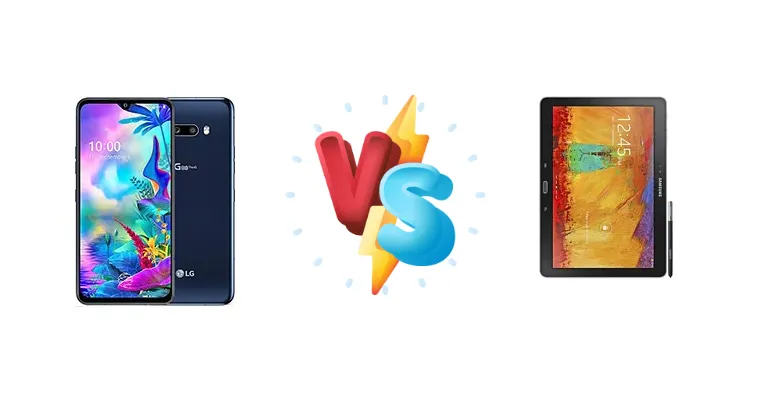
Comparing the LG G8X ThinQ and the Samsung Galaxy Note 10.1 (2014) isn't about direct competition; it's about witnessing six years of mobile technology evolution. The Note 10.1 represented a pinnacle of tablet-phone convergence in 2014, while the G8X ThinQ, released in 2019, showcases the advancements in processing power, display technology, and battery optimization achieved in the intervening years. This comparison highlights how far smartphones have come.
🏆 Quick Verdict
For the average user in 2024, the LG G8X ThinQ is the clear winner. Its Snapdragon 855 chipset, significantly brighter display (603 nits vs. an unspecified but demonstrably lower value for the Note 10.1), and superior battery endurance (111h) offer a vastly improved experience compared to the aging Galaxy Note 10.1 (2014).
| Network |
|---|
| 2G bands | GSM 850 / 900 / 1800 / 1900 | GSM 850 / 900 / 1800 / 1900 - all versions |
| 3G bands | HSDPA 850 / 900 / 1900 / 2100 | HSDPA 850 / 900 / 1900 / 2100 - all versions |
| 4G bands | 1, 2, 3, 4, 5, 7, 8, 12, 13, 17, 20, 28, 32, 38, 39, 40, 41 | 1, 3, 5, 7, 8, 20 - SM-P605 |
| Speed | HSPA 42.2/5.76 Mbps, LTE Cat20 1960/75 Mbps | HSPA 42.2(LTE)/21.1(3G)/5.76 Mbps, LTE Cat4 150/50 Mbps - cellular model only |
| Technology | GSM / CDMA / HSPA / EVDO / LTE | GSM / HSPA / LTE |
| | 1, 2, 3, 4, 5, 7, 12, 14, 20, 29, 30, 38, 39, 40, 41, 46, 66 - USA | - |
| Launch |
|---|
| Announced | 2019, September 06. Released 2019, November 01 | 2013, September. Released 2013, October |
| Status | Discontinued | Discontinued |
| Body |
|---|
| Build | Glass front (Gorilla Glass 6), glass back (Gorilla Glass 5), aluminum frame | - |
| Dimensions | 159.3 x 75.8 x 8.4 mm (6.27 x 2.98 x 0.33 in) | 243.1 x 171.4 x 7.9 mm (9.57 x 6.75 x 0.31 in) |
| SIM | · Nano-SIM· Nano-SIM + Nano-SIM | Micro-SIM - cellular model only |
| Weight | 192 g (6.77 oz) | 540g (WIFI)/ 535 g (3G)/ 547g (LTE) (1.18 lb) |
| | IP68 dust/water resistant (up to 1.5m for 30 min)
MIL-STD-810G compliant*
*does not guarantee ruggedness or use in extreme conditions | Stylus |
| Display |
|---|
| Protection | Corning Gorilla Glass 6 | - |
| Resolution | 1080 x 2340 pixels, 19.5:9 ratio (~403 ppi density) | 2560 x 1600 pixels, 16:10 ratio (~299 ppi density) |
| Size | 6.4 inches, 100.5 cm2 (~83.3% screen-to-body ratio) | 10.1 inches, 295.8 cm2 (~71.0% screen-to-body ratio) |
| Type | OLED, HDR10 | Super clear LCD |
| | Always-on display | - |
| Platform |
|---|
| CPU | Octa-core (1x2.84 GHz Kryo 485 & 3x2.42 GHz Kryo 485 & 4x1.78 GHz Kryo 485) | Quad-core 2.3 GHz Krait 400 - LTE modelOcta-core (4x1.9 GHz Cortex-A15 & 4x1.3 GHz Cortex-A7) - 3G model |
| Chipset | Qualcomm SM8150 Snapdragon 855 (7 nm) | Qualcomm Snapdragon 800 (28 nm) |
| GPU | Adreno 640 | Adreno 330 (LTE model) |
| OS | Android 9.0 (Pie), upgradable to Android 12 | Android 4.3 (Jelly Bean), upgradable to 5.1.1 (Lollipop), TouchWiz UI |
| Memory |
|---|
| Card slot | microSDXC (uses shared SIM slot) - dual-SIM model | microSDXC (dedicated slot) |
| Internal | 128GB 6GB RAM | 16GB 3GB RAM, 32GB 3GB RAM, 64GB 3GB RAM |
| | UFS 2.1 | eMMC 4.5 |
| Main Camera |
|---|
| Dual | 12 MP, f/1.8, 27mm (wide), 1/2.55", 1.4µm, dual pixel PDAF, OIS
13 MP, f/2.4, 9mm (ultrawide), 1.0µm | - |
| Features | Dual-LED dual-tone flash, HDR, panorama | LED flash |
| Single | 3.15 MP, AF | 8 MP, AF |
| Video | 4K@30/60fps, 1080p@30/60/240fps, 24-bit/192kHz stereo sound rec., gyro-EIS | 1080p@60fps (LTE model) |
| Selfie camera |
|---|
| Features | HDR | - |
| Single | 32 MP, f/1.9, 26mm (wide), 1/2.8", 0.8µm | 2 MP |
| Video | 4K@30fps, gyro-EIS | 1080p@30fps |
| Sound |
|---|
| 3.5mm jack | Yes | Yes |
| 35mm jack | Yes | Yes |
| Loudspeaker | Yes, with stereo speakers | Yes, with stereo speakers |
| | 32-bit/192kHz audio
24-bit/192kHz audio recording
Tuned by Meridian Audio | - |
| Comms |
|---|
| Bluetooth | 5.0, A2DP, LE, aptX HD | 4.0, A2DP |
| Infrared port | - | Yes |
| NFC | Yes | No |
| Positioning | GPS, GLONASS, GALILEO, BDS | GPS, GLONASS - cellular model only |
| Radio | FM radio | No |
| USB | USB Type-C 3.1, OTG | microUSB 2.0 (MHL TV-out), OTG |
| WLAN | Wi-Fi 802.11 a/b/g/n/ac, dual-band, Wi-Fi Direct, DLNA | Wi-Fi 802.11 a/b/g/n/ac, dual-band, Wi-Fi Direct, hotspot |
| Features |
|---|
| Browser | HTML, Adobe Flash | - |
| Sensors | Fingerprint (under display, optical), accelerometer, gyro, proximity, compass, barometer | Accelerometer, gyro, proximity, compass |
| Battery |
|---|
| Charging | 21W wired, PD, QC3
9W wireless | - |
| Music play | - | Up to 98 h |
| Stand-by | - | Up to 2230 h |
| Talk time | Up to 12 h (multimedia) | Up to 10 h (multimedia) (2G) / Up to 49 h (3G) |
| Type | Li-Po 4000 mAh, non-removable | Li-Po 8220 mAh, non-removable |
| Misc |
|---|
| Colors | New Aurora Black | Black, White |
| Models | LMG850EMW, LM-G850, 901LG, LM-G850N | SM-P600, SM-P601, SM-P605 |
| Price | About 560 EUR | About 370 EUR |
| SAR | 1.12 W/kg (body) | 1.59 W/kg (body) |
| SAR EU | 0.90 W/kg (head) | 0.64 W/kg (body) |
| Tests |
|---|
| Audio quality |
Noise -93.2dB / Crosstalk -93.4dB |
Noise -95.5dB / Crosstalk -97.3dB |
| Battery life |
Endurance rating 111h
| - |
| Camera |
Photo / Video |
Photo / Video |
| Display |
Contrast ratio: Infinite (nominal) |
Contrast ratio: 821:1 (nominal) |
| Loudspeaker |
-24.9 LUFS (Very good)
|
Voice 75dB / Noise 66dB / Ring 77dB |
| Performance |
AnTuTu: 339726 (v7), 411980 (v8)
GeekBench: 11251 (v4.4), 2870 (v5.1)
GFXBench: 38fps (ES 3.1 onscreen) | - |
LG G8X ThinQ
- Significantly faster processor (Snapdragon 855)
- Much brighter and more vibrant display (603 nits)
- Superior battery life (111h endurance rating)
- Smaller screen size compared to the Note 10.1
- May not have the same stylus functionality as the Note 10.1
Samsung Galaxy Note 10.1 (2014)
- Larger screen size ideal for media consumption
- Stylus support for note-taking and drawing
- Classic Samsung design aesthetic
- Outdated processor (Snapdragon 800)
- Poor battery life compared to modern smartphones
- Dimmer and less vibrant display
Display Comparison
The LG G8X ThinQ boasts a significantly brighter display, reaching 603 nits, ensuring excellent visibility even in direct sunlight. In contrast, the Samsung Galaxy Note 10.1 (2014) has a contrast ratio of 821:1, indicating a less vibrant and less dynamic image compared to the G8X’s ‘Infinite’ (nominal) contrast ratio. While the Note 10.1’s larger 10.1-inch screen was a selling point in 2014, the G8X’s more modern panel technology delivers a superior viewing experience in terms of brightness and color reproduction.
Camera Comparison
Both devices offer photo and video capabilities, but a direct comparison is difficult without detailed camera specs. However, the six-year difference in technology suggests the G8X ThinQ benefits from advancements in image processing, low-light performance, and potentially sensor size. The Note 10.1’s camera, while decent for 2014, would likely struggle to match the image quality achievable with a modern smartphone like the G8X. The G8X likely benefits from more sophisticated algorithms for noise reduction and dynamic range.
Performance
The performance gap is substantial. The LG G8X ThinQ’s Qualcomm Snapdragon 855 (7nm) is a generational leap ahead of the Samsung Galaxy Note 10.1’s Snapdragon 800 (28nm). The 855 features an octa-core CPU with a Kryo 485 architecture, offering significantly improved single-core and multi-core performance. The Note 10.1’s Snapdragon 800, while capable for its time, is limited by its older manufacturing process and quad-core configuration (or octa-core with less efficient Cortex-A15/A7 cores in the 3G model). This translates to noticeably faster app loading times, smoother multitasking, and a better gaming experience on the G8X.
Battery Life
The LG G8X ThinQ’s endurance rating of 111 hours demonstrates a significant advantage in battery life. While the Note 10.1’s battery capacity isn’t specified, its older chipset and less efficient display technology would result in considerably shorter runtimes. The G8X also supports 21W wired charging with Power Delivery (PD) and Quick Charge 3.0 (QC3), as well as 9W wireless charging, offering faster and more convenient charging options than the Note 10.1 likely supported.
Buying Guide
Buy the LG G8X ThinQ if you need a modern smartphone experience with strong performance for gaming, streaming, and everyday tasks, coupled with a long-lasting battery. Buy the Samsung Galaxy Note 10.1 (2014) if you specifically require a larger screen for media consumption and note-taking, and are willing to accept significantly reduced performance and battery life, potentially as a dedicated e-reader or secondary device.
Frequently Asked Questions
❓ Is the Snapdragon 855 in the LG G8X ThinQ still capable of handling demanding games in 2024?
Yes, the Snapdragon 855 remains a capable chipset for most mobile games in 2024, even at high settings. While not the absolute latest, it provides a smooth and enjoyable gaming experience for the vast majority of titles. Its 7nm process also contributes to better thermal management compared to the Snapdragon 800.
❓ Can I expect to find software updates for the Samsung Galaxy Note 10.1 (2014) in 2024?
No. Samsung officially ended software support for the Galaxy Note 10.1 (2014) years ago. This means it's vulnerable to security risks and lacks access to new features and improvements found in modern Android versions. The LG G8X ThinQ, while also past its prime, likely received more recent updates.
❓ How does the difference in manufacturing process (28nm vs 7nm) impact the performance and efficiency of these chipsets?
The 7nm process used in the Snapdragon 855 allows for a significantly higher transistor density, resulting in improved performance and power efficiency compared to the 28nm process of the Snapdragon 800. This means the G8X’s chipset can deliver more processing power while consuming less energy, leading to longer battery life and reduced heat generation.