
LG G8X ThinQ vs OnePlus 7T Pro 5G: A Detailed Performance and Battery Life Comparison
| Phones Images | |||||
|---|---|---|---|---|---|
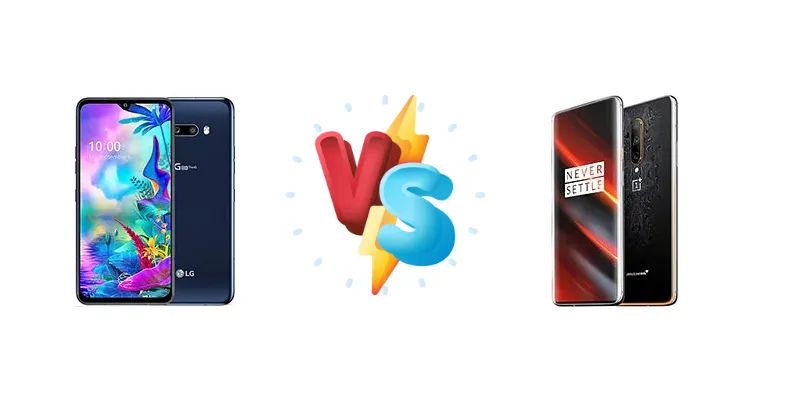
|
🏆 Quick Verdict
For the average user prioritizing all-day battery life and a more versatile experience, the LG G8X ThinQ emerges as the winner. While the OnePlus 7T Pro 5G McLaren boasts faster 30W charging and a slightly more powerful Snapdragon 855+, the LG’s impressive 111-hour endurance rating and brighter display offer a more balanced package.
| PHONES | ||
|---|---|---|
| Phone Names | LG G8X ThinQ | OnePlus 7T Pro 5G McLaren |
| Network | ||
|---|---|---|
| 2G bands | GSM 850 / 900 / 1800 / 1900 | GSM 850 / 900 / 1800 / 1900 |
| 3G bands | HSDPA 850 / 900 / 1900 / 2100 | HSDPA 850 / 900 / 1700(AWS) / 1900 / 2100 |
| 4G bands | 1, 2, 3, 4, 5, 7, 8, 12, 13, 17, 20, 28, 32, 38, 39, 40, 41 | 1, 2, 3, 4, 5, 1, 2, 3, 4, 5, 7, 8, 12, 13, 17, 18, 19, 20, 25, 26, 28, 29, 30, 34, 38, 39, 40, 41, 46, 48, 66, 71 |
| 5G bands | - | 71 SA |
| Speed | HSPA 42.2/5.76 Mbps, LTE Cat20 1960/75 Mbps | HSPA 42.2/5.76 Mbps, LTE (5CA) Cat18 1200/150 Mbps, 5G (2+ Gbps DL) |
| Technology | GSM / CDMA / HSPA / EVDO / LTE | GSM / CDMA / HSPA / LTE / 5G |
| 1, 2, 3, 4, 5, 7, 12, 14, 20, 29, 30, 38, 39, 40, 41, 46, 66 - USA | CDMA 800 / 1900 & TD-SCDMA | |
| Launch | ||
|---|---|---|
| Announced | 2019, September 06. Released 2019, November 01 | 2019, October 23. Released 2019, November 05 |
| Status | Discontinued | Discontinued |
| Body | ||
|---|---|---|
| Build | Glass front (Gorilla Glass 6), glass back (Gorilla Glass 5), aluminum frame | Glass front (Gorilla Glass 6), glass back (Gorilla Glass 5), aluminum frame |
| Dimensions | 159.3 x 75.8 x 8.4 mm (6.27 x 2.98 x 0.33 in) | 162.6 x 75.9 x 8.8 mm (6.40 x 2.99 x 0.35 in) |
| SIM | · Nano-SIM· Nano-SIM + Nano-SIM | Nano-SIM + Nano-SIM |
| Weight | 192 g (6.77 oz) | 206 g (7.27 oz) |
| IP68 dust/water resistant (up to 1.5m for 30 min) MIL-STD-810G compliant* *does not guarantee ruggedness or use in extreme conditions | - | |
| Display | ||
|---|---|---|
| Protection | Corning Gorilla Glass 6 | Corning Gorilla Glass 6 |
| Resolution | 1080 x 2340 pixels, 19.5:9 ratio (~403 ppi density) | 1440 x 3120 pixels, 19.5:9 ratio (~516 ppi density) |
| Size | 6.4 inches, 100.5 cm2 (~83.3% screen-to-body ratio) | 6.67 inches, 108.8 cm2 (~88.1% screen-to-body ratio) |
| Type | OLED, HDR10 | Fluid AMOLED, 90Hz, HDR10+ |
| Always-on display | - | |
| Platform | ||
|---|---|---|
| CPU | Octa-core (1x2.84 GHz Kryo 485 & 3x2.42 GHz Kryo 485 & 4x1.78 GHz Kryo 485) | Octa-core (1x2.96 GHz Kryo 485 & 3x2.42 GHz Kryo 485 & 4x1.78 GHz Kryo 485) |
| Chipset | Qualcomm SM8150 Snapdragon 855 (7 nm) | Qualcomm SM8150 Snapdragon 855+ (7 nm) |
| GPU | Adreno 640 | Adreno 640 (700 MHz) |
| OS | Android 9.0 (Pie), upgradable to Android 12 | Android 10, OxygenOS 10.0 |
| Memory | ||
|---|---|---|
| Card slot | microSDXC (uses shared SIM slot) - dual-SIM model | No |
| Internal | 128GB 6GB RAM | 256GB 12GB RAM |
| UFS 2.1 | UFS 3.0 | |
| Main Camera | ||
|---|---|---|
| Dual | 12 MP, f/1.8, 27mm (wide), 1/2.55", 1.4µm, dual pixel PDAF, OIS 13 MP, f/2.4, 9mm (ultrawide), 1.0µm | - |
| Features | Dual-LED dual-tone flash, HDR, panorama | Laser AF, Dual-LED flash, HDR, panorama |
| Single | 3.15 MP, AF | - |
| Triple | - | 48 MP, f/1.6, (wide), 1/2.0", 0.8µm, PDAF, OIS 8 MP, f/2.4, (telephoto), 1.0µm, PDAF, OIS, 3x optical zoom 16 MP, f/2.2, 13mm (ultrawide), AF |
| Video | 4K@30/60fps, 1080p@30/60/240fps, 24-bit/192kHz stereo sound rec., gyro-EIS | 4K@30/60fps, 1080p@30/60/240fps, 720p@960fps, Auto HDR, gyro-EIS |
| Selfie camera | ||
|---|---|---|
| Features | HDR | HDR |
| Single | 32 MP, f/1.9, 26mm (wide), 1/2.8", 0.8µm | Motorized pop-up 16 MP, f/2.0, 25mm (wide), 1/3.06", 1.0µm |
| Video | 4K@30fps, gyro-EIS | 1080p@30fps, gyro-EIS |
| Sound | ||
|---|---|---|
| 3.5mm jack | Yes | No |
| 35mm jack | Yes | No |
| Loudspeaker | Yes, with stereo speakers | Yes, with stereo speakers |
| 32-bit/192kHz audio 24-bit/192kHz audio recording Tuned by Meridian Audio | - | |
| Comms | ||
|---|---|---|
| Bluetooth | 5.0, A2DP, LE, aptX HD | 5.1, A2DP, LE, aptX HD |
| NFC | Yes | Yes |
| Positioning | GPS, GLONASS, GALILEO, BDS | GPS (L1+L5), GLONASS (G1), BDS (B1), GALILEO (E1+E5a) |
| Radio | FM radio | No |
| USB | USB Type-C 3.1, OTG | USB Type-C 3.1, OTG |
| WLAN | Wi-Fi 802.11 a/b/g/n/ac, dual-band, Wi-Fi Direct, DLNA | Wi-Fi 802.11 a/b/g/n/ac, dual-band, Wi-Fi Direct, DLNA |
| Features | ||
|---|---|---|
| Browser | HTML, Adobe Flash | - |
| Sensors | Fingerprint (under display, optical), accelerometer, gyro, proximity, compass, barometer | Fingerprint (under display, optical), accelerometer, gyro, compass |
| - | Virtual proximity sensing | |
| Battery | ||
|---|---|---|
| Charging | 21W wired, PD, QC3 9W wireless | 30W wired |
| Talk time | Up to 12 h (multimedia) | - |
| Type | Li-Po 4000 mAh, non-removable | Li-Po 4085 mAh, non-removable |
| Misc | ||
|---|---|---|
| Colors | New Aurora Black | Papaya Orange |
| Models | LMG850EMW, LM-G850, 901LG, LM-G850N | HD1925 |
| Price | About 560 EUR | About 800 EUR |
| SAR | 1.12 W/kg (body) | - |
| SAR EU | 0.90 W/kg (head) | - |
| Tests | ||
|---|---|---|
| Audio quality | Noise -93.2dB / Crosstalk -93.4dB | - |
| Battery life | Endurance rating 111h | - |
| Camera | Photo / Video | - |
| Display | Contrast ratio: Infinite (nominal) | - |
| Loudspeaker | -24.9 LUFS (Very good) | - |
| Performance | AnTuTu: 339726 (v7), 411980 (v8) GeekBench: 11251 (v4.4), 2870 (v5.1) GFXBench: 38fps (ES 3.1 onscreen) | - |
LG G8X ThinQ
- Exceptional 111-hour battery endurance
- Brighter display (603 nits)
- Versatile charging options (wired, wireless)
- Slightly slower processor (Snapdragon 855)
- Charging speed is slower than OnePlus
OnePlus 7T Pro 5G McLaren
- Faster Snapdragon 855+ processor
- 30W fast charging
- 90Hz display for smoother visuals
- Lower battery endurance compared to LG
- Potentially more thermal throttling under sustained load
Display Comparison
The LG G8X ThinQ features a display capable of reaching 603 nits of peak brightness, providing excellent visibility in direct sunlight. While the OnePlus 7T Pro 5G McLaren’s brightness isn’t specified, OnePlus typically prioritizes color accuracy and smoothness. Both phones likely utilize OLED panels, but the LG’s higher peak brightness is a measurable advantage. The LG’s ‘Infinite’ contrast ratio (nominal) suggests excellent black levels, typical of OLED technology. The OnePlus 7T Pro 5G McLaren’s display is known for its 90Hz refresh rate, which wasn’t a feature of the G8X, offering smoother scrolling and animations, though this comes at a potential battery life cost.
Camera Comparison
Both phones feature capable camera systems, but detailed sensor information is limited. Both are described as having Photo/Video capabilities. The OnePlus 7T Pro 5G McLaren is known for its excellent image processing and dynamic range, while the LG G8X ThinQ offers a wider range of shooting modes and features. Without specific sensor size or aperture data, it’s difficult to definitively declare a winner. The absence of details suggests neither phone prioritizes groundbreaking camera technology over other features.
Performance
Both devices are powered by the Qualcomm Snapdragon 855, but the OnePlus 7T Pro 5G McLaren utilizes the slightly enhanced Snapdragon 855+ (7nm). The 855+ features a marginally higher clock speed (2.96 GHz vs 2.84 GHz on the G8X’s primary core), resulting in a small performance uplift in sustained workloads. Both share the same CPU core configuration (Octa-core: 1x2.84/2.96 GHz Kryo 485, 3x2.42 GHz Kryo 485, 4x1.78 GHz Kryo 485). The real-world difference will be subtle for most users, but gamers and power users may notice a slight edge with the OnePlus. Neither phone specifies RAM speed, but both likely utilize LPDDR4X, and thermal management will be crucial in preventing throttling during extended gaming sessions.
Battery Life
The LG G8X ThinQ’s standout feature is its exceptional endurance rating of 111 hours, indicating significantly longer battery life than most competitors. This is achieved despite a likely smaller battery capacity than the OnePlus. The OnePlus 7T Pro 5G McLaren compensates with significantly faster 30W wired charging, allowing for a quicker top-up. The LG supports 21W wired charging (PD, QC3) and 9W wireless charging, offering more versatility but slower overall charging speeds. The OnePlus’s faster charging is ideal for users who frequently need to quickly replenish their battery, while the LG’s endurance is better suited for those who prioritize all-day usage without needing to plug in.
Buying Guide
Buy the LG G8X ThinQ if you need exceptional battery life, value the potential of a secondary screen for multitasking, and prefer a brighter display for outdoor visibility. Buy the OnePlus 7T Pro 5G McLaren if you prioritize the fastest possible charging speeds, want a cleaner software experience, and intend to heavily utilize 5G networks where available. The McLaren edition also appeals to those seeking a more premium aesthetic.