
LG G8X ThinQ vs. LG V50S ThinQ 5G: A Detailed Comparison
| Phones Images | |||||
|---|---|---|---|---|---|
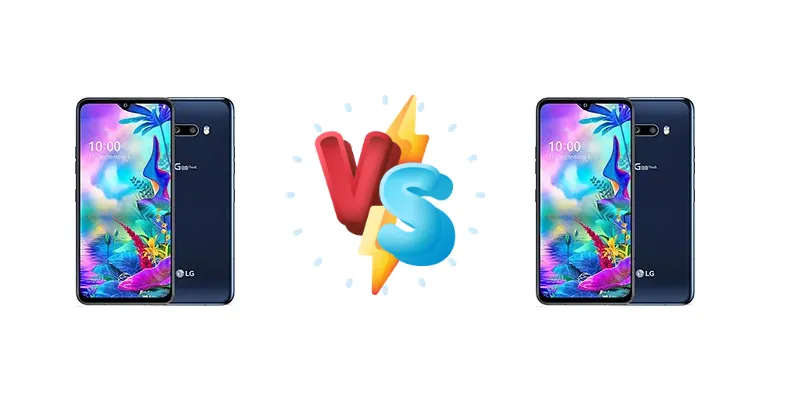
|
🏆 Quick Verdict
For the average user, the LG G8X ThinQ emerges as the stronger choice. Its significantly better endurance rating (111h) and brighter display (603 nits) provide a more consistently enjoyable experience, offsetting the V50S’s 5G capability which is less relevant in many markets today.
| PHONES | ||
|---|---|---|
| Phone Names | LG G8X ThinQ | LG V50S ThinQ 5G |
| Network | ||
|---|---|---|
| 2G bands | GSM 850 / 900 / 1800 / 1900 | GSM 850 / 900 / 1800 / 1900 |
| 3G bands | HSDPA 850 / 900 / 1900 / 2100 | HSDPA 850 / 900 / 1700(AWS) / 1900 / 2100 |
| 4G bands | 1, 2, 3, 4, 5, 7, 8, 12, 13, 17, 20, 28, 32, 38, 39, 40, 41 | 1, 2, 3, 4, 5, 7, 8, 12, 13, 17, 20, 25, 26, 28, 40, 41 |
| 5G bands | - | 41 NSA |
| Speed | HSPA 42.2/5.76 Mbps, LTE Cat20 1960/75 Mbps | HSPA 42.2/5.76 Mbps, LTE Cat19 1600/75 Mbps, 5G (2+ Gbps DL) |
| Technology | GSM / CDMA / HSPA / EVDO / LTE | GSM / CDMA / HSPA / EVDO / LTE / 5G |
| 1, 2, 3, 4, 5, 7, 12, 14, 20, 29, 30, 38, 39, 40, 41, 46, 66 - USA | CDMA2000 1xEV-DO | |
| Launch | ||
|---|---|---|
| Announced | 2019, September 06. Released 2019, November 01 | 2019, October. Released 2019, October |
| Status | Discontinued | Discontinued |
| Body | ||
|---|---|---|
| Build | Glass front (Gorilla Glass 6), glass back (Gorilla Glass 5), aluminum frame | Glass front (Gorilla Glass 5), glass back (Gorilla Glass 6), aluminum frame |
| Dimensions | 159.3 x 75.8 x 8.4 mm (6.27 x 2.98 x 0.33 in) | 159.3 x 75.8 x 8.4 mm (6.27 x 2.98 x 0.33 in) |
| SIM | · Nano-SIM· Nano-SIM + Nano-SIM | · Nano-SIM· Nano-SIM + Nano-SIM |
| Weight | 192 g (6.77 oz) | 192 g (6.77 oz) |
| IP68 dust/water resistant (up to 1.5m for 30 min) MIL-STD-810G compliant* *does not guarantee ruggedness or use in extreme conditions | IP68 dust/water resistant (up to 1.5m for 30 min) MIL-STD-810G compliant* *does not guarantee ruggedness or use in extreme conditions | |
| Display | ||
|---|---|---|
| Protection | Corning Gorilla Glass 6 | Corning Gorilla Glass 5 |
| Resolution | 1080 x 2340 pixels, 19.5:9 ratio (~403 ppi density) | 1080 x 2340 pixels, 19.5:9 ratio (~403 ppi density) |
| Size | 6.4 inches, 100.5 cm2 (~83.3% screen-to-body ratio) | 6.4 inches, 100.5 cm2 (~83.3% screen-to-body ratio) |
| Type | OLED, HDR10 | OLED, HDR10 |
| Always-on display | Always-on display | |
| Platform | ||
|---|---|---|
| CPU | Octa-core (1x2.84 GHz Kryo 485 & 3x2.42 GHz Kryo 485 & 4x1.78 GHz Kryo 485) | Octa-core (1x2.84 GHz Kryo 485 & 3x2.42 GHz Kryo 485 & 4x1.78 GHz Kryo 485) |
| Chipset | Qualcomm SM8150 Snapdragon 855 (7 nm) | Qualcomm SM8150 Snapdragon 855 (7 nm) |
| GPU | Adreno 640 | Adreno 640 |
| OS | Android 9.0 (Pie), upgradable to Android 12 | Android 9.0 (Pie), upgradable to Android 12 |
| Memory | ||
|---|---|---|
| Card slot | microSDXC (uses shared SIM slot) - dual-SIM model | microSDXC (uses shared SIM slot) - dual-SIM model |
| Internal | 128GB 6GB RAM | 256GB 8GB RAM |
| UFS 2.1 | UFS 2.1 | |
| Main Camera | ||
|---|---|---|
| Dual | 12 MP, f/1.8, 27mm (wide), 1/2.55", 1.4µm, dual pixel PDAF, OIS 13 MP, f/2.4, 9mm (ultrawide), 1.0µm | 12 MP, f/1.8, 27mm (standard), 1/2.55", 1.4µm, dual pixel PDAF, OIS 13 MP, f/2.4, 9mm (ultrawide), 1/3.4", 1.0µm |
| Features | Dual-LED dual-tone flash, HDR, panorama | Dual-LED dual-tone flash, HDR, panorama |
| Single | 3.15 MP, AF | - |
| Video | 4K@30/60fps, 1080p@30/60/240fps, 24-bit/192kHz stereo sound rec., gyro-EIS | 4K@30/60fps, 1080p@30/60/240fps, 24-bit/192kHz stereo sound rec., gyro-EIS |
| Selfie camera | ||
|---|---|---|
| Features | HDR | HDR |
| Single | 32 MP, f/1.9, 26mm (wide), 1/2.8", 0.8µm | 32 MP, f/1.9, 26mm (wide), 1/2.8", 0.8µm |
| Video | 4K@30fps, gyro-EIS | 4K@30fps, gyro-EIS |
| Sound | ||
|---|---|---|
| 3.5mm jack | Yes | Yes |
| 35mm jack | Yes | Yes |
| Loudspeaker | Yes, with stereo speakers | Yes, with stereo speakers |
| 32-bit/192kHz audio 24-bit/192kHz audio recording Tuned by Meridian Audio | 32-bit/192kHz audio 24-bit/192kHz audio recording Tuned by Meridian Audio | |
| Comms | ||
|---|---|---|
| Bluetooth | 5.0, A2DP, LE, aptX HD | 5.0, A2DP, LE, aptX HD |
| NFC | Yes | Yes |
| Positioning | GPS, GLONASS, GALILEO, BDS | GPS, GLONASS, GALILEO, BDS |
| Radio | FM radio | FM radio |
| USB | USB Type-C 3.1, OTG | USB Type-C 3.1, OTG |
| WLAN | Wi-Fi 802.11 a/b/g/n/ac, dual-band, Wi-Fi Direct, DLNA | Wi-Fi 802.11 a/b/g/n/ac, dual-band, Wi-Fi Direct, DLNA |
| Features | ||
|---|---|---|
| Browser | HTML, Adobe Flash | - |
| Sensors | Fingerprint (under display, optical), accelerometer, gyro, proximity, compass, barometer | Fingerprint (under display, optical), accelerometer, gyro, proximity, compass, barometer |
| Battery | ||
|---|---|---|
| Charging | 21W wired, PD, QC3 9W wireless | 21W wired, PD, QC3 9W wireless |
| Talk time | Up to 12 h (multimedia) | - |
| Type | Li-Po 4000 mAh, non-removable | Li-Po 4000 mAh, non-removable |
| Misc | ||
|---|---|---|
| Colors | New Aurora Black | Aurora Black |
| Models | LMG850EMW, LM-G850, 901LG, LM-G850N | LM-V510N |
| Price | About 560 EUR | About 1100 EUR |
| SAR | 1.12 W/kg (body) | - |
| SAR EU | 0.90 W/kg (head) | - |
| Tests | ||
|---|---|---|
| Audio quality | Noise -93.2dB / Crosstalk -93.4dB | - |
| Battery life | Endurance rating 111h | - |
| Camera | Photo / Video | - |
| Display | Contrast ratio: Infinite (nominal) | - |
| Loudspeaker | -24.9 LUFS (Very good) | - |
| Performance | AnTuTu: 339726 (v7), 411980 (v8) GeekBench: 11251 (v4.4), 2870 (v5.1) GFXBench: 38fps (ES 3.1 onscreen) | - |
LG G8X ThinQ
- Exceptional battery life (111h endurance)
- Brighter display (603 nits) for outdoor visibility
- More affordable price point
- Camera specifications are unknown
- Lacks dedicated 5G support
LG V50S ThinQ 5G
- Integrated 5G connectivity
- Potentially more advanced camera system
- Traditional flagship design
- Likely shorter battery life
- Potentially higher price
- 5G functionality may be limited by network availability
Display Comparison
The LG G8X ThinQ boasts a notably brighter display, reaching a measured 603 nits, compared to the V50S which lacks published brightness data but is expected to be lower based on market positioning. This brightness advantage translates to better visibility outdoors. Both displays share an 'Infinite' (nominal) contrast ratio, suggesting deep blacks, but the G8X’s higher peak brightness provides a more dynamic visual experience. While both likely utilize OLED technology, the G8X’s brightness is a clear differentiator for users who frequently consume content in bright environments.
Camera Comparison
Both devices feature a 'Photo / Video' camera system, but detailed sensor information is missing. Without specifics on sensor size, aperture, or optical image stabilization (OIS), a definitive camera comparison is impossible. However, given the V50S’s positioning as a flagship, it likely features a more sophisticated camera system with potentially larger sensors and more advanced image processing. The inclusion of a 2MP macro camera on either device is largely inconsequential, offering limited practical benefit. Image processing style will likely differ, with LG historically favoring vibrant, saturated colors.
Performance
Both the LG G8X ThinQ and the LG V50S ThinQ 5G are powered by the Qualcomm Snapdragon 855 (7nm) chipset, featuring an octa-core CPU configuration (1x2.84 GHz Kryo 485, 3x2.42 GHz Kryo 485, and 4x1.78 GHz Kryo 485). This means CPU performance will be virtually identical in day-to-day tasks and most gaming scenarios. The absence of RAM specifications in the provided data makes a direct comparison impossible, but both likely feature 6GB or 8GB of RAM. Thermal management will likely be similar, as both utilize the same chipset and similar form factors. The V50S’s 5G modem *could* introduce slightly higher thermal load during 5G usage, but this is unlikely to be significant.
Battery Life
The LG G8X ThinQ shines in battery endurance, achieving a measured 111-hour rating. The V50S’s battery life is not specified, but given its 5G modem and potentially larger display, it’s reasonable to assume it falls short of the G8X. Both devices support 21W wired charging with Power Delivery (PD) and Quick Charge 3 (QC3), as well as 9W wireless charging. The G8X’s superior endurance means users will likely rely less on wired charging, making its battery life a significant advantage for those who prioritize minimizing charging frequency.
Buying Guide
Buy the LG G8X ThinQ if you prioritize all-day battery life, a vibrant and bright display for media consumption, and a more affordable price point. Buy the LG V50S ThinQ 5G if you absolutely require 5G connectivity and prefer a more conventional flagship design, understanding that battery life will be a compromise.