
LG G8X ThinQ vs Google Pixel 4a 5G: A Detailed Comparison of Performance and Value
| Phones Images | |||||
|---|---|---|---|---|---|
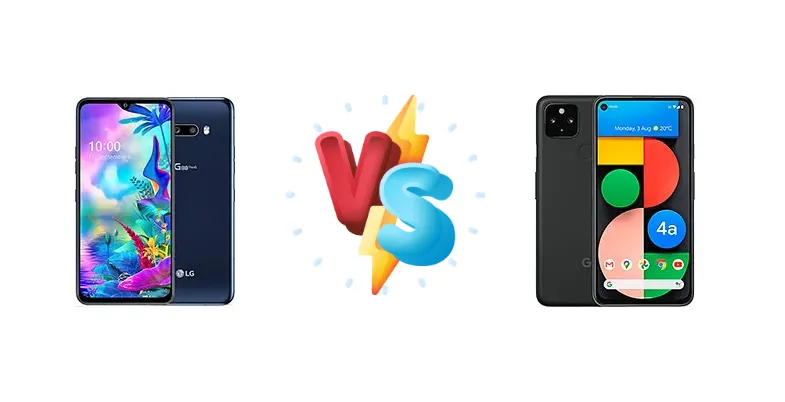
|
🏆 Quick Verdict
For users prioritizing raw performance and extended battery life, the LG G8X ThinQ is the better choice. Its Snapdragon 855 offers a significant advantage in demanding tasks. However, the Google Pixel 4a 5G excels in 5G connectivity and camera software, making it ideal for users focused on mobile photography and future-proofing.
| PHONES | ||
|---|---|---|
| Phone Names | LG G8X ThinQ | Google Pixel 4a 5G |
| Network | ||
|---|---|---|
| 2G bands | GSM 850 / 900 / 1800 / 1900 | GSM 850 / 900 / 1800 / 1900 |
| 3G bands | HSDPA 850 / 900 / 1900 / 2100 | HSDPA 850 / 900 / 1700(AWS) / 1900 / 2100 |
| 4G bands | 1, 2, 3, 4, 5, 7, 8, 12, 13, 17, 20, 28, 32, 38, 39, 40, 41 | 1, 2, 3, 4, 5, 7, 8, 12, 13, 14, 17, 18, 19, 20, 25, 26, 28, 29, 30, 32, 38, 39, 40, 41, 42, 46, 48, 66, 71 |
| 5G bands | - | 1, 2, 3, 5, 7, 8, 12, 28, 41, 66, 71, 77, 78 Sub6, mmWave (market dependant) |
| Speed | HSPA 42.2/5.76 Mbps, LTE Cat20 1960/75 Mbps | HSPA, LTE, 5G |
| Technology | GSM / CDMA / HSPA / EVDO / LTE | GSM / HSPA / LTE / 5G |
| 1, 2, 3, 4, 5, 7, 12, 14, 20, 29, 30, 38, 39, 40, 41, 46, 66 - USA | - | |
| Launch | ||
|---|---|---|
| Announced | 2019, September 06. Released 2019, November 01 | 2020, September 30 |
| Status | Discontinued | Available. Released 2020, November 05 |
| Body | ||
|---|---|---|
| Build | Glass front (Gorilla Glass 6), glass back (Gorilla Glass 5), aluminum frame | Glass front (Gorilla Glass 3), plastic back, plastic frame |
| Dimensions | 159.3 x 75.8 x 8.4 mm (6.27 x 2.98 x 0.33 in) | 153.9 x 74 x 8.2 mm (Sub-6) or 8.5 mm (Sub-6 and mmWave) |
| SIM | · Nano-SIM· Nano-SIM + Nano-SIM | Nano-SIM + eSIM |
| Weight | 192 g (6.77 oz) | 168 g (5G Sub-6); 171 g ( 5G Sub-6 and mmWave) (5.93 oz) |
| IP68 dust/water resistant (up to 1.5m for 30 min) MIL-STD-810G compliant* *does not guarantee ruggedness or use in extreme conditions | - | |
| Display | ||
|---|---|---|
| Protection | Corning Gorilla Glass 6 | Corning Gorilla Glass 3 |
| Resolution | 1080 x 2340 pixels, 19.5:9 ratio (~403 ppi density) | 1080 x 2340 pixels, 19.5:9 ratio (~413 ppi density) |
| Size | 6.4 inches, 100.5 cm2 (~83.3% screen-to-body ratio) | 6.2 inches, 95.7 cm2 (~84.1% screen-to-body ratio) |
| Type | OLED, HDR10 | OLED, HDR |
| Always-on display | Always-on display | |
| Platform | ||
|---|---|---|
| CPU | Octa-core (1x2.84 GHz Kryo 485 & 3x2.42 GHz Kryo 485 & 4x1.78 GHz Kryo 485) | Octa-core (1x2.4 GHz Kryo 475 Prime & 1x2.2 GHz Kryo 475 Gold & 6x1.8 GHz Kryo 475 Silver) |
| Chipset | Qualcomm SM8150 Snapdragon 855 (7 nm) | Qualcomm SM7250 Snapdragon 765G 5G (7 nm) |
| GPU | Adreno 640 | Adreno 620 |
| OS | Android 9.0 (Pie), upgradable to Android 12 | Android 11, upgradable to Android 14 |
| Memory | ||
|---|---|---|
| Card slot | microSDXC (uses shared SIM slot) - dual-SIM model | No |
| Internal | 128GB 6GB RAM | 128GB 6GB RAM |
| UFS 2.1 | UFS 2.1 | |
| Main Camera | ||
|---|---|---|
| Dual | 12 MP, f/1.8, 27mm (wide), 1/2.55", 1.4µm, dual pixel PDAF, OIS 13 MP, f/2.4, 9mm (ultrawide), 1.0µm | 12.2 MP, f/1.7, 27mm (wide), 1/2.55", 1.4µm, dual pixel PDAF, OIS 16 MP, f/2.2, 107˚ (ultrawide), 1.0µm |
| Features | Dual-LED dual-tone flash, HDR, panorama | LED flash, Pixel Shift, Auto-HDR, panorama |
| Single | 3.15 MP, AF | - |
| Video | 4K@30/60fps, 1080p@30/60/240fps, 24-bit/192kHz stereo sound rec., gyro-EIS | 4K@30/60fps, 1080p@30/60/120/240fps; gyro-EIS |
| Selfie camera | ||
|---|---|---|
| Features | HDR | HDR |
| Single | 32 MP, f/1.9, 26mm (wide), 1/2.8", 0.8µm | 8 MP, f/2.0, 24mm (wide), 1/4.0", 1.12µm |
| Video | 4K@30fps, gyro-EIS | 1080p@30fps |
| Sound | ||
|---|---|---|
| 3.5mm jack | Yes | Yes |
| 35mm jack | Yes | Yes |
| Loudspeaker | Yes, with stereo speakers | Yes, with stereo speakers |
| 32-bit/192kHz audio 24-bit/192kHz audio recording Tuned by Meridian Audio | - | |
| Comms | ||
|---|---|---|
| Bluetooth | 5.0, A2DP, LE, aptX HD | 5.0, A2DP, LE, aptX HD |
| NFC | Yes | Yes |
| Positioning | GPS, GLONASS, GALILEO, BDS | GPS, GLONASS, GALILEO, QZSS, BDS |
| Radio | FM radio | No |
| USB | USB Type-C 3.1, OTG | USB Type-C 3.1 |
| WLAN | Wi-Fi 802.11 a/b/g/n/ac, dual-band, Wi-Fi Direct, DLNA | Wi-Fi 802.11 a/b/g/n/ac, dual-band, Wi-Fi Direct |
| Features | ||
|---|---|---|
| Browser | HTML, Adobe Flash | - |
| Sensors | Fingerprint (under display, optical), accelerometer, gyro, proximity, compass, barometer | Fingerprint (rear-mounted), accelerometer, gyro, proximity, compass, barometer |
| Battery | ||
|---|---|---|
| Charging | 21W wired, PD, QC3 9W wireless | 18W wired, PD2.0 |
| Talk time | Up to 12 h (multimedia) | - |
| Type | Li-Po 4000 mAh, non-removable | Li-Po 3885 mAh |
| Misc | ||
|---|---|---|
| Colors | New Aurora Black | Just Black, Clearly White |
| Models | LMG850EMW, LM-G850, 901LG, LM-G850N | GD1YQ, G025I, G025E, G025H, G6QU3 |
| Price | About 560 EUR | About 140 EUR |
| SAR | 1.12 W/kg (body) | - |
| SAR EU | 0.90 W/kg (head) | - |
| Tests | ||
|---|---|---|
| Audio quality | Noise -93.2dB / Crosstalk -93.4dB | - |
| Battery life | Endurance rating 111h | - |
| Camera | Photo / Video | - |
| Display | Contrast ratio: Infinite (nominal) | - |
| Loudspeaker | -24.9 LUFS (Very good) | - |
| Performance | AnTuTu: 339726 (v7), 411980 (v8) GeekBench: 11251 (v4.4), 2870 (v5.1) GFXBench: 38fps (ES 3.1 onscreen) | - |
LG G8X ThinQ
- Superior processing power with Snapdragon 855
- Exceptional battery life (111h endurance)
- Faster charging speeds (21W wired, 9W wireless)
- Dual Screen accessory compatibility
- Older chipset compared to the Pixel 4a 5G
- Camera details are limited, potentially lagging behind Pixel's software
Google Pixel 4a 5G
- Integrated 5G connectivity
- Excellent camera software and image processing
- Clean and updated Android experience
- Competitive price point
- Less powerful Snapdragon 765G chipset
- Slower charging speeds (18W wired)
- Battery life is unknown, potentially lower than G8X
Display Comparison
The LG G8X ThinQ boasts a 603-nit peak brightness, providing excellent visibility outdoors, though the Pixel 4a 5G’s brightness isn’t specified, it’s likely lower. While both displays have an 'infinite' (nominal) contrast ratio, the G8X’s larger size and potentially higher resolution (not specified in the data) contribute to a more immersive viewing experience. The G8X’s compatibility with its Dual Screen accessory is a unique advantage, effectively doubling screen real estate for productivity or gaming. The Pixel 4a 5G’s display is likely tuned for color accuracy, a hallmark of the Pixel line, but lacks the G8X’s versatility.
Camera Comparison
Both phones offer photo and video capabilities, but the specifics are limited. Without sensor size or aperture data, it’s difficult to make a definitive judgment. However, Google’s computational photography prowess is well-known. The Pixel 4a 5G likely excels in dynamic range and low-light performance through software processing. The G8X, while potentially having a higher-resolution sensor, relies more on hardware. The Pixel’s image processing is optimized for realistic colors and detail, while LG’s tends towards more vibrant, sometimes oversaturated, results. The absence of details on the G8X’s camera system makes a direct comparison challenging, but the Pixel’s software advantage is a strong point.
Performance
The core difference lies in the chipsets: the LG G8X ThinQ utilizes the Qualcomm Snapdragon 855 (7nm), while the Pixel 4a 5G features the Snapdragon 765G (7nm). The 855’s octa-core CPU, with its 2.84 GHz Kryo 485 prime core, significantly outperforms the 765G’s 2.4 GHz Kryo 475 Prime core in single-core tasks. The 765G’s strength is integrated 5G, eliminating the need for an external modem. However, the 855’s Adreno 640 GPU provides a substantial graphical advantage, making the G8X the clear winner for gaming. The G8X’s performance headroom will translate to smoother multitasking and longer software support, despite the Pixel’s newer release.
Battery Life
The LG G8X ThinQ’s endurance rating of 111 hours is a standout feature, indicating exceptional battery life. This is likely due to the efficient Snapdragon 855 and a larger battery capacity (not specified). The Pixel 4a 5G’s battery life is not provided, but its 18W charging is slower than the G8X’s 21W wired charging with PD and QC3 support. The G8X also offers 9W wireless charging, a feature absent on the Pixel. While the Pixel’s 5G connectivity may consume more power, the G8X’s superior endurance and faster charging provide a more convenient user experience.
Buying Guide
Buy the LG G8X ThinQ if you need a phone capable of handling intensive gaming, video editing, or multitasking without slowdowns, and if the extended 111-hour endurance rating is crucial. Buy the Google Pixel 4a 5G if you prioritize a clean Android experience, excellent camera image processing, and reliable 5G connectivity for streaming and downloading on the go.