
LG G8S ThinQ vs Sony Xperia 10 V: A Detailed Comparison of Performance and Endurance
| Phones Images | |||||
|---|---|---|---|---|---|
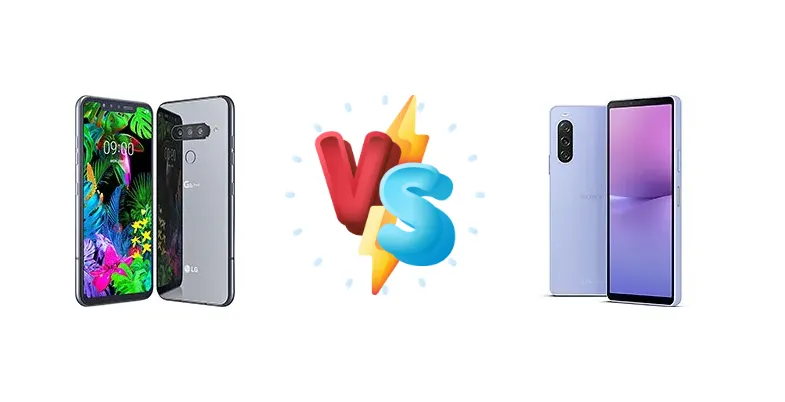
|
🏆 Quick Verdict
For the average user prioritizing all-day battery life and a bright, clear display, the Sony Xperia 10 V is the better choice. While the LG G8S ThinQ boasts a significantly more powerful Snapdragon 855, the Xperia 10 V’s 16:14h active use battery score and efficient Snapdragon 695 offer a more consistently reliable experience.
| PHONES | ||
|---|---|---|
| Phone Names | LG G8S ThinQ | Sony Xperia 10 V |
| Network | ||
|---|---|---|
| 2G bands | GSM 850 / 900 / 1800 / 1900 | GSM 850 / 900 / 1800 / 1900 |
| 3G bands | HSDPA 850 / 900 / 1700(AWS) / 1800 / 1900 / 2100 | HSDPA 850 / 900 / 1700(AWS) / 2100 |
| 4G bands | 1, 2, 3, 4, 5, 7, 8, 12, 17, 20, 28, 32, 38, 39, 40, 41 | 1, 3, 4, 5, 7, 8, 20, 28, 38, 39, 40, 41 |
| 5G bands | - | 1, 3, 5, 7, 8, 20, 28, 38, 40, 41, 77, 78, 79 SA/NSA |
| Speed | HSPA 42.2/5.76 Mbps, LTE Cat19 1600/150 Mbps | HSPA, LTE, 5G |
| Technology | GSM / HSPA / LTE | GSM / HSPA / LTE / 5G |
| Launch | ||
|---|---|---|
| Announced | 2019, February 24. Released 2019, July 02 | 2023, May 11 |
| Status | Discontinued | Available. Released 2023, June 21 |
| Body | ||
|---|---|---|
| Build | Glass front (Gorilla Glass 5), glass back (Gorilla Glass 6), aluminum frame | Glass front (Gorilla Glass Victus), plastic frame, plastic back |
| Dimensions | 155.3 x 76.6 x 8 mm (6.11 x 3.02 x 0.31 in) | 155 x 68 x 8.3 mm (6.10 x 2.68 x 0.33 in) |
| SIM | · Nano-SIM· Nano-SIM + Nano-SIM | · Nano-SIM + eSIM· Nano-SIM + Nano-SIM |
| Weight | 181 g (6.38 oz) | 159 g (5.61 oz) |
| IP68 dust/water resistant (up to 1.5m for 30 mins) MIL-STD-810G compliant* *does not guarantee ruggedness or use in extreme conditions | IP65/IP68 dust/water resistant (up to 1.5m for 30 min) | |
| Display | ||
|---|---|---|
| Protection | Corning Gorilla Glass 5 | Corning Gorilla Glass Victus |
| Resolution | 1080 x 2248 pixels (~401 ppi density) | 1080 x 2520 pixels, 21:9 ratio (~449 ppi density) |
| Size | 6.21 inches, 97.6 cm2 (~82.0% screen-to-body ratio) | 6.1 inches, 86.9 cm2 (~82.5% screen-to-body ratio) |
| Type | G-OLED, HDR10 | OLED, 1B colors, HDR |
| Always-on display | Triluminos display | |
| Platform | ||
|---|---|---|
| CPU | Octa-core (1x2.84 GHz Kryo 485 & 3x2.42 GHz Kryo 485 & 4x1.78 GHz Kryo 485) | Octa-core (2x2.2 GHz Kryo 660 Gold & 6x1.7 GHz Kryo 660 Silver) |
| Chipset | Qualcomm SM8150 Snapdragon 855 (7 nm) | Qualcomm SM6375 Snapdragon 695 5G (6 nm) |
| GPU | Adreno 640 | Adreno 619 |
| OS | Android 9.0 (Pie), upgradable to Android 12 | Android 13, upgradable to Android 15 |
| Memory | ||
|---|---|---|
| Card slot | microSDXC (dedicated slot) - single-SIM modelmicroSDXC (uses shared SIM slot) - dual-SIM model | microSDXC (uses shared SIM slot) |
| Internal | 64GB 6GB RAM, 128GB 6GB RAM | 128GB 6GB RAM, 128GB 8GB RAM |
| UFS 2.1 | UFS | |
| Main Camera | ||
|---|---|---|
| Features | LED flash, HDR, panorama | LED flash, HDR, panorama |
| Triple | 12 MP, f/1.8, 27mm (wide), 1.4µm, PDAF, OIS 12 MP, f/2.6, 49mm (telephoto), 1.0µm, PDAF, 2x optical zoom 13 MP, f/2.4, 14mm (ultrawide), 1.0µm | 48 MP, f/1.8, 26mm (wide), 1/2.0", 0.8µm, PDAF, OIS 8 MP, f/2.2, 54mm (telephoto), 1/4.4", 1.0µm, PDAF, 2x optical zoom 8 MP, f/2.2, 120˚, 16mm (ultrawide), 1/4.0", 1.12µm |
| Video | 4K@30/60fps, 1080p@30/60fps, 1080p@240fps, HDR, 24-bit/192kHz stereo sound rec. | 1080p@30fps |
| Selfie camera | ||
|---|---|---|
| Features | HDR | HDR |
| Single | 8 MP, f/1.9, 26mm (wide), 1/4.0", 1.12µm, AF TOF 3D, f/1.4, (depth sensor) | 8 MP, f/2.0, 26mm (wide), 1/4.0", 1.12µm |
| Video | 1080p@60fps | 1080p@30fps |
| Sound | ||
|---|---|---|
| 3.5mm jack | Yes | Yes |
| 35mm jack | Yes | Yes |
| Loudspeaker | Yes, with stereo speakers | Yes, with stereo speakers |
| 32-bit/192kHz audio | 24-bit/192kHz audio | |
| Comms | ||
|---|---|---|
| Bluetooth | 5.0, A2DP, LE, aptX HD | 5.1, A2DP, LE, aptX HD, aptX Adaptive |
| NFC | Yes | Yes |
| Positioning | GPS, GLONASS, GALILEO, BDS | GPS, GLONASS, GALILEO, BDS, QZSS |
| Radio | FM radio | No |
| USB | USB Type-C 3.1, OTG | USB Type-C 2.0, OTG |
| WLAN | Wi-Fi 802.11 a/b/g/n/ac, dual-band, Wi-Fi Direct, DLNA | Wi-Fi 802.11 a/b/g/n/ac, dual-band, Wi-Fi Direct |
| Features | ||
|---|---|---|
| Sensors | Fingerprint (rear-mounted), accelerometer, gyro, proximity, compass, barometer | Fingerprint (side-mounted), accelerometer, proximity, compass |
| Battery | ||
|---|---|---|
| Charging | 18W wired, QC3 Wireless | Wired, PD, QC |
| Type | Li-Po 3550 mAh, non-removable | Li-Po 5000 mAh |
| Misc | ||
|---|---|---|
| Colors | Mirror Black, Mirror Teal, Mirror White, Carmine Red, New Aurora Black, New Moroccan Blue | Black, White, Sage Green, Lavender |
| Models | LMG810, LM-G810, LMG810EAW | XQ-DC72, XQ-DC54 |
| Price | About 480 EUR | € 225.00 / $ 699.00 / £ 194.99 |
| Tests | ||
|---|---|---|
| Battery life | - | Endurance rating 175h |
| Camera | - | Photo / Video |
| Display | - | Contrast ratio: Infinite (nominal) |
| Loudspeaker | - | -27.4 LUFS (Good) |
| Performance | - | AnTuTu: 357142 (v9) GeekBench: 1897 (v5.5), 2067 (v6) GFXBench: 16fps (ES 3.1 onscreen) |
LG G8S ThinQ
- Significantly more powerful processor for demanding tasks
- Potentially better gaming performance
- QC3 fast charging support
- Likely shorter battery life
- Older chipset architecture
- May experience more thermal throttling
Sony Xperia 10 V
- Exceptional battery life (16:14h active use)
- Bright and clear display (947 nits)
- More power-efficient chipset (Snapdragon 695 6nm)
- Less powerful processor for demanding tasks
- May struggle with graphically intensive games
- Charging speed not specified
Display Comparison
The Sony Xperia 10 V’s display shines with a measured peak brightness of 947 nits, ensuring excellent visibility even in direct sunlight. While the LG G8S ThinQ’s display specifications are not provided, it likely doesn’t reach this level of brightness. The Xperia 10 V’s ‘Infinite’ contrast ratio, while a nominal specification, suggests a strong performance in displaying deep blacks. The lack of LTPO technology on either device means refresh rates are likely fixed, impacting power consumption.
Camera Comparison
Both devices offer photo and video capabilities, but detailed sensor information is lacking for the LG G8S ThinQ. The Xperia 10 V’s camera performance will depend heavily on its image processing algorithms and lens quality. Without specific sensor size or aperture data, it’s difficult to definitively assess the camera quality of either device. The presence of OIS on either device is unknown, but would be a significant advantage for low-light photography and video stabilization.
Performance
The LG G8S ThinQ’s Snapdragon 855, built on a 7nm process, represents a significant leap in raw processing power compared to the Sony Xperia 10 V’s Snapdragon 695 5G (6nm). The 855’s octa-core configuration (1x2.84 GHz Kryo 485, 3x2.42 GHz Kryo 485, 4x1.78 GHz Kryo 485) delivers superior performance in CPU-intensive tasks and gaming. However, the 6nm process of the 695 offers improved thermal efficiency, potentially leading to less throttling under sustained load. The Xperia 10 V’s CPU (2x2.2 GHz Kryo 660 Gold & 6x1.7 GHz Kryo 660 Silver) is geared towards efficiency rather than outright speed.
Battery Life
The Sony Xperia 10 V demonstrably excels in battery life, achieving an impressive 16:14h of active use and an endurance rating of 175h. The LG G8S ThinQ’s battery capacity is not specified, but its more power-hungry Snapdragon 855 and 18W charging (QC3) suggest it will require more frequent charging. The Xperia 10 V supports both PD and QC charging, offering greater flexibility. The 6nm process of the Snapdragon 695 contributes significantly to the Xperia 10 V’s superior battery performance.
Buying Guide
Buy the LG G8S ThinQ if you absolutely need the highest possible Android performance for demanding tasks like video editing or emulation, and are willing to compromise on battery life. Buy the Sony Xperia 10 V if you prioritize exceptional battery endurance, a bright and usable display, and a more modern, power-efficient chipset for everyday use.