
LG G8S ThinQ vs Samsung Galaxy S23: Can an Older Flagship Still Compete?
| Phones Images | |||||
|---|---|---|---|---|---|
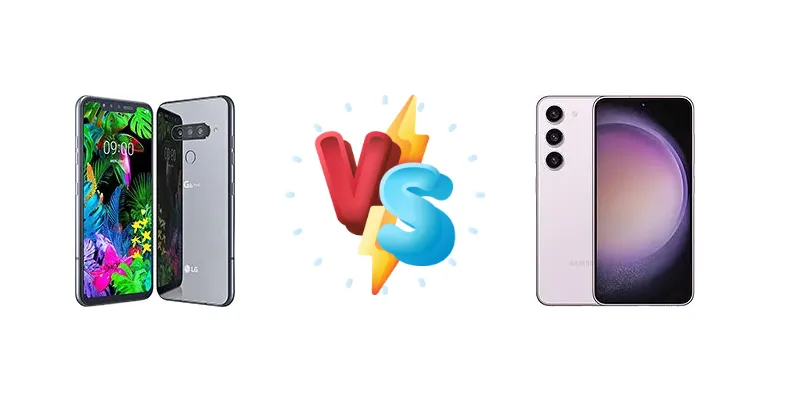
|
🏆 Quick Verdict
For the average user prioritizing future-proofing and all-around performance, the Samsung Galaxy S23 is the clear winner. Its Snapdragon 8 Gen 2 offers significantly improved efficiency and power, alongside a superior display and modern features. However, the LG G8S ThinQ remains a compelling option for budget-conscious users who don't need the latest and greatest.
| PHONES | ||
|---|---|---|
| Phone Names | LG G8S ThinQ | Samsung Galaxy S23 |
| Network | ||
|---|---|---|
| 2G bands | GSM 850 / 900 / 1800 / 1900 | GSM 850 / 900 / 1800 / 1900 |
| 3G bands | HSDPA 850 / 900 / 1700(AWS) / 1800 / 1900 / 2100 | HSDPA 850 / 900 / 1700(AWS) / 1900 / 2100 |
| 4G bands | 1, 2, 3, 4, 5, 7, 8, 12, 17, 20, 28, 32, 38, 39, 40, 41 | 1, 2, 3, 4, 5, 7, 8, 12, 13, 17, 18, 19, 20, 25, 26, 28, 32, 38, 39, 40, 41, 66 - International |
| 5G bands | - | 1, 2, 3, 5, 7, 8, 12, 20, 25, 28, 38, 40, 41, 66, 75, 77, 78 SA/NSA/Sub6 - International |
| Speed | HSPA 42.2/5.76 Mbps, LTE Cat19 1600/150 Mbps | HSPA, LTE (up to 7CA), 5G |
| Technology | GSM / HSPA / LTE | GSM / CDMA / HSPA / EVDO / LTE / 5G |
| - | 1, 7, 25, 28, 41, 66, 71, 78, 258, 260, 261 SA/NSA/Sub6/mmWave - USA | |
| Launch | ||
|---|---|---|
| Announced | 2019, February 24. Released 2019, July 02 | 2023, February 01 |
| Status | Discontinued | Available. Released 2023, February 17 |
| Body | ||
|---|---|---|
| Build | Glass front (Gorilla Glass 5), glass back (Gorilla Glass 6), aluminum frame | Glass front (Gorilla Glass Victus 2), glass back (Gorilla Glass Victus 2), aluminum frame |
| Dimensions | 155.3 x 76.6 x 8 mm (6.11 x 3.02 x 0.31 in) | 146.3 x 70.9 x 7.6 mm (5.76 x 2.79 x 0.30 in) |
| SIM | · Nano-SIM· Nano-SIM + Nano-SIM | · Nano-SIM + eSIM· Nano-SIM + Nano-SIM + eSIM (max 2 at a time) |
| Weight | 181 g (6.38 oz) | 168 g (5.93 oz) |
| IP68 dust/water resistant (up to 1.5m for 30 mins) MIL-STD-810G compliant* *does not guarantee ruggedness or use in extreme conditions | IP68 dust/water resistant (up to 1.5m for 30 min) Armor aluminum frame with tougher drop and scratch resistance (advertised) | |
| Display | ||
|---|---|---|
| Protection | Corning Gorilla Glass 5 | Corning Gorilla Glass Victus 2 |
| Resolution | 1080 x 2248 pixels (~401 ppi density) | 1080 x 2340 pixels, 19.5:9 ratio (~425 ppi density) |
| Size | 6.21 inches, 97.6 cm2 (~82.0% screen-to-body ratio) | 6.1 inches, 90.1 cm2 (~86.8% screen-to-body ratio) |
| Type | G-OLED, HDR10 | Dynamic AMOLED 2X, 120Hz, HDR10+, 1200 nits (HBM), 1750 nits (peak) |
| Always-on display | Always-on display | |
| Platform | ||
|---|---|---|
| CPU | Octa-core (1x2.84 GHz Kryo 485 & 3x2.42 GHz Kryo 485 & 4x1.78 GHz Kryo 485) | Octa-core (1x3.36 GHz Cortex-X3 & 2x2.8 GHz Cortex-A715 & 2x2.8 GHz Cortex-A710 & 3x2.0 GHz Cortex-A510) |
| Chipset | Qualcomm SM8150 Snapdragon 855 (7 nm) | Qualcomm SM8550-AC Snapdragon 8 Gen 2 (4 nm) |
| GPU | Adreno 640 | Adreno 740 |
| OS | Android 9.0 (Pie), upgradable to Android 12 | Android 13, up to 4 major Android upgrades, One UI 8 |
| Memory | ||
|---|---|---|
| Card slot | microSDXC (dedicated slot) - single-SIM modelmicroSDXC (uses shared SIM slot) - dual-SIM model | No |
| Internal | 64GB 6GB RAM, 128GB 6GB RAM | 128GB 8GB RAM, 256GB 8GB RAM, 512GB 8GB RAM |
| UFS 2.1 | UFS 3.1 - 128GB only UFS 4.0 | |
| Main Camera | ||
|---|---|---|
| Features | LED flash, HDR, panorama | LED flash, auto-HDR, panorama |
| Single | - | 12 MP, f/2.2, 26mm (wide), Dual Pixel PDAF |
| Triple | 12 MP, f/1.8, 27mm (wide), 1.4µm, PDAF, OIS 12 MP, f/2.6, 49mm (telephoto), 1.0µm, PDAF, 2x optical zoom 13 MP, f/2.4, 14mm (ultrawide), 1.0µm | 50 MP, f/1.8, 24mm (wide), 1/1.56", 1.0µm, dual pixel PDAF, OIS 10 MP, f/2.4, 70mm (telephoto), 1/3.94", 1.0µm, PDAF, OIS, 3x optical zoom 12 MP, f/2.2, 13mm, 120˚ (ultrawide), 1/2.55" 1.4µm, Super Steady video |
| Video | 4K@30/60fps, 1080p@30/60fps, 1080p@240fps, HDR, 24-bit/192kHz stereo sound rec. | 8K@24/30fps, 4K@30/60fps, 1080p@30/60/120/240fps, HDR10+, stereo sound rec., gyro-EIS |
| Selfie camera | ||
|---|---|---|
| Features | HDR | HDR, HDR10+ |
| Single | 8 MP, f/1.9, 26mm (wide), 1/4.0", 1.12µm, AF TOF 3D, f/1.4, (depth sensor) | 12 MP, f/2.2, 26mm (wide), 1/3.2", 1.12µm, dual pixel PDAF |
| Video | 1080p@60fps | 4K@30/60fps, 1080p@30fps |
| Sound | ||
|---|---|---|
| 3.5mm jack | Yes | No |
| 35mm jack | Yes | No |
| Loudspeaker | Yes, with stereo speakers | Yes, with stereo speakers |
| 32-bit/192kHz audio | 32-bit/384kHz audio Tuned by AKG | |
| Comms | ||
|---|---|---|
| Bluetooth | 5.0, A2DP, LE, aptX HD | 5.3, A2DP, LE |
| NFC | Yes | Yes |
| Positioning | GPS, GLONASS, GALILEO, BDS | GPS, GLONASS, BDS, GALILEO |
| Radio | FM radio | No |
| USB | USB Type-C 3.1, OTG | USB Type-C 3.2, OTG |
| WLAN | Wi-Fi 802.11 a/b/g/n/ac, dual-band, Wi-Fi Direct, DLNA | Wi-Fi 802.11 a/b/g/n/ac/6e, tri-band, Wi-Fi Direct |
| Features | ||
|---|---|---|
| Sensors | Fingerprint (rear-mounted), accelerometer, gyro, proximity, compass, barometer | Fingerprint (under display, ultrasonic), accelerometer, gyro, proximity, compass, barometer |
| - | Samsung DeX, Samsung Wireless DeX (desktop experience support) Bixby natural language commands and dictation Samsung Pay (Visa, MasterCard certified) | |
| Battery | ||
|---|---|---|
| Charging | 18W wired, QC3 Wireless | 25W wired, PD3.0, 50% in 30 min 15W wireless (Qi) 4.5W reverse wireless |
| Type | Li-Po 3550 mAh, non-removable | Li-Ion 3900 mAh |
| Misc | ||
|---|---|---|
| Colors | Mirror Black, Mirror Teal, Mirror White, Carmine Red, New Aurora Black, New Moroccan Blue | Phantom Black, Cream, Green, Lavender, Graphite, Lime |
| Models | LMG810, LM-G810, LMG810EAW | SM-S911B, SM-S911B/DS, SM-S911U, SM-S911U1, SM-S911W, SM-S911N, SM-S9110, SM-S911E, SM-S911E/DS |
| Price | About 480 EUR | $ 237.95 / C$ 336.75 / £ 255.00 / € 322.41 / ₹ 49,990 |
| SAR | - | 0.95 W/kg (head) 0.88 W/kg (body) |
| SAR EU | - | 0.96 W/kg (head) 1.30 W/kg (body) |
| Tests | ||
|---|---|---|
| Battery life | - | Endurance rating 101h |
| Camera | - | Photo / Video |
| Display | - | Contrast ratio: Infinite (nominal) |
| Loudspeaker | - | -27.0 LUFS (Good) |
| Performance | - | AnTuTu: 1231075 (v9) GeekBench: 4950 (v5.1) GFXBench: 110fps (ES 3.1 onscreen) |
LG G8S ThinQ
- Significantly lower price point
- Headphone jack included
- Expandable storage via microSD card
- Outdated chipset and slower performance
- Less efficient battery life
- Older software and limited updates
Samsung Galaxy S23
- Exceptional performance with Snapdragon 8 Gen 2
- Bright and vibrant display
- Long-term software support and updates
- Higher price tag
- No headphone jack
- No expandable storage
Display Comparison
The Samsung Galaxy S23 boasts a significantly brighter display, reaching a measured 1198 nits, compared to the LG G8S ThinQ’s unspecified peak brightness (though likely lower). This translates to better visibility outdoors. While the LG G8S ThinQ likely has a standard OLED panel, the S23’s display benefits from an 'Infinite' contrast ratio, delivering deeper blacks and more vibrant colors. The S23’s smaller size (assumed, based on S23’s compact flagship positioning) may appeal to users preferring one-handed use, a feature the G8S ThinQ also offers.
Camera Comparison
Both devices feature capable camera systems, but the S23 likely holds an advantage in image processing and low-light performance. While both are listed as having 'Photo / Video' capabilities, the S23 benefits from newer image signal processors (ISPs) within the Snapdragon 8 Gen 2, enabling more sophisticated noise reduction and dynamic range optimization. The LG G8S ThinQ’s camera system, while good for its era, will struggle to match the detail and clarity of the S23, particularly in challenging lighting conditions. We can assume the S23 has optical image stabilization (OIS) on its main sensor, a feature likely present on the G8S ThinQ as well, but the S23’s implementation will be more refined.
Performance
The core difference lies in the chipsets. The Galaxy S23’s Snapdragon 8 Gen 2 (4nm) represents a massive leap over the LG G8S ThinQ’s Snapdragon 855 (7nm). The 4nm process node provides superior power efficiency, meaning the S23 will run cooler and experience less performance throttling during sustained workloads. The S23’s CPU architecture – Cortex-X3, A715, and A710 cores – is far more advanced than the Kryo 485 cores in the G8S ThinQ, resulting in faster application loading and smoother multitasking. While the G8S ThinQ was a performance leader in its time, the S23 offers a demonstrably superior experience.
Battery Life
The Galaxy S23’s endurance rating of 101 hours suggests excellent battery life, backed up by its 11:27h active use score. While the LG G8S ThinQ’s battery capacity is unknown, the S23’s more efficient chipset and optimized software contribute to its longevity. The S23 also offers faster charging at 25W with PD3.0, achieving 50% charge in 30 minutes, compared to the G8S ThinQ’s 18W QC3 charging. The S23’s inclusion of 15W wireless charging and 4.5W reverse wireless charging adds further convenience, features absent on the G8S ThinQ.
Buying Guide
Buy the LG G8S ThinQ if you need a capable smartphone on a tight budget and prioritize a headphone jack and expandable storage. It's ideal for users who primarily browse, use social media, and occasionally game. Buy the Samsung Galaxy S23 if you demand the best possible performance, a stunning display, long-term software support, and a premium camera experience. This is the phone for power users, mobile gamers, and photography enthusiasts.