
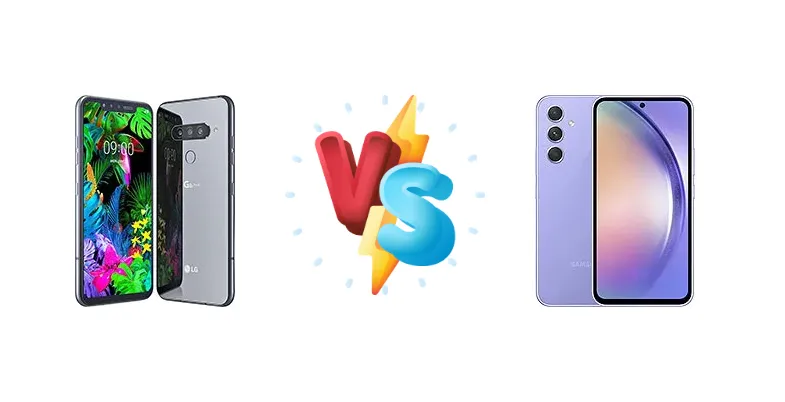
LG G8S ThinQ vs Samsung Galaxy A54: A Detailed Comparison of Performance and Value
| Phones Images | |||||
|---|---|---|---|---|---|
|
🏆 Quick Verdict
For users prioritizing raw performance and potentially finding a bargain, the LG G8S ThinQ offers a significant edge thanks to its Snapdragon 855. However, the Samsung Galaxy A54 wins for battery life consistency, a brighter display, and continued software support, making it the better all-around choice for most.
| PHONES | ||
|---|---|---|
| Phone Names | LG G8S ThinQ | Samsung Galaxy A54 |
| Network | ||
|---|---|---|
| 2G bands | GSM 850 / 900 / 1800 / 1900 | GSM 850 / 900 / 1800 / 1900 |
| 3G bands | HSDPA 850 / 900 / 1700(AWS) / 1800 / 1900 / 2100 | HSDPA 850 / 900 / 1700(AWS) / 1900 / 2100 |
| 4G bands | 1, 2, 3, 4, 5, 7, 8, 12, 17, 20, 28, 32, 38, 39, 40, 41 | 1, 2, 3, 4, 5, 7, 8, 12, 17, 20, 26, 28, 32, 38, 40, 41, 66 - International |
| 5G bands | - | 1, 3, 7, 8, 20, 28, 38, 40, 41, 77, 78 SA/NSA/Sub6 - International |
| Speed | HSPA 42.2/5.76 Mbps, LTE Cat19 1600/150 Mbps | HSPA, LTE, 5G |
| Technology | GSM / HSPA / LTE | GSM / HSPA / LTE / 5G |
| - | 25, 41, 66, 71 SA/NSA/Sub6/mmWave - USA | |
| Launch | ||
|---|---|---|
| Announced | 2019, February 24. Released 2019, July 02 | 2023, March 15 |
| Status | Discontinued | Available. Released 2023, March 24 |
| Body | ||
|---|---|---|
| Build | Glass front (Gorilla Glass 5), glass back (Gorilla Glass 6), aluminum frame | Glass front (Gorilla Glass 5), glass back (Gorilla Glass 5), plastic frame |
| Dimensions | 155.3 x 76.6 x 8 mm (6.11 x 3.02 x 0.31 in) | 158.2 x 76.7 x 8.2 mm (6.23 x 3.02 x 0.32 in) |
| SIM | · Nano-SIM· Nano-SIM + Nano-SIM | · Nano-SIM + eSIM· Nano-SIM + Nano-SIM |
| Weight | 181 g (6.38 oz) | 202 g (7.13 oz) |
| IP68 dust/water resistant (up to 1.5m for 30 mins) MIL-STD-810G compliant* *does not guarantee ruggedness or use in extreme conditions | IP67 dust/water resistant (up to 1m for 30 min) | |
| Display | ||
|---|---|---|
| Protection | Corning Gorilla Glass 5 | Corning Gorilla Glass 5 |
| Resolution | 1080 x 2248 pixels (~401 ppi density) | 1080 x 2340 pixels, 19.5:9 ratio (~403 ppi density) |
| Size | 6.21 inches, 97.6 cm2 (~82.0% screen-to-body ratio) | 6.4 inches, 100.5 cm2 (~82.9% screen-to-body ratio) |
| Type | G-OLED, HDR10 | Super AMOLED, 120Hz, HDR10+, 1000 nits (HBM) |
| Always-on display | - | |
| Platform | ||
|---|---|---|
| CPU | Octa-core (1x2.84 GHz Kryo 485 & 3x2.42 GHz Kryo 485 & 4x1.78 GHz Kryo 485) | Octa-core (4x2.4 GHz Cortex-A78 & 4x2.0 GHz Cortex-A55) |
| Chipset | Qualcomm SM8150 Snapdragon 855 (7 nm) | Exynos 1380 (5 nm) |
| GPU | Adreno 640 | Mali-G68 MP5 |
| OS | Android 9.0 (Pie), upgradable to Android 12 | Android 13, up to 4 major Android upgrades, One UI 7 |
| Memory | ||
|---|---|---|
| Card slot | microSDXC (dedicated slot) - single-SIM modelmicroSDXC (uses shared SIM slot) - dual-SIM model | microSDXC (uses shared SIM slot) |
| Internal | 64GB 6GB RAM, 128GB 6GB RAM | 128GB 4GB RAM, 128GB 6GB RAM, 128GB 8GB RAM, 256GB 6GB RAM, 256GB 8GB RAM |
| UFS 2.1 | - | |
| Main Camera | ||
|---|---|---|
| Features | LED flash, HDR, panorama | LED flash, panorama, HDR |
| Single | - | 32 MP, f/2.2, 26mm (wide), 1/2.8", 0.8µm |
| Triple | 12 MP, f/1.8, 27mm (wide), 1.4µm, PDAF, OIS 12 MP, f/2.6, 49mm (telephoto), 1.0µm, PDAF, 2x optical zoom 13 MP, f/2.4, 14mm (ultrawide), 1.0µm | 50 MP, f/1.8, 23mm (wide), 1/1.56", 1.0µm, PDAF, OIS 12 MP, f/2.2, 13mm, 123˚ (ultrawide), 1/3.X", 1.12µm 5 MP (macro) |
| Video | 4K@30/60fps, 1080p@30/60fps, 1080p@240fps, HDR, 24-bit/192kHz stereo sound rec. | 4K@30fps, 1080p@30/60fps, 720p@480fps, gyro-EIS |
| Selfie camera | ||
|---|---|---|
| Features | HDR | - |
| Single | 8 MP, f/1.9, 26mm (wide), 1/4.0", 1.12µm, AF TOF 3D, f/1.4, (depth sensor) | 32 MP, f/2.2, 26mm (wide), 1/2.8", 0.8µm |
| Video | 1080p@60fps | 4K@30fps, 1080p@30/60fps |
| Sound | ||
|---|---|---|
| 3.5mm jack | Yes | No |
| 35mm jack | Yes | No |
| Loudspeaker | Yes, with stereo speakers | Yes, with stereo speakers |
| 32-bit/192kHz audio | - | |
| Comms | ||
|---|---|---|
| Bluetooth | 5.0, A2DP, LE, aptX HD | 5.3, A2DP, LE |
| NFC | Yes | Yes (market/region dependent) |
| Positioning | GPS, GLONASS, GALILEO, BDS | GPS, GLONASS, GALILEO, BDS |
| Radio | FM radio | No |
| USB | USB Type-C 3.1, OTG | USB Type-C 2.0, OTG |
| WLAN | Wi-Fi 802.11 a/b/g/n/ac, dual-band, Wi-Fi Direct, DLNA | Wi-Fi 802.11 a/b/g/n/ac/6, dual-band, Wi-Fi Direct |
| Features | ||
|---|---|---|
| Sensors | Fingerprint (rear-mounted), accelerometer, gyro, proximity, compass, barometer | Fingerprint (under display, optical), accelerometer, gyro, compass, barometer (USA only) |
| - | Virtual proximity sensing | |
| Battery | ||
|---|---|---|
| Charging | 18W wired, QC3 Wireless | 25W wired |
| Type | Li-Po 3550 mAh, non-removable | 5000 mAh |
| Misc | ||
|---|---|---|
| Colors | Mirror Black, Mirror Teal, Mirror White, Carmine Red, New Aurora Black, New Moroccan Blue | Lime, Graphite, Violet, White |
| Models | LMG810, LM-G810, LMG810EAW | SM-A546V, SM-A546U, SM-A546U1, SM-A546B, SM-A546B/DS, SM-A546E, SM-A546E/DS, SM-A5460, SM-A546M, SM-A546M/DS, SM-A546W |
| Price | About 480 EUR | € 210.00 / $ 119.11 / £ 169.95 / ₹ 28,999 |
| SAR | - | 0.81 W/kg (head) 0.67 W/kg (body) |
| SAR EU | - | 0.69 W/kg (head) 1.34 W/kg (body) |
| Tests | ||
|---|---|---|
| Battery life | - | Endurance rating 119h |
| Camera | - | Photo / Video |
| Display | - | Contrast ratio: Infinite (nominal) |
| Loudspeaker | - | -26.6 LUFS (Good) |
| Performance | - | AnTuTu: 506678 (v9) GeekBench: 2703 (v5.1), 2797 (v6) GFXBench: 25fps (ES 3.1 onscreen) |
LG G8S ThinQ
- More powerful processor (Snapdragon 855)
- Potentially lower price (due to age)
- Wireless charging support
- Likely shorter battery life
- Potentially limited software updates
- May experience more thermal throttling
Samsung Galaxy A54
- Excellent battery life (11:15h active use)
- Brighter display (980 nits)
- Continued software support
- Less powerful processor (Exynos 1380)
- Slower charging than some competitors
- Image processing may be overly aggressive for some tastes
Display Comparison
The Samsung Galaxy A54 boasts a significantly brighter display, reaching a measured 980 nits, compared to the LG G8S ThinQ’s unspecified peak brightness (likely lower, based on typical LG OLED implementations of the era). While the G8S likely has excellent color accuracy due to its OLED panel, the A54’s higher brightness ensures better visibility outdoors. The A54’s 'Infinite' contrast ratio, typical of OLEDs, is likely comparable to the G8S, but the brightness difference is a key advantage for the Samsung device. We lack PWM data for both, but the A54's newer panel tech may offer improvements in flicker reduction.
Camera Comparison
Both devices offer photo and video capabilities, but detailed sensor information is lacking for the G8S. The A54 likely features a more modern image processing pipeline. Without specific sensor sizes, it’s difficult to make a definitive judgment, but Samsung generally prioritizes computational photography, potentially delivering more consistently pleasing results in various lighting conditions. The G8S’s camera system, while capable, is likely showing its age compared to the A54’s newer technology. We can assume the A54's camera will have better low-light performance and more advanced features.
Performance
The LG G8S ThinQ’s Snapdragon 855, built on a 7nm process, was a flagship processor in its time. Its octa-core configuration (1x2.84 GHz Kryo 485, 3x2.42 GHz Kryo 485, 4x1.78 GHz Kryo 485) provides substantial processing power. However, the Samsung Galaxy A54’s Exynos 1380 (5nm) benefits from a more efficient manufacturing process. While the Exynos 1380’s CPU (4x2.4 GHz Cortex-A78 & 4x2.0 GHz Cortex-A55) has a slightly different architecture, the 5nm node allows for better thermal management, potentially leading to more sustained performance under load. The G8S may exhibit more throttling during extended gaming sessions. The A54's RAM configuration (likely LPDDR4x) is not specified, but the Snapdragon 855 typically paired with LPDDR5, giving the G8S a potential memory bandwidth advantage.
Battery Life
The Samsung Galaxy A54 demonstrates superior battery endurance with an 'Endurance rating' of 119 hours and a real-world active use score of 11:15h. The LG G8S ThinQ’s battery capacity is unspecified, but its older chipset and potentially less efficient display likely result in shorter battery life. The A54’s 25W wired charging is also faster than the G8S’s 18W QC3 charging, reducing the time to fully recharge. While the G8S supports wireless charging, the A54’s overall battery performance and faster wired charging provide a more practical advantage.
Buying Guide
Buy the LG G8S ThinQ if you need a phone capable of handling demanding games and applications without significant throttling, and are comfortable with potentially limited software updates. Buy the Samsung Galaxy A54 if you prefer a modern, well-supported device with excellent battery life, a vibrant display, and a reliable camera system, even if it means sacrificing some peak processing power.