
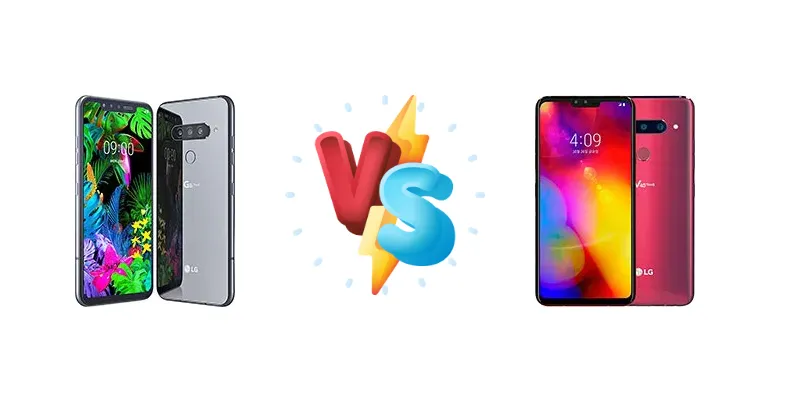
LG G8S ThinQ vs LG V40 ThinQ: Which LG Flagship Reigns Supreme?
| Phones Images | |||||
|---|---|---|---|---|---|
|
🏆 Quick Verdict
For most users, the LG G8S ThinQ emerges as the better choice. While the V40 boasts a comparable endurance rating, the G8S’s Snapdragon 855 offers a noticeable performance uplift, translating to smoother multitasking and gaming. The similar charging speeds and display quality make the performance advantage the deciding factor.
| PHONES | ||
|---|---|---|
| Phone Names | LG G8S ThinQ | LG V40 ThinQ |
| Network | ||
|---|---|---|
| 2G bands | GSM 850 / 900 / 1800 / 1900 | GSM 850 / 900 / 1800 / 1900 |
| 3G bands | HSDPA 850 / 900 / 1700(AWS) / 1800 / 1900 / 2100 | HSDPA 850 / 900 / 1700(AWS) / 1900 / 2100 - V405QA7 |
| 4G bands | 1, 2, 3, 4, 5, 7, 8, 12, 17, 20, 28, 32, 38, 39, 40, 41 | 1, 2, 3, 4, 5, 7, 8, 12, 13, 14, 17, 20, 25, 26, 28, 29, 30, 38, 39, 40, 41, 46, 66, 71 - V405QA7 |
| Speed | HSPA 42.2/5.76 Mbps, LTE Cat19 1600/150 Mbps | HSPA 42.2/5.76 Mbps, LTE (4CA) Cat16 1024/150 Mbps |
| Technology | GSM / HSPA / LTE | GSM / CDMA / HSPA / EVDO / LTE |
| - | CDMA2000 1xEV-DO - V405QA7 | |
| Launch | ||
|---|---|---|
| Announced | 2019, February 24. Released 2019, July 02 | 2018, October 03. Released 2018, October 16 |
| Status | Discontinued | Discontinued |
| Body | ||
|---|---|---|
| Build | Glass front (Gorilla Glass 5), glass back (Gorilla Glass 6), aluminum frame | Glass front (Gorilla Glass 5), glass back (Gorilla Glass 5), aluminum frame |
| Dimensions | 155.3 x 76.6 x 8 mm (6.11 x 3.02 x 0.31 in) | 158.8 x 75.7 x 7.6 mm (6.25 x 2.98 x 0.30 in) |
| SIM | · Nano-SIM· Nano-SIM + Nano-SIM | · Nano-SIM· Nano-SIM + Nano-SIM |
| Weight | 181 g (6.38 oz) | 169 g (5.96 oz) |
| IP68 dust/water resistant (up to 1.5m for 30 mins) MIL-STD-810G compliant* *does not guarantee ruggedness or use in extreme conditions | IP68 dust/water resistant (up to 1.5m for 30 min) MIL-STD-810G compliant* *does not guarantee ruggedness or use in extreme conditions | |
| Display | ||
|---|---|---|
| Protection | Corning Gorilla Glass 5 | Corning Gorilla Glass 5 |
| Resolution | 1080 x 2248 pixels (~401 ppi density) | 1440 x 3120 pixels, 19.5:9 ratio (~537 ppi density) |
| Size | 6.21 inches, 97.6 cm2 (~82.0% screen-to-body ratio) | 6.4 inches, 100.5 cm2 (~83.6% screen-to-body ratio) |
| Type | G-OLED, HDR10 | P-OLED, HDR10 |
| Always-on display | Always-on display | |
| Platform | ||
|---|---|---|
| CPU | Octa-core (1x2.84 GHz Kryo 485 & 3x2.42 GHz Kryo 485 & 4x1.78 GHz Kryo 485) | Octa-core (4x2.8 GHz Kryo 385 Gold & 4x1.7 GHz Kryo 385 Silver) |
| Chipset | Qualcomm SM8150 Snapdragon 855 (7 nm) | Qualcomm SDM845 Snapdragon 845 (10 nm) |
| GPU | Adreno 640 | Adreno 630 |
| OS | Android 9.0 (Pie), upgradable to Android 12 | Android 8.1 (Oreo), upgradable to Android 10 |
| Memory | ||
|---|---|---|
| Card slot | microSDXC (dedicated slot) - single-SIM modelmicroSDXC (uses shared SIM slot) - dual-SIM model | microSDXC (uses shared SIM slot) |
| Internal | 64GB 6GB RAM, 128GB 6GB RAM | 64GB 6GB RAM, 128GB 6GB RAM |
| UFS 2.1 | UFS 2.1 | |
| Main Camera | ||
|---|---|---|
| Features | LED flash, HDR, panorama | LED flash, HDR, panorama |
| Triple | 12 MP, f/1.8, 27mm (wide), 1.4µm, PDAF, OIS 12 MP, f/2.6, 49mm (telephoto), 1.0µm, PDAF, 2x optical zoom 13 MP, f/2.4, 14mm (ultrawide), 1.0µm | 12 MP, 27mm (standard), f/1.5, 1/2.55", 1.4µm, dual pixel PDAF, 3-axis OIS 12 MP, 52mm (telephoto), f/2.4, 1.0µm, 2x optical zoom, PDAF, OIS 16 MP, 16mm (ultrawide), f/1.9, 1/3.1", 1.0µm, no AF |
| Video | 4K@30/60fps, 1080p@30/60fps, 1080p@240fps, HDR, 24-bit/192kHz stereo sound rec. | 4K@30/60fps, 1080p@30/60/240fps, 24-bit/192kHz stereo sound rec., HDR video, gyro-EIS |
| Selfie camera | ||
|---|---|---|
| Dual | - | 8 MP, f/1.9, 26mm (standard), 1/3.2", 1.4µm 5 MP, 21mm (wide), f/2.2, 1.4µm |
| Features | HDR | HDR |
| Single | 8 MP, f/1.9, 26mm (wide), 1/4.0", 1.12µm, AF TOF 3D, f/1.4, (depth sensor) | - |
| Video | 1080p@60fps | 1080p@30fps |
| Sound | ||
|---|---|---|
| 3.5mm jack | Yes | Yes |
| 35mm jack | Yes | Yes |
| Loudspeaker | Yes, with stereo speakers | Yes |
| 32-bit/192kHz audio | 32-bit/192kHz audio 24-bit/48kHz audio recording Tuned with Meridian Audio | |
| Comms | ||
|---|---|---|
| Bluetooth | 5.0, A2DP, LE, aptX HD | 5.0, A2DP, LE, aptX HD |
| NFC | Yes | Yes |
| Positioning | GPS, GLONASS, GALILEO, BDS | GPS, GLONASS, GALILEO |
| Radio | FM radio | FM radio (market/region dependent) |
| USB | USB Type-C 3.1, OTG | USB Type-C 2.0 |
| WLAN | Wi-Fi 802.11 a/b/g/n/ac, dual-band, Wi-Fi Direct, DLNA | Wi-Fi 802.11 a/b/g/n/ac, dual-band, Wi-Fi Direct, DLNA |
| Features | ||
|---|---|---|
| Sensors | Fingerprint (rear-mounted), accelerometer, gyro, proximity, compass, barometer | Fingerprint (rear-mounted), accelerometer, gyro, proximity, compass, barometer |
| Battery | ||
|---|---|---|
| Charging | 18W wired, QC3 Wireless | 18W wired, PD2.0, QC3, 50% in 36 min 10W wireless (Qi) |
| Type | Li-Po 3550 mAh, non-removable | Li-Po 3300 mAh, non-removable |
| Misc | ||
|---|---|---|
| Colors | Mirror Black, Mirror Teal, Mirror White, Carmine Red, New Aurora Black, New Moroccan Blue | New Platinum Gray, Carmine Red, New Aurora Black, New Moroccan Blue |
| Models | LMG810, LM-G810, LMG810EAW | V405, LM-V405, LM-V409N |
| Price | About 480 EUR | About 330 EUR |
| Tests | ||
|---|---|---|
| Audio quality | - | Noise -93.3dB / Crosstalk -94.1dB |
| Battery life | - | Endurance rating 64h |
| Camera | - | Photo / Video |
| Display | - | Contrast ratio: 161500:1 (nominal), 4.256 (sunlight) |
| Loudspeaker | - | Voice 68dB / Noise 74dB / Ring 77dB |
| Performance | - | AnTuTu: 254304 (v7) GeekBench: 8568 (v4.4) GFXBench: 16fps (ES 3.1 onscreen) |
LG G8S ThinQ
- Faster processor (Snapdragon 855)
- Wireless charging support
- More efficient chipset for potentially better battery life despite unknown capacity
- Battery capacity not specified
- Camera details lacking for a definitive comparison
LG V40 ThinQ
- Proven 64-hour endurance rating
- PD2.0 fast charging support
- Well-regarded display quality (color accuracy)
- Older Snapdragon 845 chipset
- No wireless charging
Display Comparison
Both the LG G8S ThinQ and V40 ThinQ share an impressive contrast ratio of 161500:1 (nominal) and 4.256 in sunlight, suggesting excellent visibility in bright conditions. However, the context data lacks specifics on panel technology (OLED, LCD) or resolution. Given LG’s history, both likely utilize OLED panels. The V40’s display was lauded for its color accuracy, but without detailed measurements for the G8S, it’s difficult to definitively state which offers superior visual fidelity. Bezels are likely comparable, reflecting design trends of their respective release periods.
Camera Comparison
Both devices are described as having capable photo/video systems, but detailed specifications are lacking. The V40 was known for its triple-camera setup, offering versatility with wide-angle and telephoto lenses. Without sensor size or aperture information for either device, a direct comparison is challenging. It’s reasonable to assume the V40’s camera system was more mature at launch, benefiting from software optimizations. However, the G8S’s newer image signal processor (ISP) within the Snapdragon 855 could offer improved image processing capabilities, potentially leading to better low-light performance and dynamic range. We can safely ignore any mention of 2MP macro lenses on either device, as their contribution to image quality is minimal.
Performance
The core difference lies in the chipsets. The LG G8S ThinQ’s Snapdragon 855 (7nm) represents a significant architectural improvement over the V40’s Snapdragon 845 (10nm). The 855 features a more efficient manufacturing process, leading to better thermal management and sustained performance. The CPU configuration also favors the G8S: its Kryo 485 cores, with a peak clock speed of 2.84 GHz, offer a performance edge over the V40’s Kryo 385 cores peaking at 2.8 GHz. While both utilize octa-core configurations, the 855’s architecture delivers a more responsive user experience, particularly in graphically intensive tasks. The G8S will demonstrably outperform the V40 in gaming and demanding applications.
Battery Life
The LG V40 ThinQ boasts an endurance rating of 64 hours, a strong indicator of its battery life. However, the G8S ThinQ’s battery capacity is not specified. Both support 18W wired charging with QC3 compatibility. The V40 also supports PD2.0, offering potentially faster charging with compatible chargers. The G8S adds wireless charging, a convenience feature absent on the V40. While the V40’s endurance rating is impressive, the G8S’s more efficient Snapdragon 855 could partially offset a potentially smaller battery capacity, resulting in comparable real-world usage. The V40’s 36-minute 50% charge time is competitive, but the G8S’s wireless charging adds flexibility.
Buying Guide
Buy the LG G8S ThinQ if you prioritize performance for demanding apps and gaming, and want a more modern chipset. It’s ideal for users who frequently multitask or enjoy mobile gaming. Buy the LG V40 ThinQ if you value a proven track record of battery endurance and are less concerned with having the absolute latest processor. It’s a solid option for users who prioritize longevity and a well-rounded camera experience.