
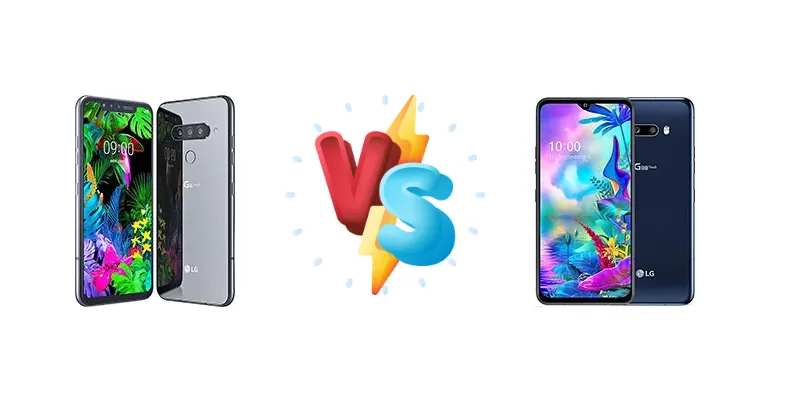
LG G8X vs G8S ThinQ: Which LG Flagship Reigns Supreme?
| Phones Images | |||||
|---|---|---|---|---|---|
|
🏆 Quick Verdict
For most users, the LG G8X ThinQ is the superior choice. Its 21W charging with Power Delivery support and slightly improved battery endurance rating, despite identical battery capacity, offer a more convenient and reliable experience. The G8S remains a viable option for those prioritizing a potentially lower price point.
| PHONES | ||
|---|---|---|
| Phone Names | LG G8S ThinQ | LG G8X ThinQ |
| Network | ||
|---|---|---|
| 2G bands | GSM 850 / 900 / 1800 / 1900 | GSM 850 / 900 / 1800 / 1900 |
| 3G bands | HSDPA 850 / 900 / 1700(AWS) / 1800 / 1900 / 2100 | HSDPA 850 / 900 / 1900 / 2100 |
| 4G bands | 1, 2, 3, 4, 5, 7, 8, 12, 17, 20, 28, 32, 38, 39, 40, 41 | 1, 2, 3, 4, 5, 7, 8, 12, 13, 17, 20, 28, 32, 38, 39, 40, 41 |
| Speed | HSPA 42.2/5.76 Mbps, LTE Cat19 1600/150 Mbps | HSPA 42.2/5.76 Mbps, LTE Cat20 1960/75 Mbps |
| Technology | GSM / HSPA / LTE | GSM / CDMA / HSPA / EVDO / LTE |
| - | 1, 2, 3, 4, 5, 7, 12, 14, 20, 29, 30, 38, 39, 40, 41, 46, 66 - USA | |
| Launch | ||
|---|---|---|
| Announced | 2019, February 24. Released 2019, July 02 | 2019, September 06. Released 2019, November 01 |
| Status | Discontinued | Discontinued |
| Body | ||
|---|---|---|
| Build | Glass front (Gorilla Glass 5), glass back (Gorilla Glass 6), aluminum frame | Glass front (Gorilla Glass 6), glass back (Gorilla Glass 5), aluminum frame |
| Dimensions | 155.3 x 76.6 x 8 mm (6.11 x 3.02 x 0.31 in) | 159.3 x 75.8 x 8.4 mm (6.27 x 2.98 x 0.33 in) |
| SIM | · Nano-SIM· Nano-SIM + Nano-SIM | · Nano-SIM· Nano-SIM + Nano-SIM |
| Weight | 181 g (6.38 oz) | 192 g (6.77 oz) |
| IP68 dust/water resistant (up to 1.5m for 30 mins) MIL-STD-810G compliant* *does not guarantee ruggedness or use in extreme conditions | IP68 dust/water resistant (up to 1.5m for 30 min) MIL-STD-810G compliant* *does not guarantee ruggedness or use in extreme conditions | |
| Display | ||
|---|---|---|
| Protection | Corning Gorilla Glass 5 | Corning Gorilla Glass 6 |
| Resolution | 1080 x 2248 pixels (~401 ppi density) | 1080 x 2340 pixels, 19.5:9 ratio (~403 ppi density) |
| Size | 6.21 inches, 97.6 cm2 (~82.0% screen-to-body ratio) | 6.4 inches, 100.5 cm2 (~83.3% screen-to-body ratio) |
| Type | G-OLED, HDR10 | OLED, HDR10 |
| Always-on display | Always-on display | |
| Platform | ||
|---|---|---|
| CPU | Octa-core (1x2.84 GHz Kryo 485 & 3x2.42 GHz Kryo 485 & 4x1.78 GHz Kryo 485) | Octa-core (1x2.84 GHz Kryo 485 & 3x2.42 GHz Kryo 485 & 4x1.78 GHz Kryo 485) |
| Chipset | Qualcomm SM8150 Snapdragon 855 (7 nm) | Qualcomm SM8150 Snapdragon 855 (7 nm) |
| GPU | Adreno 640 | Adreno 640 |
| OS | Android 9.0 (Pie), upgradable to Android 12 | Android 9.0 (Pie), upgradable to Android 12 |
| Memory | ||
|---|---|---|
| Card slot | microSDXC (dedicated slot) - single-SIM modelmicroSDXC (uses shared SIM slot) - dual-SIM model | microSDXC (uses shared SIM slot) - dual-SIM model |
| Internal | 64GB 6GB RAM, 128GB 6GB RAM | 128GB 6GB RAM |
| UFS 2.1 | UFS 2.1 | |
| Main Camera | ||
|---|---|---|
| Dual | - | 12 MP, f/1.8, 27mm (wide), 1/2.55", 1.4µm, dual pixel PDAF, OIS 13 MP, f/2.4, 9mm (ultrawide), 1.0µm |
| Features | LED flash, HDR, panorama | Dual-LED dual-tone flash, HDR, panorama |
| Single | - | 3.15 MP, AF |
| Triple | 12 MP, f/1.8, 27mm (wide), 1.4µm, PDAF, OIS 12 MP, f/2.6, 49mm (telephoto), 1.0µm, PDAF, 2x optical zoom 13 MP, f/2.4, 14mm (ultrawide), 1.0µm | - |
| Video | 4K@30/60fps, 1080p@30/60fps, 1080p@240fps, HDR, 24-bit/192kHz stereo sound rec. | 4K@30/60fps, 1080p@30/60/240fps, 24-bit/192kHz stereo sound rec., gyro-EIS |
| Selfie camera | ||
|---|---|---|
| Features | HDR | HDR |
| Single | 8 MP, f/1.9, 26mm (wide), 1/4.0", 1.12µm, AF TOF 3D, f/1.4, (depth sensor) | 32 MP, f/1.9, 26mm (wide), 1/2.8", 0.8µm |
| Video | 1080p@60fps | 4K@30fps, gyro-EIS |
| Sound | ||
|---|---|---|
| 3.5mm jack | Yes | Yes |
| 35mm jack | Yes | Yes |
| Loudspeaker | Yes, with stereo speakers | Yes, with stereo speakers |
| 32-bit/192kHz audio | 32-bit/192kHz audio 24-bit/192kHz audio recording Tuned by Meridian Audio | |
| Comms | ||
|---|---|---|
| Bluetooth | 5.0, A2DP, LE, aptX HD | 5.0, A2DP, LE, aptX HD |
| NFC | Yes | Yes |
| Positioning | GPS, GLONASS, GALILEO, BDS | GPS, GLONASS, GALILEO, BDS |
| Radio | FM radio | FM radio |
| USB | USB Type-C 3.1, OTG | USB Type-C 3.1, OTG |
| WLAN | Wi-Fi 802.11 a/b/g/n/ac, dual-band, Wi-Fi Direct, DLNA | Wi-Fi 802.11 a/b/g/n/ac, dual-band, Wi-Fi Direct, DLNA |
| Features | ||
|---|---|---|
| Browser | - | HTML, Adobe Flash |
| Sensors | Fingerprint (rear-mounted), accelerometer, gyro, proximity, compass, barometer | Fingerprint (under display, optical), accelerometer, gyro, proximity, compass, barometer |
| Battery | ||
|---|---|---|
| Charging | 18W wired, QC3 Wireless | 21W wired, PD, QC3 9W wireless |
| Talk time | - | Up to 12 h (multimedia) |
| Type | Li-Po 3550 mAh, non-removable | Li-Po 4000 mAh, non-removable |
| Misc | ||
|---|---|---|
| Colors | Mirror Black, Mirror Teal, Mirror White, Carmine Red, New Aurora Black, New Moroccan Blue | New Aurora Black |
| Models | LMG810, LM-G810, LMG810EAW | LMG850EMW, LM-G850, 901LG, LM-G850N |
| Price | About 480 EUR | About 560 EUR |
| SAR | - | 1.12 W/kg (body) |
| SAR EU | - | 0.90 W/kg (head) |
| Tests | ||
|---|---|---|
| Audio quality | - | Noise -93.2dB / Crosstalk -93.4dB |
| Battery life | - | Endurance rating 111h |
| Camera | - | Photo / Video |
| Display | - | Contrast ratio: Infinite (nominal) |
| Loudspeaker | - | -24.9 LUFS (Very good) |
| Performance | - | AnTuTu: 339726 (v7), 411980 (v8) GeekBench: 11251 (v4.4), 2870 (v5.1) GFXBench: 38fps (ES 3.1 onscreen) |
LG G8S ThinQ
- Potentially lower price point
- Snapdragon 855 provides flagship performance
- OLED display offers vibrant colors
- Slower 18W charging
- Less detailed battery endurance information
- Wireless charging wattage unspecified
LG G8X ThinQ
- Faster 21W charging with Power Delivery
- Slightly better battery endurance (111h rating)
- Brighter display (603 nits)
- Higher price compared to the G8S
- Still uses the Snapdragon 855 (older chipset)
- Camera specs lack detail
Display Comparison
Both the LG G8S and G8X feature OLED displays, but the G8X boasts a significantly brighter panel, reaching a measured 603 nits. While both offer an 'infinite' contrast ratio (typical for OLED), the higher peak brightness of the G8X translates to better visibility in direct sunlight. Details regarding refresh rate and resolution are missing, but given the era, both likely feature a 60Hz, FHD+ panel. The G8X’s brighter display is a clear advantage for outdoor use.
Camera Comparison
Both the G8S and G8X are listed as having 'Photo / Video' capabilities, lacking specific details. Without sensor size or aperture information, a direct comparison is difficult. However, LG’s image processing was generally well-regarded during this period. The absence of details suggests a similar camera experience, with the G8X potentially benefiting from slightly better image stabilization due to its overall more refined feature set. The lack of detail makes it difficult to assess any meaningful difference in camera performance.
Performance
Both devices are equipped with the Qualcomm Snapdragon 855 (7nm) chipset, featuring an octa-core CPU configuration identical in clock speeds: 1x2.84 GHz Kryo 485, 3x2.42 GHz Kryo 485, and 4x1.78 GHz Kryo 485. This means raw processing power will be virtually indistinguishable between the two. However, the G8X’s slightly better battery endurance suggests potentially more sustained performance under load, minimizing thermal throttling. RAM specifications are not provided, but both likely feature 6GB or 8GB of LPDDR4X RAM, sufficient for smooth multitasking.
Battery Life
The LG G8X ThinQ edges out the G8S in battery performance, achieving an endurance rating of 111 hours versus an unspecified rating for the G8S. Crucially, the G8X supports 21W wired charging with Power Delivery (PD) and Quick Charge 3.0 (QC3), significantly faster than the G8S’s 18W QC3 charging. The G8X also offers 9W wireless charging, while the G8S’s wireless charging capabilities are simply listed as ‘Wireless’ without specifying wattage. This faster charging and PD support on the G8X translate to a more convenient user experience, allowing for quicker top-ups.
Buying Guide
Buy the LG G8S ThinQ if you prioritize finding the lowest possible price for a Snapdragon 855-powered phone and are comfortable with slower charging speeds. Buy the LG G8X ThinQ if you value faster charging, slightly better battery life, and are willing to pay a premium for the convenience of Power Delivery support. Both phones are excellent choices for users who want a flagship experience without the flagship price tag of newer models.