
LG G8 ThinQ vs Samsung Galaxy S10: A Detailed Comparison of 2019 Flagships
| Phones Images | |||||
|---|---|---|---|---|---|
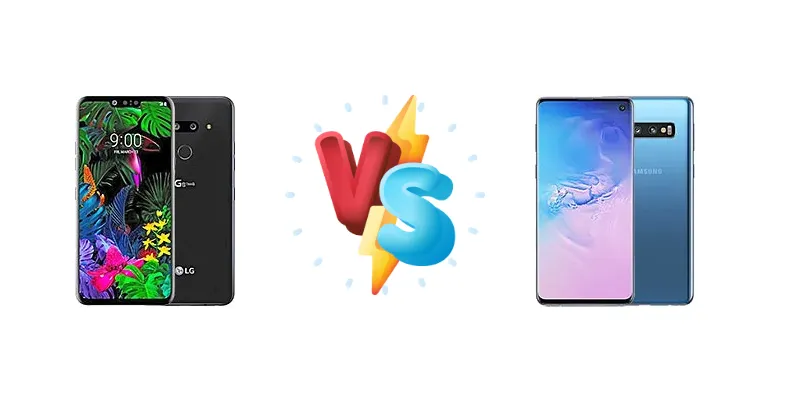
|
🏆 Quick Verdict
For the average user, the Samsung Galaxy S10 emerges as the slightly better choice. While both phones share the same 79-hour endurance rating, the S10’s broader availability with the Snapdragon 855 chipset, coupled with its superior display contrast in sunlight, provides a more consistently premium experience.
| PHONES | ||
|---|---|---|
| Phone Names | LG G8 ThinQ | Samsung Galaxy S10 |
| Network | ||
|---|---|---|
| 2G bands | GSM 850 / 900 / 1800 / 1900 | GSM 850 / 900 / 1800 / 1900 |
| 3G bands | HSDPA 850 / 900 / 1900 / 2100 | HSDPA 850 / 900 / 1700(AWS) / 1900 / 2100 - Global, USA |
| 4G bands | 1, 2, 3, 4, 5, 7, 8, 12, 13, 14, 17, 20, 25, 26, 28, 29, 30, 38, 39, 40, 41, 46, 48, 66, 71 - USA | 1, 2, 3, 4, 5, 7, 8, 12, 13, 17, 18, 19, 20, 25, 26, 28, 32, 38, 39, 40, 41, 66 - Global |
| Speed | HSPA 42.2/5.76 Mbps, LTE Cat19 1600/150 Mbps | HSPA 42.2/5.76 Mbps, LTE (7CA) Cat20 2000/150 Mbps |
| Technology | GSM / CDMA / HSPA / EVDO / LTE | GSM / CDMA / HSPA / EVDO / LTE |
| 2, 3, 4, 5, 7, 13, 20, 28, 46, 48, 66 - Verison | 1, 2, 3, 4, 5, 7, 8, 12, 13, 14, 17, 18, 19, 20, 25, 26, 28, 29, 30, 38, 39, 40, 41, 46, 66, 71 - USA | |
| Launch | ||
|---|---|---|
| Announced | 2019, February 24. Released 2019, April 11 | 2019, February 20. Released 2019, March 08 |
| Status | Discontinued | Discontinued |
| Body | ||
|---|---|---|
| Build | Glass front (Gorilla Glass 5), glass back (Gorilla Glass 6), aluminum frame | Glass front (Gorilla Glass 6), glass back (Gorilla Glass 5), aluminum frame |
| Dimensions | 151.9 x 71.8 x 8.4 mm (5.98 x 2.83 x 0.33 in) | 149.9 x 70.4 x 7.8 mm (5.90 x 2.77 x 0.31 in) |
| SIM | · Nano-SIM· Nano-SIM + Nano-SIM | · Nano-SIM· Nano-SIM + Nano-SIM |
| Weight | 167 g (5.89 oz) | 157 g (5.54 oz) |
| IP68 dust/water resistant (up to 1.5m for 30 min) MIL-STD-810G compliant* Method 516.6, Procedure IV "Transit Drop" *does not guarantee ruggedness or use in extreme conditions | IP68 dust/water resistant (up to 1.5m for 30 min) | |
| Display | ||
|---|---|---|
| Protection | Corning Gorilla Glass 5 | Corning Gorilla Glass 6 |
| Resolution | 1440 x 3120 pixels, 19.5:9 ratio (~564 ppi density) | 1440 x 3040 pixels, 19:9 ratio (~550 ppi density) |
| Size | 6.1 inches, 91.0 cm2 (~83.5% screen-to-body ratio) | 6.1 inches, 93.2 cm2 (~88.3% screen-to-body ratio) |
| Type | P-OLED, HDR10 | Dynamic AMOLED, HDR10+ |
| Always-on display | Always-on display | |
| Platform | ||
|---|---|---|
| CPU | Octa-core (1x2.84 GHz Kryo 485 & 3x2.42 GHz Kryo 485 & 4x1.78 GHz Kryo 485) | Octa-core (2x2.73 GHz Mongoose M4 & 2x2.31 GHz Cortex-A75 & 4x1.95 GHz Cortex-A55) - EMEA/LATAMOcta-core (1x2.84 GHz Kryo 485 & 3x2.42 GHz Kryo 485 & 4x1.78 GHz Kryo 485) - USA/China |
| Chipset | Qualcomm SM8150 Snapdragon 855 (7 nm) | Exynos 9820 (8 nm) - EMEA/LATAMQualcomm SM8150 Snapdragon 855 (7 nm) - USA/China |
| GPU | Adreno 640 | Mali-G76 MP12 - EMEA/LATAMAdreno 640 - USA/China |
| OS | Android 9.0 (Pie), upgradable to Android 11 | Android 9.0 (Pie), upgradable to Android 12, One UI 4.1 |
| Memory | ||
|---|---|---|
| Card slot | microSDXC (dedicated slot) - single-SIM modelmicroSDXC (uses shared SIM slot) - dual-SIM model | microSDXC (uses shared SIM slot) - dual SIM model only |
| Internal | 128GB 6GB RAM | 128GB 6GB RAM, 128GB 8GB RAM, 512GB 8GB RAM |
| UFS 2.1 | UFS 2.1 | |
| Main Camera | ||
|---|---|---|
| Dual or Triple | 12 MP, f/1.5, 27mm (standard), 1/2.55", 1.4µm, dual pixel PDAF, OIS 16 MP, f/1.9, 16mm (ultrawide), 1/3.1", 1.0µm, no AF or 12 MP, f/1.5, 27mm (standard), 1/2.55", 1.4µm, dual pixel PDAF, OIS 16 MP, f/1.9, 16mm (ultrawide), 1/3.1", 1.0µm, no AF 12 MP, 52mm (telephoto), f/2.4, 1.0µm, 2x optical zoom, dual pixel PDAF, OIS | - |
| Features | LED flash, HDR, panorama | LED flash, auto-HDR, panorama |
| Triple | - | 12 MP, f/1.5-2.4, 26mm (wide), 1/2.55", 1.4µm, dual pixel PDAF, OIS 12 MP, f/2.4, 52mm (telephoto), 1/3.6", 1.0µm, AF, OIS, 2x optical zoom 16 MP, f/2.2, 12mm (ultrawide), 1/3.1", 1.0µm, Super Steady video |
| Video | 4K@30/60fps, 1080p@30/60fps, 720p@240fps, HDR10, 24-bit/192kHz stereo sound rec. | 4K@60fps (no EIS), 4K@30fps, 1080p@30/60/240fps, 720p@960fps, HDR10+, stereo sound rec., gyro-EIS & OIS |
| Selfie camera | ||
|---|---|---|
| Features | HDR | HDR |
| Single | 8 MP, f/1.7, 26mm (wide), 1/3.6", 1.22µm, AF TOF 3D, f/1.4, (depth/biometrics sensor) | 10 MP, f/1.9, 26mm (wide), 1/3", 1.22µm, dual pixel PDAF |
| Video | 1080p@60fps | 4K@30/60fps, 1080p@30fps |
| Sound | ||
|---|---|---|
| 3.5mm jack | Yes | Yes |
| 35mm jack | Yes | Yes |
| Loudspeaker | Yes | Yes, with stereo speakers |
| 32-bit/192kHz audio | 32-bit/384kHz audio Tuned by AKG | |
| Comms | ||
|---|---|---|
| Bluetooth | 5.0, A2DP, LE, aptX HD | 5.0, A2DP, LE, aptX |
| NFC | Yes | Yes |
| Positioning | GPS, GLONASS, GALILEO, BDS | GPS, GLONASS, BDS, GALILEO |
| Radio | FM radio (market/region dependent) | FM radio (USA & Canada only) |
| USB | USB Type-C 3.1, OTG | USB Type-C 3.1, OTG, DisplayPort |
| WLAN | Wi-Fi 802.11 a/b/g/n/ac, dual-band, Wi-Fi Direct, DLNA | Wi-Fi 802.11 a/b/g/n/ac/6, dual-band, Wi-Fi Direct |
| Features | ||
|---|---|---|
| Sensors | Face ID, Hand ID, fingerprint (rear-mounted), accelerometer, gyro, proximity, compass, barometer | Fingerprint (under display, ultrasonic), accelerometer, gyro, proximity, compass, barometer, heart rate, SpO2 |
| - | ANT+ Bixby natural language commands and dictation Samsung DeX (desktop experience support) Samsung Pay (Visa, MasterCard certified) | |
| Battery | ||
|---|---|---|
| Charging | 21W wired, PD, QC3 9W wireless | 15W wired, PD2.0 15W wireless (Qi) 4.5W reverse wireless |
| Type | Li-Po 3500 mAh, non-removable | Li-Ion 3400 mAh, non-removable |
| Misc | ||
|---|---|---|
| Colors | Platinum Gray, New Aurora Black, New Moroccan Blue, Carmine Red | Prism White, Prism Black, Prism Green, Prism Blue, Canary Yellow, Flamingo Pink, Cardinal Red, Smoke Blue |
| Models | LMG820QM7, LM-G820UMB, LMG820UM0, LMG820UM1, LMG820UM2, LM-G820N, LM-G820, LM-G820QM | SM-G973F, SM-G973U, SM-G973W, SM-G973U1, SM-G9730, SM-G973N, SM-G973X, SCV41, SM-G973C |
| Price | About 350 EUR | About 150 EUR |
| SAR | - | 0.93 W/kg (head) 0.79 W/kg (body) |
| SAR EU | - | 0.48 W/kg (head) 1.59 W/kg (body) |
| Tests | ||
|---|---|---|
| Audio quality | Noise -94.1dB / Crosstalk -87.6dB | Noise -92.2dB / Crosstalk -92.7dB |
| Battery life | Endurance rating 79h | Endurance rating 79h |
| Camera | Photo / Video | Photo / Video |
| Display | Contrast ratio: infinite | Contrast ratio: Infinite (nominal), 4.498 (sunlight) |
| Loudspeaker | Voice 68dB / Noise 74dB / Ring 92dB | Voice 82dB / Noise 74dB / Ring 85dB |
| Performance | AnTuTu: 331537 (v7), 362730 (v8) GeekBench: 10735 (v4.4), 2700 (v5.1) GFXBench: 20fps (ES 3.1 onscreen) | AnTuTu: 328366 (v7) GeekBench: 10174 (v4.4) GFXBench: 23fps (ES 3.1 onscreen) |
LG G8 ThinQ
- Faster 21W wired charging
- Guaranteed Snapdragon 855 performance
- Innovative Air Motion features
- Less refined software experience
- Potentially lower display visibility in sunlight
Samsung Galaxy S10
- Brighter display in sunlight
- More polished software experience
- Wireless PowerShare (reverse wireless charging)
- Potential for Exynos chipset overheating
- Slower 15W wired charging
Display Comparison
Both the LG G8 ThinQ and Samsung Galaxy S10 boast 'infinite' contrast ratios, a common marketing claim for OLED panels. However, the S10 distinguishes itself with a measured sunlight contrast ratio of 4.498, significantly better than the G8’s unspecified value. This translates to improved visibility under bright outdoor conditions. Both achieve a peak brightness of 655 nits, making them comparable in indoor viewing, but the S10’s superior sunlight performance is a key differentiator for outdoor users. While both utilize OLED technology, Samsung’s panel calibration and outdoor visibility give it a slight edge.
Camera Comparison
Both phones feature capable photo and video cameras, but details beyond that are limited in the provided data. The absence of sensor size or megapixel counts makes a direct comparison difficult. However, given Samsung’s history of camera innovation, it’s reasonable to assume the S10’s image processing algorithms are more refined, offering better dynamic range and color accuracy. The inclusion of a 2MP macro camera on both devices is largely a marketing gimmick, offering limited practical benefit. Without further data, it’s difficult to declare a clear winner, but Samsung’s established camera reputation suggests a slight advantage.
Performance
The chipset situation is complex. The Galaxy S10 shipped with either the Exynos 9820 (EMEA/LATAM) or the Snapdragon 855 (USA/China). The LG G8 ThinQ exclusively used the Snapdragon 855. The Snapdragon 855, built on a 7nm process, generally offers better thermal efficiency and sustained performance compared to the 8nm Exynos 9820. Both CPUs feature octa-core architectures, but the Snapdragon’s Kryo cores are optimized for a balance of performance and power efficiency. For users in regions receiving the Exynos variant, the G8 ThinQ offers a guaranteed performance advantage. However, in regions with the Snapdragon S10, the performance difference is minimal, with both phones handling demanding tasks and gaming with ease.
Battery Life
Interestingly, both the LG G8 ThinQ and Samsung Galaxy S10 achieve the same endurance rating of 79 hours. This suggests similar real-world battery life despite the differing charging capabilities. The G8 ThinQ supports faster 21W wired charging with Power Delivery (PD) and Quick Charge 3.0, while the S10 is limited to 15W wired charging with PD2.0. The S10 also offers 15W wireless charging and 4.5W reverse wireless charging, a feature absent on the G8. While the G8 charges faster, the S10’s wireless charging options add convenience. The identical endurance rating indicates efficient power management on both devices.
Buying Guide
Buy the LG G8 ThinQ if you prioritize unique features like Air Motion and are comfortable with a potentially less refined software experience. Its 21W charging is also a slight advantage. Buy the Samsung Galaxy S10 if you prefer a more polished, widely-supported device with a brighter, more visible display in direct sunlight and a more established ecosystem of accessories and software updates. The S10 is the safer bet for long-term usability.