
LG G8 ThinQ vs. LG Velvet 5G UW: A Detailed Showdown
| Phones Images | |||||
|---|---|---|---|---|---|
|
🏆 Quick Verdict
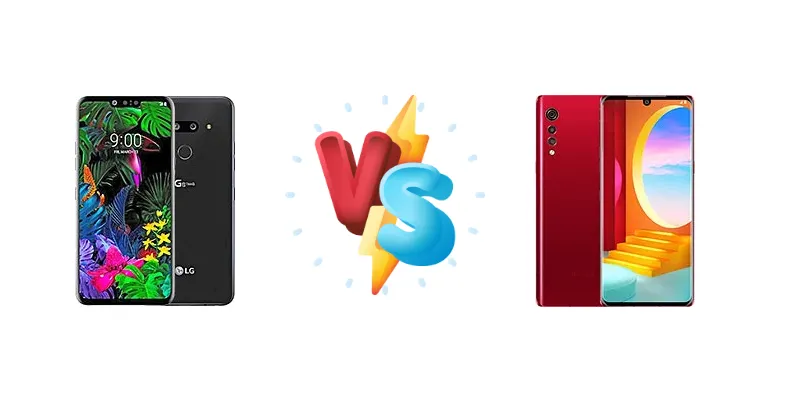
The LG G8 ThinQ offers superior performance thanks to its Snapdragon 855, while the Velvet 5G UW brings 5G connectivity and a slightly more modern design. For raw power and a brighter display, the G8 wins. For 5G and potentially better software support, the Velvet is the choice.
| PHONES | ||
|---|---|---|
| Phone Names | LG G8 ThinQ | LG Velvet 5G UW |
| Network | ||
|---|---|---|
| 2G bands | GSM 850 / 900 / 1800 / 1900 | GSM 850 / 900 / 1800 / 1900 |
| 3G bands | HSDPA 850 / 900 / 1900 / 2100 | HSDPA 850 / 900 / 1700(AWS) / 1900 / 2100 |
| 4G bands | 1, 2, 3, 4, 5, 7, 8, 12, 13, 14, 17, 20, 25, 26, 28, 29, 30, 38, 39, 40, 41, 46, 48, 66, 71 - USA | 2, 3, 4, 5, 7, 12, 13, 20, 28, 46, 48, 66 |
| 5G bands | - | 260, 261 mmWave |
| Speed | HSPA 42.2/5.76 Mbps, LTE Cat19 1600/150 Mbps | HSPA 42.2/5.76 Mbps, LTE (5CA) Cat16 1000/75 Mbps, 5G 2Gbps |
| Technology | GSM / CDMA / HSPA / EVDO / LTE | GSM / CDMA / HSPA / LTE / 5G |
| 2, 3, 4, 5, 7, 13, 20, 28, 46, 48, 66 - Verison | CDMA 800 / 1900 | |
| Launch | ||
|---|---|---|
| Announced | 2019, February 24. Released 2019, April 11 | 2020, August 19. Released 2020, August 21 |
| Status | Discontinued | Discontinued |
| Body | ||
|---|---|---|
| Build | Glass front (Gorilla Glass 5), glass back (Gorilla Glass 6), aluminum frame | Glass front, glass back, aluminum frame |
| Dimensions | 151.9 x 71.8 x 8.4 mm (5.98 x 2.83 x 0.33 in) | 167.2 x 74.1 x 7.9 mm (6.58 x 2.92 x 0.31 in) |
| SIM | · Nano-SIM· Nano-SIM + Nano-SIM | Nano-SIM (pre-installed) |
| Weight | 167 g (5.89 oz) | - |
| IP68 dust/water resistant (up to 1.5m for 30 min) MIL-STD-810G compliant* Method 516.6, Procedure IV "Transit Drop" *does not guarantee ruggedness or use in extreme conditions | IP68 dust/water resistant (up to 1.5m for 30 mins) MIL-STD-810G compliant* *does not guarantee ruggedness or use in extreme conditions | |
| Display | ||
|---|---|---|
| Protection | Corning Gorilla Glass 5 | - |
| Resolution | 1440 x 3120 pixels, 19.5:9 ratio (~564 ppi density) | 1080 x 2460 pixels (~395 ppi density) |
| Size | 6.1 inches, 91.0 cm2 (~83.5% screen-to-body ratio) | 6.8 inches, 109.8 cm2 (~88.6% screen-to-body ratio) |
| Type | P-OLED, HDR10 | P-OLED |
| Always-on display | - | |
| Platform | ||
|---|---|---|
| CPU | Octa-core (1x2.84 GHz Kryo 485 & 3x2.42 GHz Kryo 485 & 4x1.78 GHz Kryo 485) | Octa-core (1x2.4 GHz Kryo 475 Prime & 1x2.2 GHz Kryo 475 Gold & 6x1.8 GHz Kryo 475 Silver) |
| Chipset | Qualcomm SM8150 Snapdragon 855 (7 nm) | Qualcomm SM7250 Snapdragon 765G 5G (7 nm) |
| GPU | Adreno 640 | Adreno 620 |
| OS | Android 9.0 (Pie), upgradable to Android 11 | Android 10, upgradable to Android 11, LG UX |
| Memory | ||
|---|---|---|
| Card slot | microSDXC (dedicated slot) - single-SIM modelmicroSDXC (uses shared SIM slot) - dual-SIM model | microSDXC (uses shared SIM slot) |
| Internal | 128GB 6GB RAM | 128GB 6GB RAM |
| UFS 2.1 | UFS 2.1 | |
| Main Camera | ||
|---|---|---|
| Dual or Triple | 12 MP, f/1.5, 27mm (standard), 1/2.55", 1.4µm, dual pixel PDAF, OIS 16 MP, f/1.9, 16mm (ultrawide), 1/3.1", 1.0µm, no AF or 12 MP, f/1.5, 27mm (standard), 1/2.55", 1.4µm, dual pixel PDAF, OIS 16 MP, f/1.9, 16mm (ultrawide), 1/3.1", 1.0µm, no AF 12 MP, 52mm (telephoto), f/2.4, 1.0µm, 2x optical zoom, dual pixel PDAF, OIS | - |
| Features | LED flash, HDR, panorama | LED flash, panorama, HDR |
| Triple | - | 48 MP, f/1.8, 26mm (wide), 1/2.0", 0.8µm, PDAF 8 MP, f/2.2, 120˚, 15mm (ultrawide), 1/4.0", 1.12µm Auxiliary lens |
| Video | 4K@30/60fps, 1080p@30/60fps, 720p@240fps, HDR10, 24-bit/192kHz stereo sound rec. | 4K@30fps, 1080p@30/60fps, gyro-EIS |
| Selfie camera | ||
|---|---|---|
| Features | HDR | HDR |
| Single | 8 MP, f/1.7, 26mm (wide), 1/3.6", 1.22µm, AF TOF 3D, f/1.4, (depth/biometrics sensor) | 16 MP, f/1.9, 29mm (standard), 1/3.06, 1.0µm |
| Video | 1080p@60fps | 1080p@30fps |
| Sound | ||
|---|---|---|
| 3.5mm jack | Yes | Yes |
| 35mm jack | Yes | Yes |
| Loudspeaker | Yes | Yes, with stereo speakers |
| 32-bit/192kHz audio | - | |
| Comms | ||
|---|---|---|
| Bluetooth | 5.0, A2DP, LE, aptX HD | 5.1, A2DP, LE, aptX HD |
| NFC | Yes | Yes |
| Positioning | GPS, GLONASS, GALILEO, BDS | GPS (L1+L5), GLONASS, BDS, GALILEO, QZSS |
| Radio | FM radio (market/region dependent) | No |
| USB | USB Type-C 3.1, OTG | USB Type-C 2.0, OTG |
| WLAN | Wi-Fi 802.11 a/b/g/n/ac, dual-band, Wi-Fi Direct, DLNA | Wi-Fi 802.11 a/b/g/n/ac, dual-band, Wi-Fi Direct, DLNA |
| Features | ||
|---|---|---|
| Sensors | Face ID, Hand ID, fingerprint (rear-mounted), accelerometer, gyro, proximity, compass, barometer | Fingerprint (under display, optical), accelerometer, gyro, proximity, compass, barometer |
| Battery | ||
|---|---|---|
| Charging | 21W wired, PD, QC3 9W wireless | 25W wired, PD3.0, QC4 9W wireless |
| Type | Li-Po 3500 mAh, non-removable | Li-Po 4300 mAh |
| Misc | ||
|---|---|---|
| Colors | Platinum Gray, New Aurora Black, New Moroccan Blue, Carmine Red | Aurora Red |
| Models | LMG820QM7, LM-G820UMB, LMG820UM0, LMG820UM1, LMG820UM2, LM-G820N, LM-G820, LM-G820QM | LM-G900V, LM-G900V |
| Price | About 350 EUR | About 590 EUR |
| Tests | ||
|---|---|---|
| Audio quality | Noise -94.1dB / Crosstalk -87.6dB | - |
| Battery life | Endurance rating 79h | - |
| Camera | Photo / Video | - |
| Display | Contrast ratio: infinite | - |
| Loudspeaker | Voice 68dB / Noise 74dB / Ring 92dB | - |
| Performance | AnTuTu: 331537 (v7), 362730 (v8) GeekBench: 10735 (v4.4), 2700 (v5.1) GFXBench: 20fps (ES 3.1 onscreen) | - |
LG G8 ThinQ
- Superior Performance (Snapdragon 855)
- Brighter Display (655 nits)
- Excellent Battery Life (79h Endurance)
- Infinite Contrast Ratio
- Older Device - Limited Software Updates
- Design Feels Dated
- No 5G Connectivity
LG Velvet 5G UW
- 5G Connectivity
- Larger Display (6.8 inches)
- Slightly More Modern Design
- Faster Wired Charging (25W)
- Lower Performance (Snapdragon 765G)
- Likely Less Bright Display
- Potentially Shorter Battery Life
- Older Device - Limited Software Updates
Display Comparison
The LG G8 ThinQ features a 6.1-inch OLED display with a measured peak brightness of 655 nits and an infinite contrast ratio, offering excellent color accuracy and deep blacks. The Velvet 5G UW has a 6.8-inch OLED display, likely with slightly less peak brightness, but a larger screen size for media consumption. The G8's display is noticeably brighter.
Camera Comparison
Both phones feature capable camera systems, but the G8 likely has a slight edge in image quality due to its higher-end chipset and potentially better image processing algorithms. The Velvet 5G UW's camera is still quite good, offering decent image quality in various lighting conditions. Specific camera specs (megapixels, aperture) would be needed for a more precise comparison, but the G8's processing advantage is likely noticeable.
Performance
Here's where the G8 truly shines. The Snapdragon 855 in the G8 ThinQ is significantly more powerful than the Snapdragon 765G in the Velvet 5G UW. Expect smoother multitasking, faster app loading times, and better performance in graphically intensive games on the G8. The Velvet is still capable, but it won't match the G8's raw processing power.
Battery Life
The LG G8 ThinQ boasts an impressive endurance rating of 79 hours, suggesting excellent battery life. The Velvet 5G UW's battery life is likely good, but not as exceptional as the G8's. The Velvet's 25W charging is slightly faster than the G8's 21W wired charging, but both support wireless charging at 9W.
Buying Guide
The LG G8 ThinQ is ideal for users prioritizing performance and a vibrant display, especially those who enjoy gaming or demanding applications. The LG Velvet 5G UW is better suited for users who need 5G connectivity and prefer a more streamlined, modern design, and potentially better software support (though both are aging devices).