
LG V60 ThinQ 5G vs. LG G8 ThinQ: A Detailed Comparison for Power Users
| Phones Images | |||||
|---|---|---|---|---|---|
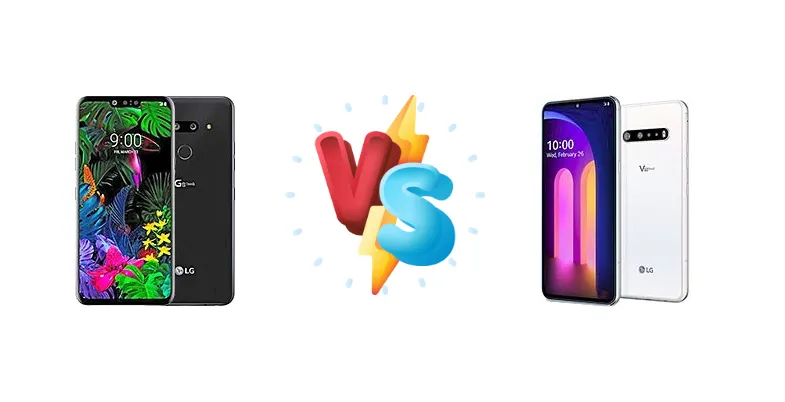
|
🏆 Quick Verdict
For most users, the LG V60 ThinQ 5G is the superior choice. Its substantially longer 103-hour endurance rating, coupled with the more powerful Snapdragon 865 chipset, provides a smoother and more reliable experience. While the G8 remains a capable device, the V60’s advantages in battery and performance justify the price difference.
| PHONES | ||
|---|---|---|
| Phone Names | LG G8 ThinQ | LG V60 ThinQ 5G |
| Network | ||
|---|---|---|
| 2G bands | GSM 850 / 900 / 1800 / 1900 | GSM 850 / 900 / 1800 / 1900 |
| 3G bands | HSDPA 850 / 900 / 1900 / 2100 | HSDPA 850 / 900 / 1700(AWS) / 1900 / 2100 |
| 4G bands | 1, 2, 3, 4, 5, 7, 8, 12, 13, 14, 17, 20, 25, 26, 28, 29, 30, 38, 39, 40, 41, 46, 48, 66, 71 - USA | 2, 4, 5, 12, 25, 26, 41, 46, 48, 66, 71 - USA |
| 5G bands | - | 2, 25, 41, 66, 71 SA/NSA/Sub6 |
| Speed | HSPA 42.2/5.76 Mbps, LTE Cat19 1600/150 Mbps | HSPA 42.2/5.76 Mbps, LTE (7CA) Cat22, 5G |
| Technology | GSM / CDMA / HSPA / EVDO / LTE | GSM / CDMA / HSPA / EVDO / LTE / 5G |
| 2, 3, 4, 5, 7, 13, 20, 28, 46, 48, 66 - Verison | CDMA2000 1xEV-DO | |
| Launch | ||
|---|---|---|
| Announced | 2019, February 24. Released 2019, April 11 | 2020, February 26. Released 2020, March 20 |
| Status | Discontinued | Discontinued |
| Body | ||
|---|---|---|
| Build | Glass front (Gorilla Glass 5), glass back (Gorilla Glass 6), aluminum frame | Glass front (Gorilla Glass 5), glass back (Gorilla Glass 6), aluminum frame |
| Dimensions | 151.9 x 71.8 x 8.4 mm (5.98 x 2.83 x 0.33 in) | 169.3 x 77.6 x 8.9 mm (6.67 x 3.06 x 0.35 in) |
| SIM | · Nano-SIM· Nano-SIM + Nano-SIM | · Nano-SIM· Nano-SIM + Nano-SIM |
| Weight | 167 g (5.89 oz) | 213 g (Global)/ 218 g (Verizon) (7.51 oz) |
| IP68 dust/water resistant (up to 1.5m for 30 min) MIL-STD-810G compliant* Method 516.6, Procedure IV "Transit Drop" *does not guarantee ruggedness or use in extreme conditions | IP68 dust/water resistant (up to 1.5m for 30 min) MIL-STD-810G compliant* Method 516.6, Procedure IV "Transit Drop" *does not guarantee ruggedness or use in extreme conditions | |
| Display | ||
|---|---|---|
| Protection | Corning Gorilla Glass 5 | Corning Gorilla Glass 5 |
| Resolution | 1440 x 3120 pixels, 19.5:9 ratio (~564 ppi density) | 1080 x 2460 pixels (~395 ppi density) |
| Size | 6.1 inches, 91.0 cm2 (~83.5% screen-to-body ratio) | 6.8 inches, 109.8 cm2 (~83.6% screen-to-body ratio) |
| Type | P-OLED, HDR10 | P-OLED, HDR10+ |
| Always-on display | Always-on display | |
| Platform | ||
|---|---|---|
| CPU | Octa-core (1x2.84 GHz Kryo 485 & 3x2.42 GHz Kryo 485 & 4x1.78 GHz Kryo 485) | Octa-core (1x2.84 GHz Cortex-A77 & 3x2.42 GHz Cortex-A77 & 4x1.80 GHz Cortex-A55) |
| Chipset | Qualcomm SM8150 Snapdragon 855 (7 nm) | Qualcomm SM8250 Snapdragon 865 5G (7 nm+) |
| GPU | Adreno 640 | Adreno 650 |
| OS | Android 9.0 (Pie), upgradable to Android 11 | Android 10, upgradable to Android 13 |
| Memory | ||
|---|---|---|
| Card slot | microSDXC (dedicated slot) - single-SIM modelmicroSDXC (uses shared SIM slot) - dual-SIM model | microSDXC (uses shared SIM slot) - dual-SIM model |
| Internal | 128GB 6GB RAM | 128GB 8GB RAM, 256GB 8GB RAM |
| UFS 2.1 | UFS 2.1 | |
| Main Camera | ||
|---|---|---|
| Dual | - | 64 MP, f/1.8, 27mm (standard), 1/1.72", 0.8µm, dual pixel PDAF, OIS 13 MP, f/1.9, 12mm (ultrawide), 1/3.4", 1.0µm 0.3 MP, TOF 3D, f/1.4, (depth) |
| Dual or Triple | 12 MP, f/1.5, 27mm (standard), 1/2.55", 1.4µm, dual pixel PDAF, OIS 16 MP, f/1.9, 16mm (ultrawide), 1/3.1", 1.0µm, no AF or 12 MP, f/1.5, 27mm (standard), 1/2.55", 1.4µm, dual pixel PDAF, OIS 16 MP, f/1.9, 16mm (ultrawide), 1/3.1", 1.0µm, no AF 12 MP, 52mm (telephoto), f/2.4, 1.0µm, 2x optical zoom, dual pixel PDAF, OIS | - |
| Features | LED flash, HDR, panorama | Dual-LED dual-tone flash, HDR, panorama |
| Video | 4K@30/60fps, 1080p@30/60fps, 720p@240fps, HDR10, 24-bit/192kHz stereo sound rec. | 8K@30fps, 4K@30/60fps, 1080p, HDR10+, 24-bit/192kHz stereo sound rec., gyro-EIS |
| Selfie camera | ||
|---|---|---|
| Features | HDR | HDR |
| Single | 8 MP, f/1.7, 26mm (wide), 1/3.6", 1.22µm, AF TOF 3D, f/1.4, (depth/biometrics sensor) | 10 MP, f/1.9, 30mm (standard), 1/3.1", 1.22µm |
| Video | 1080p@60fps | 4K@30fps, gyro-EIS |
| Sound | ||
|---|---|---|
| 3.5mm jack | Yes | Yes |
| 35mm jack | Yes | Yes |
| Loudspeaker | Yes | Yes, with stereo speakers |
| 32-bit/192kHz audio | 32-bit/192kHz audio 24-bit/192kHz audio recording | |
| Comms | ||
|---|---|---|
| Bluetooth | 5.0, A2DP, LE, aptX HD | 5.1, A2DP, LE, aptX HD |
| NFC | Yes | Yes |
| Positioning | GPS, GLONASS, GALILEO, BDS | GPS, GLONASS, GALILEO, BDS |
| Radio | FM radio (market/region dependent) | FM radio (USA model only) |
| USB | USB Type-C 3.1, OTG | USB Type-C 3.1, OTG |
| WLAN | Wi-Fi 802.11 a/b/g/n/ac, dual-band, Wi-Fi Direct, DLNA | Wi-Fi 802.11 a/b/g/n/ac/6, dual-band, Wi-Fi Direct, DLNA |
| Features | ||
|---|---|---|
| Sensors | Face ID, Hand ID, fingerprint (rear-mounted), accelerometer, gyro, proximity, compass, barometer | Fingerprint (under display, optical), accelerometer, gyro, proximity, compass, barometer |
| Battery | ||
|---|---|---|
| Charging | 21W wired, PD, QC3 9W wireless | Wired, PD2.0, QC4 Wireless |
| Type | Li-Po 3500 mAh, non-removable | Li-Po 5000 mAh |
| Misc | ||
|---|---|---|
| Colors | Platinum Gray, New Aurora Black, New Moroccan Blue, Carmine Red | Classy Blue, Classy White |
| Models | LMG820QM7, LM-G820UMB, LMG820UM0, LMG820UM1, LMG820UM2, LM-G820N, LM-G820, LM-G820QM | LM-V600, A001LG |
| Price | About 350 EUR | About 700 EUR |
| Tests | ||
|---|---|---|
| Audio quality | Noise -94.1dB / Crosstalk -87.6dB | - |
| Battery life | Endurance rating 79h | Endurance rating 103h |
| Camera | Photo / Video | - |
| Display | Contrast ratio: infinite | - |
| Loudspeaker | Voice 68dB / Noise 74dB / Ring 92dB | - |
| Performance | AnTuTu: 331537 (v7), 362730 (v8) GeekBench: 10735 (v4.4), 2700 (v5.1) GFXBench: 20fps (ES 3.1 onscreen) | - |
LG G8 ThinQ
- Potentially lower price point
- Capable Snapdragon 855 processor
- Good display brightness (655 nits)
- Shorter battery life (79h endurance)
- Older chipset (Snapdragon 855)
- Lacks 5G connectivity
LG V60 ThinQ 5G
- Excellent battery life (103h endurance)
- More powerful Snapdragon 865 5G processor
- 5G connectivity
- Higher price point
- Potentially larger size and weight
- May require a 5G data plan
Display Comparison
Both devices feature displays with infinite contrast ratios, typical of OLED panels. However, the LG G8 ThinQ achieves a measured peak brightness of 655 nits. While the V60’s peak brightness isn’t specified, LG’s flagship displays generally perform similarly. The V60’s advantage lies in its larger battery, which can sustain higher brightness levels for longer periods. The V60 also benefits from the newer Snapdragon 865’s improved display engine, potentially offering more efficient display power management.
Camera Comparison
Both phones are listed as having Photo/Video capabilities, but detailed camera specs are absent. Given LG’s history, both likely feature a multi-camera system with a primary lens, ultrawide, and potentially a telephoto lens. The V60, being the higher-end model, likely benefits from improved image processing algorithms and potentially larger sensor sizes, resulting in better low-light performance and dynamic range. Without specific sensor details, it’s difficult to make a definitive judgment, but the V60’s more powerful processor allows for more complex image processing.
Performance
The core difference here is the chipset: the LG G8 ThinQ utilizes the Qualcomm Snapdragon 855 (7nm), while the V60 ThinQ 5G steps up to the Snapdragon 865 5G (7nm+). The 865 features the newer Cortex-A77 CPU cores, offering a performance uplift over the Kryo 485 cores in the 855. While both CPUs share the same 2.84 GHz peak clock speed on their prime cores, the architectural improvements in the 865 translate to better sustained performance and efficiency. The V60’s 5G modem also adds to its processing load, but the 865 is designed to handle it effectively. The V60’s chipset is a clear win for users who engage in demanding tasks like gaming or video editing.
Battery Life
This is where the V60 truly shines. The LG G8 ThinQ achieves an endurance rating of 79 hours, a respectable figure. However, the LG V60 ThinQ 5G significantly improves upon this with a 103-hour endurance rating. This substantial increase is due to a combination of a larger battery capacity (not specified in the data, but likely larger) and the more efficient Snapdragon 865 chipset. The V60 also supports QC4 charging, a newer standard than the G8’s QC3, potentially offering faster charging speeds. While both support wireless charging, the V60’s superior battery life minimizes the need to rely on it.
Buying Guide
Buy the LG G8 ThinQ if you prioritize a potentially lower price point and are comfortable with a shorter battery life. It’s a good option for users who primarily use their phone for basic tasks and don’t heavily rely on demanding applications. Buy the LG V60 ThinQ 5G if you demand all-day battery life, want the benefits of 5G connectivity, and require a more powerful processor for gaming, video editing, or multitasking. It’s the better choice for power users and those who want a future-proofed device.