
LG G8 ThinQ vs. LG V50 ThinQ 5G: A Deep Dive Comparison
| Phones Images | |||||
|---|---|---|---|---|---|
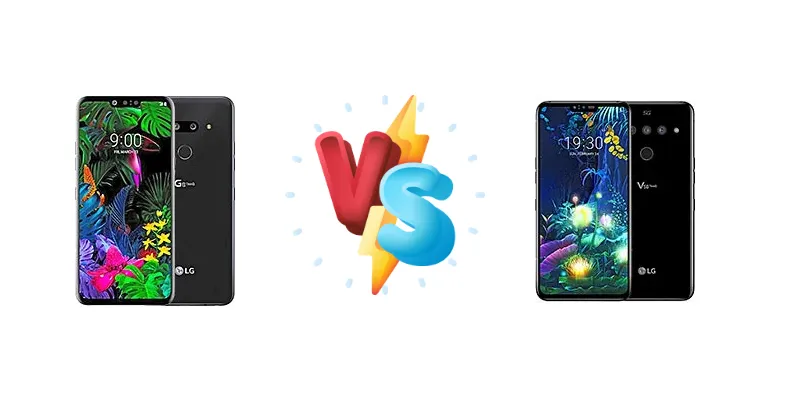
|
🏆 Quick Verdict
For most users, the LG V50 ThinQ 5G emerges as the superior choice. Its significantly longer battery life – boasting a 96-hour endurance rating versus the G8’s 79 – and improved contrast ratio outweigh the G8’s slightly brighter display. The 5G capability, while dependent on network availability, adds future-proofing.
| PHONES | ||
|---|---|---|
| Phone Names | LG G8 ThinQ | LG V50 ThinQ 5G |
| Network | ||
|---|---|---|
| 2G bands | GSM 850 / 900 / 1800 / 1900 | GSM 850 / 900 / 1800 / 1900 |
| 3G bands | HSDPA 850 / 900 / 1900 / 2100 | HSDPA 850 / 900 / 1700(AWS) / 1900 / 2100 - USA |
| 4G bands | 1, 2, 3, 4, 5, 7, 8, 12, 13, 14, 17, 20, 25, 26, 28, 29, 30, 38, 39, 40, 41, 46, 48, 66, 71 - USA | 1, 2, 3, 4, 5, 7, 8, 12, 13, 17, 20, 25, 26, 28, 40, 41, 46, 66, 71 - USA |
| 5G bands | - | 41, 260, 261 NSA |
| Speed | HSPA 42.2/5.76 Mbps, LTE Cat19 1600/150 Mbps | HSPA 42.2/5.76 Mbps, LTE (6CA) Cat18 1200/75 Mbps, 5G (2+ Gbps DL) |
| Technology | GSM / CDMA / HSPA / EVDO / LTE | GSM / CDMA / HSPA / EVDO / LTE / 5G |
| 2, 3, 4, 5, 7, 13, 20, 28, 46, 48, 66 - Verison | CDMA2000 1xEV-DO | |
| Launch | ||
|---|---|---|
| Announced | 2019, February 24. Released 2019, April 11 | 2019, February 24. Released 2019, April 19 |
| Status | Discontinued | Discontinued |
| Body | ||
|---|---|---|
| Build | Glass front (Gorilla Glass 5), glass back (Gorilla Glass 6), aluminum frame | Glass front (Gorilla Glass 5), glass back (Gorilla Glass 6), aluminum frame |
| Dimensions | 151.9 x 71.8 x 8.4 mm (5.98 x 2.83 x 0.33 in) | 159.2 x 76.1 x 8.3 mm (6.27 x 3.00 x 0.33 in) |
| SIM | · Nano-SIM· Nano-SIM + Nano-SIM | · Nano-SIM· Nano-SIM + Nano-SIM |
| Weight | 167 g (5.89 oz) | 183 g (6.46 oz) |
| IP68 dust/water resistant (up to 1.5m for 30 min) MIL-STD-810G compliant* Method 516.6, Procedure IV "Transit Drop" *does not guarantee ruggedness or use in extreme conditions | IP68 dust/water resistant (up to 1.5m for 30 min) MIL-STD-810G compliant* *does not guarantee ruggedness or use in extreme conditions | |
| Display | ||
|---|---|---|
| Protection | Corning Gorilla Glass 5 | Corning Gorilla Glass 5 |
| Resolution | 1440 x 3120 pixels, 19.5:9 ratio (~564 ppi density) | 1440 x 3120 pixels, 19.5:9 ratio (~538 ppi density) |
| Size | 6.1 inches, 91.0 cm2 (~83.5% screen-to-body ratio) | 6.4 inches, 100.2 cm2 (~82.7% screen-to-body ratio) |
| Type | P-OLED, HDR10 | P-OLED, HDR10 |
| Always-on display | Always-on display | |
| Platform | ||
|---|---|---|
| CPU | Octa-core (1x2.84 GHz Kryo 485 & 3x2.42 GHz Kryo 485 & 4x1.78 GHz Kryo 485) | Octa-core (1x2.84 GHz Kryo 485 & 3x2.42 GHz Kryo 485 & 4x1.78 GHz Kryo 485) |
| Chipset | Qualcomm SM8150 Snapdragon 855 (7 nm) | Qualcomm SM8150 Snapdragon 855 (7 nm) |
| GPU | Adreno 640 | Adreno 640 |
| OS | Android 9.0 (Pie), upgradable to Android 11 | Android 9.0 (Pie), upgradable to Android 11 |
| Memory | ||
|---|---|---|
| Card slot | microSDXC (dedicated slot) - single-SIM modelmicroSDXC (uses shared SIM slot) - dual-SIM model | microSDXC (dedicated slot) |
| Internal | 128GB 6GB RAM | 128GB 6GB RAM |
| UFS 2.1 | UFS 2.1 | |
| Main Camera | ||
|---|---|---|
| Dual or Triple | 12 MP, f/1.5, 27mm (standard), 1/2.55", 1.4µm, dual pixel PDAF, OIS 16 MP, f/1.9, 16mm (ultrawide), 1/3.1", 1.0µm, no AF or 12 MP, f/1.5, 27mm (standard), 1/2.55", 1.4µm, dual pixel PDAF, OIS 16 MP, f/1.9, 16mm (ultrawide), 1/3.1", 1.0µm, no AF 12 MP, 52mm (telephoto), f/2.4, 1.0µm, 2x optical zoom, dual pixel PDAF, OIS | - |
| Features | LED flash, HDR, panorama | LED flash, HDR, panorama |
| Triple | - | 12 MP, 27mm (wide), f/1.5, 1/2.55", 1.4µm, dual pixel PDAF, 3-axis OIS 12 MP, 52mm (telephoto), f/2.4, 1/3.4", 1.0µm, 2x optical zoom, PDAF, OIS 16 MP, 16mm (ultrawide), f/1.9, 1/3.1", 1.0µm, no AF |
| Video | 4K@30/60fps, 1080p@30/60fps, 720p@240fps, HDR10, 24-bit/192kHz stereo sound rec. | 4K@30/60fps, 1080p@30/60/240fps, 24-bit/192kHz stereo sound rec., HDR10 video, gyro-EIS |
| Selfie camera | ||
|---|---|---|
| Dual | - | 8 MP, f/1.9, 26mm (wide), 1/4.0", 1.12µm 5 MP, 21mm (wide), f/2.2, 1/5.0", 1.12µm |
| Features | HDR | HDR |
| Single | 8 MP, f/1.7, 26mm (wide), 1/3.6", 1.22µm, AF TOF 3D, f/1.4, (depth/biometrics sensor) | - |
| Video | 1080p@60fps | 1080p@60fps |
| Sound | ||
|---|---|---|
| 3.5mm jack | Yes | Yes |
| 35mm jack | Yes | Yes |
| Loudspeaker | Yes | Yes, with stereo speakers |
| 32-bit/192kHz audio | 32-bit/192kHz audio 24-bit/192kHz audio recording Tuned with Meridian Audio | |
| Comms | ||
|---|---|---|
| Bluetooth | 5.0, A2DP, LE, aptX HD | 5.0, A2DP, LE, aptX HD |
| NFC | Yes | Yes |
| Positioning | GPS, GLONASS, GALILEO, BDS | GPS, GLONASS, GALILEO |
| Radio | FM radio (market/region dependent) | FM radio |
| USB | USB Type-C 3.1, OTG | USB Type-C 3.1 |
| WLAN | Wi-Fi 802.11 a/b/g/n/ac, dual-band, Wi-Fi Direct, DLNA | Wi-Fi 802.11 a/b/g/n/ac, dual-band, Wi-Fi Direct, DLNA |
| Features | ||
|---|---|---|
| Sensors | Face ID, Hand ID, fingerprint (rear-mounted), accelerometer, gyro, proximity, compass, barometer | Fingerprint (rear-mounted), accelerometer, gyro, proximity, compass, barometer |
| Battery | ||
|---|---|---|
| Charging | 21W wired, PD, QC3 9W wireless | 18W wired, PD2.0, QC3, 50% in 36 min 10W wireless (Qi) |
| Type | Li-Po 3500 mAh, non-removable | Li-Po 4000 mAh, non-removable |
| Misc | ||
|---|---|---|
| Colors | Platinum Gray, New Aurora Black, New Moroccan Blue, Carmine Red | New Aurora Black |
| Models | LMG820QM7, LM-G820UMB, LMG820UM0, LMG820UM1, LMG820UM2, LM-G820N, LM-G820, LM-G820QM | LM-V500, LM-V500N, LM-V500EM, LM-V500XM, LM-V450PM, LM-V450 |
| Price | About 350 EUR | About 550 EUR |
| Tests | ||
|---|---|---|
| Audio quality | Noise -94.1dB / Crosstalk -87.6dB | Noise -92.5dB / Crosstalk -92.6dB |
| Battery life | Endurance rating 79h | Endurance rating 96h |
| Camera | Photo / Video | Photo / Video |
| Display | Contrast ratio: infinite | Contrast ratio: 194000:1 (nominal) |
| Loudspeaker | Voice 68dB / Noise 74dB / Ring 92dB | -25.2 LUFS (Very good) |
| Performance | AnTuTu: 331537 (v7), 362730 (v8) GeekBench: 10735 (v4.4), 2700 (v5.1) GFXBench: 20fps (ES 3.1 onscreen) | AnTuTu: 343758 (v7), 421934 (v8) GeekBench: 10928 (v4.4), 2672 (v5.1) GFXBench: 22fps (ES 3.1 onscreen) |
LG G8 ThinQ
- Slightly brighter display for outdoor use
- Air Motion gesture control (unique feature)
- Faster wired charging (21W)
- Significantly shorter battery life (79h endurance)
- Lower display contrast ratio
- Lacks 5G connectivity
LG V50 ThinQ 5G
- Superior battery life (96h endurance)
- Higher display contrast ratio
- 5G connectivity for future-proofing
- Lower peak display brightness
- Slower wired charging (18W)
- Larger and heavier form factor
Display Comparison
The LG G8 ThinQ boasts a peak brightness of 655 nits, offering excellent visibility in direct sunlight. However, the LG V50 ThinQ 5G counters with a significantly higher contrast ratio of 194000:1 (nominal) compared to the G8’s infinite ratio, resulting in richer blacks and more vibrant colors. While the V50’s peak brightness is lower at 533 nits, the improved contrast makes a noticeable difference in real-world viewing, particularly for video content. Both displays share the same resolution and aspect ratio, so the difference comes down to color science and contrast performance.
Camera Comparison
Both phones feature capable camera systems, but detailed specifications are limited in the provided data. Both are described as having Photo/Video capabilities. Without sensor size or aperture information, a direct comparison is difficult. However, the V50’s larger size *could* allow for a larger sensor, potentially improving low-light performance. The image processing style is likely similar, given LG’s software approach at the time. It’s important to note that the presence of a 2MP macro camera on either device is unlikely to be a significant factor in image quality.
Performance
Both the LG G8 and V50 are powered by the Qualcomm Snapdragon 855 (7nm) chipset, featuring the same octa-core CPU configuration. This means performance in everyday tasks and demanding applications will be largely identical. The real-world difference lies in thermal management. While neither phone is prone to significant throttling, the V50’s larger chassis may offer slightly better heat dissipation during prolonged gaming sessions. Both devices utilize the same RAM configuration, so the CPU and GPU performance will be nearly indistinguishable.
Battery Life
The LG V50 ThinQ 5G clearly wins in the battery department. Its 96-hour endurance rating significantly surpasses the LG G8 ThinQ’s 79-hour rating. This translates to a tangible difference in real-world usage, allowing the V50 to comfortably last a full day even with heavy use. While the G8 supports faster wired charging at 21W (with PD and QC3), the V50’s 18W charging (with PD2.0 and QC3) and 36-minute 50% charge time is still competitive. Wireless charging is similar, with the G8 offering 9W and the V50 offering 10W (Qi).
Buying Guide
Buy the LG G8 ThinQ if you value a slightly brighter display for outdoor visibility and are intrigued by its unique Air Motion gesture control. Buy the LG V50 ThinQ 5G if you prioritize all-day battery life, superior contrast for media consumption, and want to be prepared for the rollout of 5G networks. The V50 is the better option for power users and travelers.