
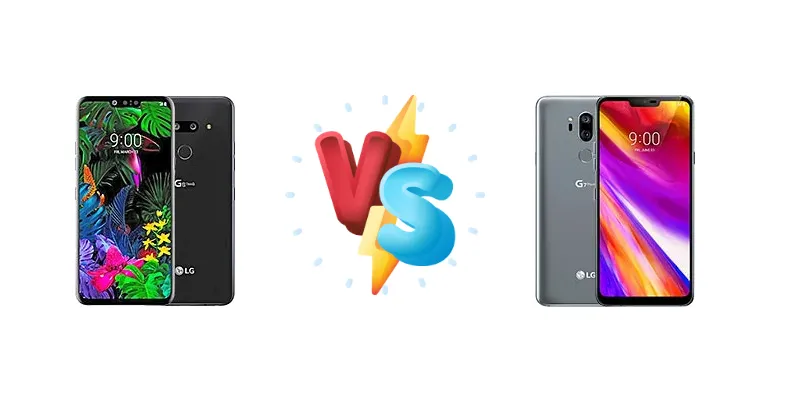
LG G8 ThinQ vs LG G7 ThinQ: Which Flagship Still Holds Up?
| Phones Images | |||||
|---|---|---|---|---|---|
|
🏆 Quick Verdict
For most users, the LG G8 ThinQ represents the better overall value. The Snapdragon 855 offers a noticeable performance boost and improved efficiency, while the higher display brightness enhances outdoor visibility. However, the G7 remains a viable option for budget-conscious buyers who prioritize a high contrast display.
| PHONES | ||
|---|---|---|
| Phone Names | LG G8 ThinQ | LG G7 ThinQ |
| Network | ||
|---|---|---|
| 2G bands | GSM 850 / 900 / 1800 / 1900 | GSM 850 / 900 / 1800 / 1900 |
| 3G bands | HSDPA 850 / 900 / 1900 / 2100 | HSDPA 850 / 900 / 1900 / 2100 - Global |
| 4G bands | 1, 2, 3, 4, 5, 7, 8, 12, 13, 14, 17, 20, 25, 26, 28, 29, 30, 38, 39, 40, 41, 46, 48, 66, 71 - USA | 1, 3, 4, 5, 7, 8, 12, 17, 20, 28, 32, 38, 40, 42, 46 - Global |
| Speed | HSPA 42.2/5.76 Mbps, LTE Cat19 1600/150 Mbps | HSPA 42.2/5.76 Mbps, LTE (3CA) Cat16 1024/150 Mbps or Cat15 800/150 Mbps (region dependant) |
| Technology | GSM / CDMA / HSPA / EVDO / LTE | GSM / CDMA / HSPA / LTE |
| 2, 3, 4, 5, 7, 13, 20, 28, 46, 48, 66 - Verison | 1, 3, 5, 7, 8, 28, 38, 39, 40, 41 - G710EMW, G710EAW1,2,3,4,5,7,8,12,13,17,20,25,29,30,38,41,46,66 - G710AWM | |
| Launch | ||
|---|---|---|
| Announced | 2019, February 24. Released 2019, April 11 | 2018, May 02. Released 2018, June 01 |
| Status | Discontinued | Discontinued |
| Body | ||
|---|---|---|
| Build | Glass front (Gorilla Glass 5), glass back (Gorilla Glass 6), aluminum frame | Glass front (Gorilla Glass 5), glass back (Gorilla Glass 5), aluminum frame |
| Dimensions | 151.9 x 71.8 x 8.4 mm (5.98 x 2.83 x 0.33 in) | 153.2 x 71.9 x 7.9 mm (6.03 x 2.83 x 0.31 in) |
| SIM | · Nano-SIM· Nano-SIM + Nano-SIM | · Nano-SIM· Nano-SIM + Nano-SIM |
| Weight | 167 g (5.89 oz) | 162 g (5.71 oz) |
| IP68 dust/water resistant (up to 1.5m for 30 min) MIL-STD-810G compliant* Method 516.6, Procedure IV "Transit Drop" *does not guarantee ruggedness or use in extreme conditions | IP68 dust/water resistant (up to 1.5m for 30 min) MIL-STD-810G compliant* *does not guarantee ruggedness or use in extreme conditions | |
| Display | ||
|---|---|---|
| Protection | Corning Gorilla Glass 5 | Corning Gorilla Glass 5 |
| Resolution | 1440 x 3120 pixels, 19.5:9 ratio (~564 ppi density) | 1440 x 3120 pixels, 19.5:9 ratio (~564 ppi density) |
| Size | 6.1 inches, 91.0 cm2 (~83.5% screen-to-body ratio) | 6.1 inches, 91.0 cm2 (~82.6% screen-to-body ratio) |
| Type | P-OLED, HDR10 | IPS LCD, HDR10 |
| Always-on display | Always-on display | |
| Platform | ||
|---|---|---|
| CPU | Octa-core (1x2.84 GHz Kryo 485 & 3x2.42 GHz Kryo 485 & 4x1.78 GHz Kryo 485) | Octa-core (4x2.8 GHz Kryo 385 Gold & 4x1.7 GHz Kryo 385 Silver) |
| Chipset | Qualcomm SM8150 Snapdragon 855 (7 nm) | Qualcomm SDM845 Snapdragon 845 (10 nm) |
| GPU | Adreno 640 | Adreno 630 |
| OS | Android 9.0 (Pie), upgradable to Android 11 | Android 8.0 (Oreo), upgradable to Android 10 |
| Memory | ||
|---|---|---|
| Card slot | microSDXC (dedicated slot) - single-SIM modelmicroSDXC (uses shared SIM slot) - dual-SIM model | microSDXC (dedicated slot) - single-SIM modelmicroSDXC (uses shared SIM slot) - dual-SIM model |
| Internal | 128GB 6GB RAM | 64GB 4GB RAM, 128GB 6GB RAM |
| UFS 2.1 | UFS 2.1 | |
| Main Camera | ||
|---|---|---|
| Dual | - | 16 MP, f/1.6, 30mm (standard), 1/3.1", 1.0µm, PDAF, OIS 16 MP, f/1.9, 16mm (ultrawide), 1/3.1", no AF |
| Dual or Triple | 12 MP, f/1.5, 27mm (standard), 1/2.55", 1.4µm, dual pixel PDAF, OIS 16 MP, f/1.9, 16mm (ultrawide), 1/3.1", 1.0µm, no AF or 12 MP, f/1.5, 27mm (standard), 1/2.55", 1.4µm, dual pixel PDAF, OIS 16 MP, f/1.9, 16mm (ultrawide), 1/3.1", 1.0µm, no AF 12 MP, 52mm (telephoto), f/2.4, 1.0µm, 2x optical zoom, dual pixel PDAF, OIS | - |
| Features | LED flash, HDR, panorama | Laser AF, LED flash, HDR, panorama |
| Video | 4K@30/60fps, 1080p@30/60fps, 720p@240fps, HDR10, 24-bit/192kHz stereo sound rec. | 4K@30/60fps, 1080p@30/60fps, 720p@240fps, HDR, 24-bit/192kHz stereo sound rec. |
| Selfie camera | ||
|---|---|---|
| Features | HDR | - |
| Single | 8 MP, f/1.7, 26mm (wide), 1/3.6", 1.22µm, AF TOF 3D, f/1.4, (depth/biometrics sensor) | 8 MP, f/1.9, 26mm (wide) |
| Video | 1080p@60fps | 1080p@60fps |
| Sound | ||
|---|---|---|
| 3.5mm jack | Yes | Yes |
| 35mm jack | Yes | Yes |
| Loudspeaker | Yes | Yes |
| 32-bit/192kHz audio | 32-bit/192kHz audio | |
| Comms | ||
|---|---|---|
| Bluetooth | 5.0, A2DP, LE, aptX HD | 5.0, A2DP, LE, aptX HD |
| NFC | Yes | Yes |
| Positioning | GPS, GLONASS, GALILEO, BDS | GPS, GLONASS, BDS |
| Radio | FM radio (market/region dependent) | FM radio |
| USB | USB Type-C 3.1, OTG | USB Type-C 3.1, OTG |
| WLAN | Wi-Fi 802.11 a/b/g/n/ac, dual-band, Wi-Fi Direct, DLNA | Wi-Fi 802.11 a/b/g/n/ac, dual-band, Wi-Fi Direct, DLNA |
| Features | ||
|---|---|---|
| Sensors | Face ID, Hand ID, fingerprint (rear-mounted), accelerometer, gyro, proximity, compass, barometer | Fingerprint (rear-mounted), accelerometer, gyro, proximity, compass, barometer |
| Battery | ||
|---|---|---|
| Charging | 21W wired, PD, QC3 9W wireless | 18W wired, QC3 Wireless (USA) |
| Type | Li-Po 3500 mAh, non-removable | Li-Po 3000 mAh, non-removable |
| Misc | ||
|---|---|---|
| Colors | Platinum Gray, New Aurora Black, New Moroccan Blue, Carmine Red | New Platinum Gray, New Aurora Black, New Moroccan Blue, Raspberry Rose |
| Models | LMG820QM7, LM-G820UMB, LMG820UM0, LMG820UM1, LMG820UM2, LM-G820N, LM-G820, LM-G820QM | LM-G710, LM-G710N, LM-G710VM, G710, SM-G710, LM-G710V |
| Price | About 350 EUR | About 370 EUR |
| SAR EU | - | 0.24 W/kg (head) 1.47 W/kg (body) |
| Tests | ||
|---|---|---|
| Audio quality | Noise -94.1dB / Crosstalk -87.6dB | Noise -94.0dB / Crosstalk -93.0dB |
| Battery life | Endurance rating 79h | Endurance rating 77h |
| Camera | Photo / Video | Photo / Video |
| Display | Contrast ratio: infinite | Contrast ratio: 2044:1 (nominal), 3.978 (sunlight) |
| Loudspeaker | Voice 68dB / Noise 74dB / Ring 92dB | -24.5 LUFS (Very good) |
| Performance | AnTuTu: 331537 (v7), 362730 (v8) GeekBench: 10735 (v4.4), 2700 (v5.1) GFXBench: 20fps (ES 3.1 onscreen) | AnTuTu: 259393 (v7), 297116 (v8) GeekBench: 8865 (v4.4), 2047 (v5.1) GFXBench: 18fps (ES 3.1 onscreen) |
LG G8 ThinQ
- Faster Snapdragon 855 processor
- Higher display brightness for outdoor use
- Faster 21W charging with wireless support
- Potentially higher price point
- No significant camera improvements detailed in specs
LG G7 ThinQ
- Higher contrast ratio for immersive viewing
- Lower price point
- Solid overall performance for everyday tasks
- Slower Snapdragon 845 processor
- Slower 18W charging
Display Comparison
The LG G8 ThinQ boasts a maximum brightness of 655 nits, a substantial improvement over the G7's contrast ratio of 2044:1 (nominal) and 3.978 (sunlight). While the G7 excels in contrast, providing richer blacks and more vibrant colors in controlled lighting, the G8’s higher peak brightness makes it significantly more usable under direct sunlight. Both phones feature infinite contrast ratios, but this is a result of OLED technology not present in either device. The G7’s contrast ratio specification is a bit misleading, as it refers to a measurement under sunlight, which is less relevant for typical indoor usage.
Camera Comparison
Both the LG G8 and G7 ThinQ feature capable photo and video cameras, but detailed sensor specifications are lacking in the provided data. The G8’s Snapdragon 855 ISP likely offers improved image processing capabilities, potentially resulting in better dynamic range and noise reduction. However, without knowing sensor sizes or lens apertures, it’s difficult to definitively declare a winner. The G7’s camera performance was generally well-regarded for its time, but the G8 benefits from the advancements in computational photography enabled by the newer chipset.
Performance
The LG G8 ThinQ’s Qualcomm SM8150 Snapdragon 855 (7nm) represents a significant architectural leap over the G7’s SDM845 Snapdragon 845 (10nm). The 7nm process allows for greater transistor density and improved power efficiency, resulting in sustained performance and reduced thermal throttling. The G8’s CPU configuration – Octa-core (1x2.84 GHz Kryo 485 & 3x2.42 GHz Kryo 485 & 4x1.78 GHz Kryo 485) – offers a performance advantage over the G7’s Octa-core (4x2.8 GHz Kryo 385 Gold & 4x1.7 GHz Kryo 385 Silver), particularly in multi-threaded applications. This translates to faster app loading times, smoother multitasking, and a more responsive user experience.
Battery Life
Both devices achieve a similar endurance rating of approximately 77-79 hours. The G8’s 21W wired charging with PD and QC3 support is a clear advantage over the G7’s 18W QC3 charging, allowing for faster top-ups. The G8 also adds 9W wireless charging, a feature absent on the G7 (in some regions). While the battery capacity isn’t specified, the Snapdragon 855’s improved efficiency likely contributes to the G8’s comparable battery life despite the faster charging capabilities.
Buying Guide
Buy the LG G8 ThinQ if you need a smoother, more responsive experience for demanding tasks like gaming or video editing, and if you frequently use your phone outdoors. Buy the LG G7 ThinQ if you prioritize a higher contrast ratio for media consumption in darker environments and are looking for a flagship experience at a significantly reduced price point.