
LG G8 ThinQ vs Google Pixel 6a: A Detailed Comparison of Two Android Contenders
| Phones Images | |||||
|---|---|---|---|---|---|
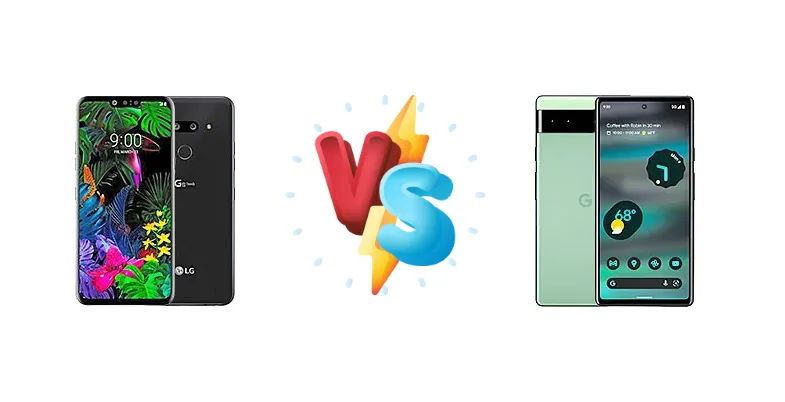
|
🏆 Quick Verdict
For most users, the Google Pixel 6a is the better choice. Its superior battery life (94h endurance vs 79h), brighter display (876 nits vs 655 nits), and Google’s software support outweigh the LG G8 ThinQ’s older, but still capable, Snapdragon 855.
| PHONES | ||
|---|---|---|
| Phone Names | LG G8 ThinQ | Google Pixel 6a |
| Network | ||
|---|---|---|
| 2G bands | GSM 850 / 900 / 1800 / 1900 | GSM 850 / 900 / 1800 / 1900 |
| 3G bands | HSDPA 850 / 900 / 1900 / 2100 | HSDPA 800 / 850 / 900 / 1700(AWS) / 1900 / 2100 |
| 4G bands | 1, 2, 3, 4, 5, 7, 8, 12, 13, 14, 17, 20, 25, 26, 28, 29, 30, 38, 39, 40, 41, 46, 48, 66, 71 - USA | 1, 2, 3, 4, 5, 7, 8, 12, 13, 14, 17, 18, 19, 20, 25, 26, 28, 29, 30, 38, 39, 40, 41, 42, 48, 66, 71 - GX7AS, GB62Z (USA/Canada) |
| 5G bands | - | 1, 2, 3, 5, 7, 8, 12, 20, 25, 28, 30, 38, 40, 41, 48, 66, 71, 77, 78 SA/NSA/Sub6 - GX7AS (USA/Canada) |
| Speed | HSPA 42.2/5.76 Mbps, LTE Cat19 1600/150 Mbps | HSPA, LTE, 5G |
| Technology | GSM / CDMA / HSPA / EVDO / LTE | GSM / HSPA / LTE / 5G |
| 2, 3, 4, 5, 7, 13, 20, 28, 46, 48, 66 - Verison | 1, 2, 3, 5, 7, 8, 12, 20, 25, 28, 30, 40, 48, 66, 71, 77, 78 SA/NSA/Sub6 - G1AZG (International) | |
| Launch | ||
|---|---|---|
| Announced | 2019, February 24. Released 2019, April 11 | 2022, May 11 |
| Status | Discontinued | Available. Released 2022, July 21 |
| Body | ||
|---|---|---|
| Build | Glass front (Gorilla Glass 5), glass back (Gorilla Glass 6), aluminum frame | Glass front (Gorilla Glass 3), aluminum frame, plastic back |
| Dimensions | 151.9 x 71.8 x 8.4 mm (5.98 x 2.83 x 0.33 in) | 152.2 x 71.8 x 8.9 mm (5.99 x 2.83 x 0.35 in) |
| SIM | · Nano-SIM· Nano-SIM + Nano-SIM | Nano-SIM + eSIM |
| Weight | 167 g (5.89 oz) | 178 g (6.28 oz) |
| IP68 dust/water resistant (up to 1.5m for 30 min) MIL-STD-810G compliant* Method 516.6, Procedure IV "Transit Drop" *does not guarantee ruggedness or use in extreme conditions | IP67 dust/water resistant (up to 1m for 30 min) | |
| Display | ||
|---|---|---|
| Protection | Corning Gorilla Glass 5 | Corning Gorilla Glass 3 |
| Resolution | 1440 x 3120 pixels, 19.5:9 ratio (~564 ppi density) | 1080 x 2400 pixels, 20:9 ratio (~429 ppi density) |
| Size | 6.1 inches, 91.0 cm2 (~83.5% screen-to-body ratio) | 6.1 inches, 90.7 cm2 (~83.0% screen-to-body ratio) |
| Type | P-OLED, HDR10 | OLED, HDR |
| Always-on display | Always-on display | |
| Platform | ||
|---|---|---|
| CPU | Octa-core (1x2.84 GHz Kryo 485 & 3x2.42 GHz Kryo 485 & 4x1.78 GHz Kryo 485) | Octa-core (2x2.80 GHz Cortex-X1 & 2x2.25 GHz Cortex-A76 & 4x1.80 GHz Cortex-A55) |
| Chipset | Qualcomm SM8150 Snapdragon 855 (7 nm) | Google Tensor (5 nm) |
| GPU | Adreno 640 | Mali-G78 MP20 |
| OS | Android 9.0 (Pie), upgradable to Android 11 | Android 12, upgradable to Android 15, up to 5 major Android upgrades |
| Memory | ||
|---|---|---|
| Card slot | microSDXC (dedicated slot) - single-SIM modelmicroSDXC (uses shared SIM slot) - dual-SIM model | No |
| Internal | 128GB 6GB RAM | 128GB 6GB RAM |
| UFS 2.1 | UFS 3.1 | |
| Main Camera | ||
|---|---|---|
| Dual | - | 12.2 MP, f/1.7, 27mm, (wide), 1/2.55", 1.4µm, dual pixel PDAF, OIS 12 MP, f/2.2, 17mm, 114˚ (ultrawide), 1.25µm |
| Dual or Triple | 12 MP, f/1.5, 27mm (standard), 1/2.55", 1.4µm, dual pixel PDAF, OIS 16 MP, f/1.9, 16mm (ultrawide), 1/3.1", 1.0µm, no AF or 12 MP, f/1.5, 27mm (standard), 1/2.55", 1.4µm, dual pixel PDAF, OIS 16 MP, f/1.9, 16mm (ultrawide), 1/3.1", 1.0µm, no AF 12 MP, 52mm (telephoto), f/2.4, 1.0µm, 2x optical zoom, dual pixel PDAF, OIS | - |
| Features | LED flash, HDR, panorama | Dual-LED flash, Pixel Shift, Auto-HDR, panorama |
| Single | - | 8 MP, f/2.0, 24mm (wide), 1.12µm |
| Video | 4K@30/60fps, 1080p@30/60fps, 720p@240fps, HDR10, 24-bit/192kHz stereo sound rec. | 4K@30/60fps, 1080p@30/60/120/240fps; gyro-EIS, OIS |
| Selfie camera | ||
|---|---|---|
| Features | HDR | HDR, panorama |
| Single | 8 MP, f/1.7, 26mm (wide), 1/3.6", 1.22µm, AF TOF 3D, f/1.4, (depth/biometrics sensor) | 8 MP, f/2.0, 24mm (wide), 1.12µm |
| Video | 1080p@60fps | 1080p@30fps |
| Sound | ||
|---|---|---|
| 3.5mm jack | Yes | No |
| 35mm jack | Yes | No |
| Loudspeaker | Yes | Yes, with stereo speakers |
| 32-bit/192kHz audio | - | |
| Comms | ||
|---|---|---|
| Bluetooth | 5.0, A2DP, LE, aptX HD | 5.2, A2DP, LE |
| NFC | Yes | Yes |
| Positioning | GPS, GLONASS, GALILEO, BDS | GPS, GLONASS, GALILEO, QZSS |
| Radio | FM radio (market/region dependent) | No |
| USB | USB Type-C 3.1, OTG | USB Type-C 3.1 |
| WLAN | Wi-Fi 802.11 a/b/g/n/ac, dual-band, Wi-Fi Direct, DLNA | Wi-Fi 802.11 a/b/g/n/ac/6e, dual-band, Wi-Fi Direct |
| Features | ||
|---|---|---|
| Sensors | Face ID, Hand ID, fingerprint (rear-mounted), accelerometer, gyro, proximity, compass, barometer | Fingerprint (under display, optical), accelerometer, gyro, proximity, compass, barometer |
| Battery | ||
|---|---|---|
| Charging | 21W wired, PD, QC3 9W wireless | 18W wired, PD3.0 |
| Type | Li-Po 3500 mAh, non-removable | Li-Po 4410 mAh |
| Misc | ||
|---|---|---|
| Colors | Platinum Gray, New Aurora Black, New Moroccan Blue, Carmine Red | Chalk, Charcoal, Sage |
| Models | LMG820QM7, LM-G820UMB, LMG820UM0, LMG820UM1, LMG820UM2, LM-G820N, LM-G820, LM-G820QM | GX7AS, GB62Z, G1AZG, GB17L |
| Price | About 350 EUR | $ 138.99 / C$ 228.74 / ₹ 23,999 |
| Tests | ||
|---|---|---|
| Audio quality | Noise -94.1dB / Crosstalk -87.6dB | - |
| Battery life | Endurance rating 79h | Endurance rating 94h |
| Camera | Photo / Video | - |
| Display | Contrast ratio: infinite | Contrast ratio: Infinite (nominal) |
| Loudspeaker | Voice 68dB / Noise 74dB / Ring 92dB | - |
| Performance | AnTuTu: 331537 (v7), 362730 (v8) GeekBench: 10735 (v4.4), 2700 (v5.1) GFXBench: 20fps (ES 3.1 onscreen) | - |
LG G8 ThinQ
- Expandable storage via microSD card
- Faster wired charging (21W vs 18W)
- Headphone jack
- No longer receives software updates
- Lower display brightness
- Shorter battery life
Google Pixel 6a
- Long-term software support from Google
- Brighter and more efficient display
- Superior battery life
- Excellent camera with computational photography
- No expandable storage
- Slower wired charging
- No headphone jack
Display Comparison
The Pixel 6a’s display is a clear upgrade. While both phones feature an infinite contrast ratio (nominal for the Pixel 6a), the Pixel 6a achieves a peak brightness of 876 nits, significantly exceeding the LG G8 ThinQ’s 655 nits. This translates to better visibility outdoors. While both displays offer a good viewing experience, the Pixel 6a’s higher brightness and more modern panel technology provide a noticeable advantage for users who consume content in bright environments.
Camera Comparison
Both phones offer capable cameras, but approach image processing differently. The LG G8 ThinQ’s camera system is described as offering both photo and video capabilities, but lacks specific sensor details in the provided data. The Pixel 6a, leveraging Google’s computational photography, excels in dynamic range and low-light performance. The Tensor chip’s image signal processor (ISP) plays a crucial role in delivering consistently excellent results, even without relying on large sensor sizes. The Pixel 6a’s software optimizations are a significant advantage, providing features like Magic Eraser and Real Tone.
Performance
The LG G8 ThinQ’s Snapdragon 855 was a powerhouse in its day, featuring an octa-core CPU with a prime core clocked at 2.84 GHz. However, the Google Pixel 6a’s custom Google Tensor chip, built on a more efficient 5nm process, offers comparable, and in some cases superior, performance. The Tensor’s unique architecture, with its Cortex-X1 cores clocked at 2.80 GHz, excels in AI and machine learning tasks, enhancing features like voice recognition and image processing. While the Snapdragon 855 remains capable, the Tensor’s efficiency and specialized processing capabilities give the Pixel 6a an edge.
Battery Life
Battery life is a key differentiator. The Google Pixel 6a boasts an endurance rating of 94 hours, significantly outperforming the LG G8 ThinQ’s 79 hours. While the G8 ThinQ supports faster wired charging at 21W (with QC3 and PD), the Pixel 6a’s 18W charging (with PD3.0) is sufficient given its more efficient processor and optimized software. The Pixel 6a’s superior battery endurance means users can expect a full day of use, even with moderate to heavy usage, while the G8 ThinQ may require a top-up before the end of the day.
Buying Guide
Buy the LG G8 ThinQ if you prioritize a phone with expandable storage (a feature the Pixel 6a lacks) and are comfortable with a device that will no longer receive official software updates. Buy the Google Pixel 6a if you value long-term software support, a significantly brighter and more efficient display, and a streamlined Android experience with Google’s computational photography prowess.