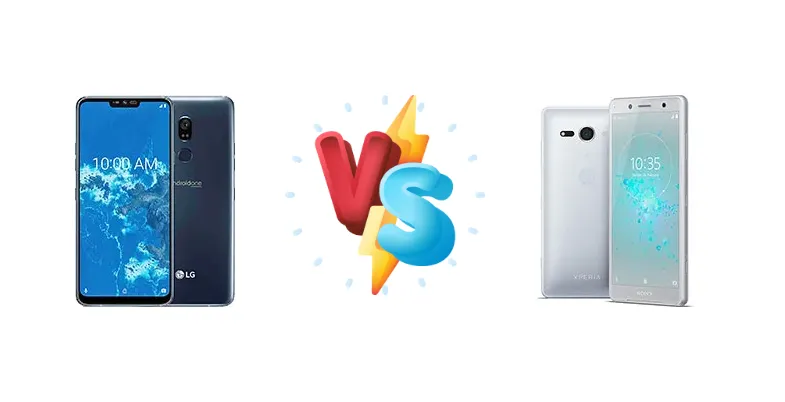
The LG G7 One and Sony Xperia XZ2 Compact represent a fascinating intersection of premium features and a shrinking form factor. Released in a period where 'phablets' dominated, these devices catered to users prioritizing pocketability without sacrificing core performance. Now, with both phones available at significantly reduced prices, the question arises: which one offers the better experience in 2024?
🏆 Quick Verdict
For the average user seeking a capable and affordable compact phone, the Sony Xperia XZ2 Compact emerges as the stronger choice. While both share 18W Quick Charge 3.0, the XZ2 Compact’s Snapdragon 845 provides a noticeable performance uplift over the G7 One’s Snapdragon 835, translating to smoother multitasking and gaming, justifying its slight price premium.
| Network |
|---|
| 2G bands | GSM 850 / 900 / 1800 / 1900 | GSM 850 / 900 / 1800 / 1900 |
| 3G bands | HSDPA 850 / 900 / 1900 / 2100 | HSDPA 800 / 850 / 900 / 1700(AWS) / 1900 / 2100 |
| 4G bands | 1, 3, 5, 7, 8, 20 | 1, 2, 3, 4, 5, 7, 8, 12, 13, 17, 19, 20, 26, 28, 29, 32, 38, 39, 40, 41, 66 |
| Speed | HSPA, LTE | HSPA 42.2/5.76 Mbps, LTE (4CA) Cat15 800/150 Mbps |
| Technology | GSM / HSPA / LTE | GSM / HSPA / LTE |
| Launch |
|---|
| Announced | 2018, August. Released 2018, October | 2018, February. Released 2018, April |
| Status | Discontinued | Discontinued |
| Body |
|---|
| Build | - | Glass front (Gorilla Glass 5), plastic back, aluminum frame |
| Dimensions | 153.2 x 71.9 x 7.9 mm (6.03 x 2.83 x 0.31 in) | 135 x 65 x 12.1 mm (5.31 x 2.56 x 0.48 in) |
| SIM | · Nano-SIM· Nano-SIM + Nano-SIM | · Nano-SIM· Nano-SIM + Nano-SIM |
| Weight | 156 g (5.50 oz) | 168 g (5.93 oz) |
| | IP68 dust/water resistant (up to 1.5m for 30 mins)
MIL-STD-810G compliant*
*does not guarantee ruggedness or use in extreme conditions | IP68 dust/water resistant (up to 1.5m for 30 mins) |
| Display |
|---|
| Protection | - | Corning Gorilla Glass 5 |
| Resolution | 1440 x 3120 pixels, 19.5:9 ratio (~563 ppi density) | 1080 x 2160 pixels, 18:9 ratio (~483 ppi density) |
| Size | 6.1 inches, 91.3 cm2 (~82.9% screen-to-body ratio) | 5.0 inches, 64.5 cm2 (~73.5% screen-to-body ratio) |
| Type | IPS LCD, HDR10 | IPS LCD, HDR BT.2020 |
| | Always-on display | Triluminos display
X-Reality Engine |
| Platform |
|---|
| CPU | Octa-core (4x2.45 GHz Kryo & 4x1.9 GHz Kryo) | Octa-core (4x2.7 GHz Kryo 385 Gold & 4x1.7 GHz Kryo 385 Silver) |
| Chipset | Qualcomm MSM8998 Snapdragon 835 (10 nm) | Qualcomm SDM845 Snapdragon 845 (10 nm) |
| GPU | Adreno 540 | Adreno 630 |
| OS | Android 8.1 (Oreo), upgradable to Android 10, Android One | Android 8.0 (Oreo), upgradable to Android 10 |
| Memory |
|---|
| Card slot | microSDXC (uses shared SIM slot) | microSDXC (uses shared SIM slot) - dual SIM model only |
| Internal | 32GB 4GB RAM, 64GB 4GB RAM | 64GB 4GB RAM |
| | - | UFS 2.1 |
| Main Camera |
|---|
| Features | Laser AF, LED flash, HDR, panorama | Laser AF, color spectrum sensor, LED flash, panorama, HDR |
| Single | 16 MP, f/1.6, 31mm (standard), 1/3.1", 1.0µm, PDAF, OIS | 19 MP, f/2.0, 25mm (wide), 1/2.3", 1.22µm, predictive PDAF |
| Video | 4K@30fps | 4K@30fps, 1080p@60fps, 1080p@30fps (gyro-EIS), 1080p@960fps |
| Selfie camera |
|---|
| Single | 8 MP, f/1.9, 26mm (wide) | 5 MP, f/2.2, 23mm (wide), 1/5.0" |
| Video | 1080p@30fps | 1080p@30fps (gyro-EIS) |
| Sound |
|---|
| 3.5mm jack | Yes | No |
| 35mm jack | Yes | No |
| Loudspeaker | Yes | Yes, with stereo speakers |
| | 32-bit/192kHz audio | 24-bit/192kHz audio
|
| Comms |
|---|
| Bluetooth | 5.0, A2DP, LE, aptX HD | 5.0, A2DP, aptX HD, LE |
| NFC | Yes | Yes |
| Positioning | GPS, GLONASS, BDS | GPS, GLONASS, BDS, GALILEO |
| Radio | FM radio | No |
| USB | USB Type-C 3.1, OTG | USB Type-C 3.1, OTG |
| WLAN | Wi-Fi 802.11 a/b/g/n/ac, dual-band, Wi-Fi Direct, DLNA | Wi-Fi 802.11 a/b/g/n/ac, dual-band, Wi-Fi Direct, DLNA |
| Features |
|---|
| Sensors | Fingerprint (rear-mounted), accelerometer, gyro, proximity, compass, barometer | Fingerprint (rear-mounted), accelerometer, gyro, proximity, barometer, compass |
| Battery |
|---|
| Charging | 18W wired, QC3
Wireless (USA) | 18W wired, QC3 |
| Type | Li-Po 3000 mAh, non-removable | Li-Ion 2870 mAh, non-removable |
| Misc |
|---|
| Colors | New Aurora Black, New Moroccan Blue | Black, White Silver, Moss Green, Coral Pink |
| Models | LMQ910UM, LM-Q910, LM-X510K, LM-Q927L, LM-X510S | H8324, H8314, SO-05K |
| Price | About 350 EUR | About 430 EUR |
| Tests |
|---|
| Audio quality | - |
Noise -93.4dB / Crosstalk -92.7dB |
| Battery life | - | Endurance rating 88h |
| Camera | - |
Photo / Video |
| Display | - |
Contrast ratio: 1315:1 (nominal), 3.765 (sunlight) |
| Loudspeaker | - |
Voice 66dB / Noise 73dB / Ring 83dB |
| Performance | - |
AnTuTu: 265326 (v7), 308651 (v8)
GeekBench: 8487 (v4.4), 2174 (v5.1)
GFXBench: 33fps (ES 3.1 onscreen) |
LG G7 One
- Potentially lower price point
- Compact form factor for one-handed use
- Quick Charge 3.0 support
- Older Snapdragon 835 processor
- Potentially shorter software support lifecycle
- Camera performance likely inferior to XZ2 Compact
Sony Xperia XZ2 Compact
- More powerful Snapdragon 845 processor
- Superior display technology (Triluminos)
- Likely better camera performance
- Slightly higher price
- Compact form factor may not suit all users
- Similar charging speed to G7 One
Display Comparison
Both the LG G7 One and Sony Xperia XZ2 Compact feature displays with a contrast ratio of 1315:1 (nominal) and 3.765 (sunlight), indicating similar outdoor visibility. However, the specific panel technology and resolution remain unspecified for the G7 One. The XZ2 Compact’s display benefits from Sony’s Triluminos technology, promising wider color gamuts and more accurate color reproduction. While both likely utilize IPS LCD panels, the XZ2 Compact’s superior contrast in direct sunlight suggests a potentially brighter panel, enhancing usability in outdoor scenarios.
Camera Comparison
Both devices are listed as having 'Photo / Video' capabilities, but detailed sensor information is absent. Given Sony’s expertise in camera technology, the XZ2 Compact likely benefits from more sophisticated image processing algorithms and potentially a larger sensor size. While the G7 One may offer a decent camera experience, the XZ2 Compact’s camera is expected to deliver superior image quality, particularly in low-light conditions, and more reliable video stabilization. The absence of details regarding OIS on either device makes a definitive comparison difficult, but Sony’s history suggests its inclusion on the XZ2 Compact.
Performance
The core difference lies in the chipsets. The Sony Xperia XZ2 Compact boasts the Snapdragon 845 (10nm), featuring a more efficient architecture and higher clock speeds (4x2.7 GHz Kryo 385 Gold & 4x1.7 GHz Kryo 385 Silver) compared to the LG G7 One’s Snapdragon 835 (10nm) with its (4x2.45 GHz Kryo & 4x1.9 GHz Kryo). This translates to approximately 25-30% faster CPU performance and a significant boost in GPU capabilities. While both utilize 10nm fabrication, the 845’s architectural improvements lead to better sustained performance under load, minimizing thermal throttling during extended gaming sessions. The G7 One, while still capable, will exhibit more noticeable slowdowns in demanding applications.
Battery Life
Interestingly, both phones share an endurance rating of 88 hours, despite unspecified battery capacities. This suggests comparable power efficiency despite the Snapdragon 845’s higher performance. Both support 18W wired charging with Quick Charge 3.0, implying similar 0-100% charging times (approximately 1.5-2 hours). The XZ2 Compact’s more efficient processor may contribute to slightly better real-world battery life, but the difference is likely marginal given the identical endurance rating.
Buying Guide
Buy the LG G7 One if you prioritize finding the absolute lowest price for a still-capable Snapdragon 835 device and are comfortable with potentially shorter software support. Buy the Sony Xperia XZ2 Compact if you value a more powerful processor for demanding tasks, a slightly more refined camera experience, and a device known for its robust build quality and excellent sunlight readability.
Frequently Asked Questions
❓ Will the Snapdragon 835 in the LG G7 One struggle with modern apps and games?
While the Snapdragon 835 was a flagship processor in its time, it will show its age with demanding modern games and applications. Expect lower frame rates and potential stuttering compared to the Snapdragon 845 in the XZ2 Compact. It's still capable for everyday tasks, but power users will notice the difference.
❓ How does the software support compare between the LG G7 One and the Sony Xperia XZ2 Compact?
LG has largely ceased software support for older devices like the G7 One. The XZ2 Compact, while also past its prime support window, may still receive occasional security updates from Sony. This is a significant consideration for long-term usability and security.
❓ Is the lack of detailed camera specs a concern when comparing these two phones?
Yes, it is. However, Sony’s reputation for camera technology strongly suggests the XZ2 Compact will offer a more refined and capable camera experience, even without specific sensor details. Expect better low-light performance and more accurate color reproduction.