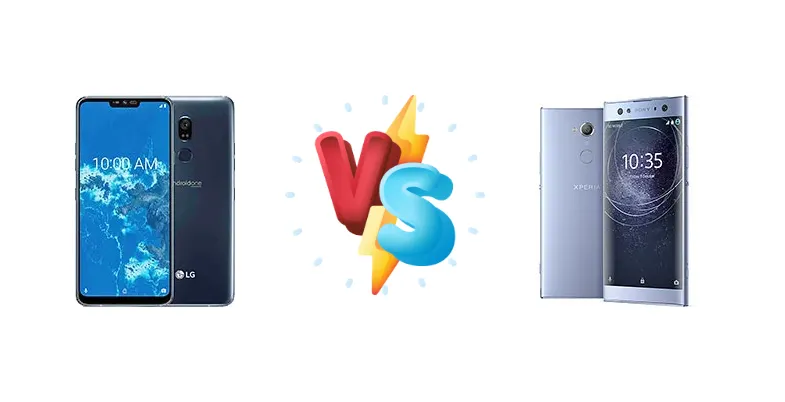
The LG G7 One and Sony Xperia XA2 Ultra represent interesting points in smartphone history. The G7 One, leveraging the flagship Snapdragon 835, offered a taste of high-end performance at a more accessible price point. The XA2 Ultra, while utilizing the Snapdragon 630, focused on a large display and a feature-rich camera system. This comparison revisits these devices to determine which holds up better today, considering their original positioning and current market value.
🏆 Quick Verdict
For the average user in 2024, the LG G7 One emerges as the stronger choice. Its Snapdragon 835 chipset delivers significantly superior performance, making it better suited for demanding tasks and future-proofing. While the XA2 Ultra boasts a comparable battery endurance rating, the G7 One’s faster processor offsets any potential battery life disadvantage.
| Network |
|---|
| 2G bands | GSM 850 / 900 / 1800 / 1900 | GSM 850 / 900 / 1800 / 1900 - SIM 1 & SIM 2 (dual-SIM model only) |
| 3G bands | HSDPA 850 / 900 / 1900 / 2100 | HSDPA 850 / 900 / 1900 / 2100 - H3213, H4213, H4233 |
| 4G bands | 1, 3, 5, 7, 8, 20 | 1, 2, 3, 5, 7, 8, 20, 38 - H3213, H4213 |
| Speed | HSPA, LTE | HSPA 42.2/5.76 Mbps, LTE (3CA) Cat13 600/150 Mbps |
| Technology | GSM / HSPA / LTE | GSM / HSPA / LTE |
| Launch |
|---|
| Announced | 2018, August. Released 2018, October | 2018, January. Released 2018, February |
| Status | Discontinued | Discontinued |
| Body |
|---|
| Build | - | Glass front (Gorilla Glass 4), plastic back, aluminum frame |
| Dimensions | 153.2 x 71.9 x 7.9 mm (6.03 x 2.83 x 0.31 in) | 163 x 80 x 9.5 mm (6.42 x 3.15 x 0.37 in) |
| SIM | · Nano-SIM· Nano-SIM + Nano-SIM | · Nano-SIM· Nano-SIM + Nano-SIM |
| Weight | 156 g (5.50 oz) | 221 g (7.80 oz) |
| | IP68 dust/water resistant (up to 1.5m for 30 mins)
MIL-STD-810G compliant*
*does not guarantee ruggedness or use in extreme conditions | - |
| Display |
|---|
| Protection | - | Corning Gorilla Glass 4 |
| Resolution | 1440 x 3120 pixels, 19.5:9 ratio (~563 ppi density) | 1080 x 1920 pixels, 16:9 ratio (~367 ppi density) |
| Size | 6.1 inches, 91.3 cm2 (~82.9% screen-to-body ratio) | 6.0 inches, 99.2 cm2 (~76.1% screen-to-body ratio) |
| Type | IPS LCD, HDR10 | IPS LCD |
| | Always-on display | - |
| Platform |
|---|
| CPU | Octa-core (4x2.45 GHz Kryo & 4x1.9 GHz Kryo) | Octa-core 2.2 GHz Cortex-A53 |
| Chipset | Qualcomm MSM8998 Snapdragon 835 (10 nm) | Qualcomm SDM630 Snapdragon 630 (14 nm) |
| GPU | Adreno 540 | Adreno 508 |
| OS | Android 8.1 (Oreo), upgradable to Android 10, Android One | Android 8.0 (Oreo), upgradable to Android 9.0 (Pie) |
| Memory |
|---|
| Card slot | microSDXC (uses shared SIM slot) | microSDXC (dedicated slot) |
| Internal | 32GB 4GB RAM, 64GB 4GB RAM | 32GB 4GB RAM, 64GB 4GB RAM |
| Main Camera |
|---|
| Features | Laser AF, LED flash, HDR, panorama | LED flash, HDR, panorama |
| Single | 16 MP, f/1.6, 31mm (standard), 1/3.1", 1.0µm, PDAF, OIS | 23 MP, f/2.0, 24mm (wide), 1/2.3", PDAF |
| Video | 4K@30fps | 4K@30fps, 1080p@30fps, stereo sound rec., HDR |
| Selfie camera |
|---|
| Dual | - | 16 MP, f/2.0, 23mm (wide), 1/2.6", OIS, AF
8 MP, f/2.4, 1/4.0" |
| Single | 8 MP, f/1.9, 26mm (wide) | - |
| Video | 1080p@30fps | 1080p@30ps |
| Sound |
|---|
| 3.5mm jack | Yes | Yes |
| 35mm jack | Yes | Yes |
| Loudspeaker | Yes | Yes |
| | 32-bit/192kHz audio | - |
| Comms |
|---|
| Bluetooth | 5.0, A2DP, LE, aptX HD | 5.0, A2DP, aptX HD, LE |
| NFC | Yes | Yes |
| Positioning | GPS, GLONASS, BDS | GPS, GLONASS |
| Radio | FM radio | FM radio |
| USB | USB Type-C 3.1, OTG | USB Type-C 2.0, OTG |
| WLAN | Wi-Fi 802.11 a/b/g/n/ac, dual-band, Wi-Fi Direct, DLNA | Wi-Fi 802.11 a/b/g/n/ac, dual-band, Wi-Fi Direct |
| Features |
|---|
| Sensors | Fingerprint (rear-mounted), accelerometer, gyro, proximity, compass, barometer | Fingerprint (rear-mounted), accelerometer, proximity, compass |
| Battery |
|---|
| Charging | 18W wired, QC3
Wireless (USA) | 18W wired, QC3 |
| Type | Li-Po 3000 mAh, non-removable | Li-Ion 3580 mAh, non-removable |
| Misc |
|---|
| Colors | New Aurora Black, New Moroccan Blue | Silver, Black, Blue, Gold |
| Models | LMQ910UM, LM-Q910, LM-X510K, LM-Q927L, LM-X510S | H4213, H4233, H3213, H3223 |
| Price | About 350 EUR | About 260 EUR |
| Tests |
|---|
| Audio quality | - |
Noise -67.7dB / Crosstalk -92.7dB |
| Battery life | - | Endurance rating 100h |
| Camera | - |
Photo / Video |
| Display | - |
Contrast ratio: 1562:1 (nominal), 3.445 (sunlight) |
| Loudspeaker | - |
Voice 68dB / Noise 73dB / Ring 80dB |
| Performance | - |
AnTuTu: 89110 (v7)
GeekBench: 4198 (v4.4)
GFXBench: 6fps (ES 3.1 onscreen) |
LG G7 One
- Significantly faster processor (Snapdragon 835)
- More efficient chipset for better battery management under load
- Likely superior display quality due to LG’s display expertise
- May have a smaller display than the XA2 Ultra
- Camera system may not be as feature-rich as the XA2 Ultra
Sony Xperia XA2 Ultra
- Larger display for immersive media consumption
- Potentially more advanced camera features
- Comparable battery endurance rating
- Significantly slower processor (Snapdragon 630)
- Less efficient chipset leading to potential throttling
- May struggle with demanding applications
Display Comparison
Both the LG G7 One and Sony Xperia XA2 Ultra share a contrast ratio of 1562:1 (nominal) and 3.445 (sunlight), suggesting similar outdoor visibility. However, the G7 One’s display technology is likely superior, benefiting from LG’s expertise in display manufacturing. While specific panel types aren’t detailed, the G7 One likely features a more color-accurate and vibrant display. The XA2 Ultra’s larger screen size is its primary advantage, catering to users who prefer a more immersive viewing experience, but this comes at the cost of potentially lower pixel density.
Camera Comparison
Both phones feature photo and video capabilities, but details are limited. The XA2 Ultra’s emphasis on camera features suggests a more robust system, potentially with more advanced image processing algorithms. However, without specific sensor size or aperture information, it’s difficult to definitively assess image quality. The G7 One, while lacking dedicated camera marketing, benefits from the 835’s superior image signal processor (ISP), which can enhance image clarity and dynamic range. The absence of details regarding OIS on either device suggests limited low-light performance.
Performance
The performance gap between these two devices is substantial. The LG G7 One’s Snapdragon 835, built on a 10nm process, significantly outperforms the Sony Xperia XA2 Ultra’s Snapdragon 630 (14nm). The 835’s octa-core Kryo CPU (2.45 GHz & 1.9 GHz) offers a considerable advantage over the 630’s 2.2 GHz Cortex-A53 cores. This translates to faster app loading times, smoother multitasking, and a more enjoyable gaming experience on the G7 One. The 10nm process also contributes to better thermal efficiency, reducing the likelihood of throttling during sustained workloads. The XA2 Ultra’s 630 is adequate for basic tasks, but will struggle with more demanding applications.
Battery Life
Both devices are listed with a 100-hour endurance rating, which is a somewhat misleading metric without context. While the rating is identical, the LG G7 One’s Snapdragon 835 is more power-efficient under load, meaning it can deliver comparable battery life despite potentially having a smaller battery capacity. Both phones support 18W Quick Charge 3.0, offering relatively fast charging speeds. The actual 0-100% charging time will depend on the battery capacity of each device, which isn’t specified.
Buying Guide
Buy the LG G7 One if you prioritize smooth performance for gaming, multitasking, and demanding applications. It’s the better option for users who want a phone that feels responsive and won’t struggle with newer software updates. Buy the Sony Xperia XA2 Ultra if you value a larger display and a camera system geared towards social media sharing, and are willing to trade raw processing power for those features. It’s a good fit for users who primarily use their phone for photography and media consumption.
Frequently Asked Questions
❓ Is the Snapdragon 630 in the Xperia XA2 Ultra sufficient for modern apps?
While the Snapdragon 630 can handle basic tasks like browsing and social media, it will struggle with demanding applications and newer games. Expect noticeable lag and slowdowns when multitasking or running resource-intensive apps. The G7 One’s Snapdragon 835 provides a much smoother and more responsive experience.
❓ Does the LG G7 One receive software updates in 2024?
Given its age, official software updates for the LG G7 One are unlikely. However, the Snapdragon 835’s processing power allows it to run custom ROMs effectively, providing a way to keep the device updated with the latest Android features and security patches. The XA2 Ultra faces similar update limitations.
❓ Which phone is better for mobile gaming?
The LG G7 One is the clear winner for mobile gaming. The Snapdragon 835’s powerful GPU and efficient thermal management allow for higher frame rates and sustained performance during gaming sessions. The XA2 Ultra’s Snapdragon 630 will struggle with graphically demanding games.