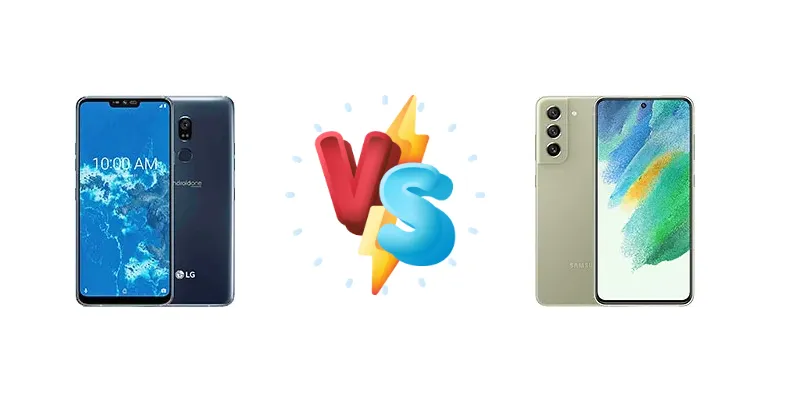
The LG G7 One, released in 2018, represented a compelling value proposition with its flagship Snapdragon 835 processor. Now, several years later, the Samsung Galaxy S21 FE 5G offers a more modern experience with the Snapdragon 888 (or Exynos 2100). This comparison dissects whether the S21 FE’s advancements justify the price difference for users seeking a balance of performance and affordability.
🏆 Quick Verdict
For most users, the Samsung Galaxy S21 FE 5G is the superior choice. While the LG G7 One remains a capable device, the S21 FE’s significantly faster Snapdragon 888 (or Exynos 2100) chipset, brighter display, and modern features like 25W fast charging and wireless charging provide a more compelling overall experience.
| Network |
|---|
| 2G bands | GSM 850 / 900 / 1800 / 1900 | GSM 850 / 900 / 1800 / 1900 |
| 3G bands | HSDPA 850 / 900 / 1900 / 2100 | HSDPA 850 / 900 / 1700(AWS) / 1900 / 2100 |
| 4G bands | 1, 3, 5, 7, 8, 20 | 1, 2, 3, 4, 5, 7, 8, 12, 17, 20, 26, 28, 32, 38, 40, 41, 66 - International |
| 5G bands | - | 1, 3, 5, 8, 20, 28, 38, 40, 41, 66, 78 SA/NSA/Sub6 - International |
| Speed | HSPA, LTE | HSPA 42.2/5.76 Mbps, LTE (5CA) Cat19 1600/200 Mbps, 5G |
| Technology | GSM / HSPA / LTE | GSM / CDMA / HSPA / EVDO / LTE / 5G |
| | - | 41, 66, 71, 260, 261 SA/NSA/Sub6/mmWave - USA |
| Launch |
|---|
| Announced | 2018, August. Released 2018, October | 2022, January 04 |
| Status | Discontinued | Available. Released 2022, January 07 |
| Body |
|---|
| Build | - | Glass front (Gorilla Glass Victus), plastic back, aluminum frame |
| Dimensions | 153.2 x 71.9 x 7.9 mm (6.03 x 2.83 x 0.31 in) | 155.7 x 74.5 x 7.9 mm (6.13 x 2.93 x 0.31 in) |
| SIM | · Nano-SIM· Nano-SIM + Nano-SIM | · Nano-SIM· Nano-SIM + Nano-SIM |
| Weight | 156 g (5.50 oz) | 177 g (6.24 oz) |
| | IP68 dust/water resistant (up to 1.5m for 30 mins)
MIL-STD-810G compliant*
*does not guarantee ruggedness or use in extreme conditions | IP68 dust/water resistant (up to 1.5m for 30 min) |
| Display |
|---|
| Protection | - | Corning Gorilla Glass Victus |
| Resolution | 1440 x 3120 pixels, 19.5:9 ratio (~563 ppi density) | 1080 x 2340 pixels, 19.5:9 ratio (~403 ppi density) |
| Size | 6.1 inches, 91.3 cm2 (~82.9% screen-to-body ratio) | 6.4 inches, 100.5 cm2 (~86.7% screen-to-body ratio) |
| Type | IPS LCD, HDR10 | Dynamic AMOLED 2X, 120Hz, HDR10+ |
| | Always-on display | Always-on display |
| Platform |
|---|
| CPU | Octa-core (4x2.45 GHz Kryo & 4x1.9 GHz Kryo) | Octa-core (1x2.84 GHz Cortex-X1 & 3x2.42 GHz Cortex-A78 & 4x1.80 GHz Cortex-A55) - Version 1Octa-core (1x2.9 GHz Cortex-X1 & 3x2.80 GHz Cortex-A78 & 4x2.2 GHz Cortex-A55) - Version 2 |
| Chipset | Qualcomm MSM8998 Snapdragon 835 (10 nm) | Qualcomm SM8350 Snapdragon 888 5G (5 nm) - Version 1Exynos 2100 (5 nm) - Version 2 |
| GPU | Adreno 540 | Adreno 660 - Version 1Mali-G78 MP14 - Version 2 |
| OS | Android 8.1 (Oreo), upgradable to Android 10, Android One | Android 12, up to 4 major Android upgrades, One UI 8 |
| Memory |
|---|
| Card slot | microSDXC (uses shared SIM slot) | No |
| Internal | 32GB 4GB RAM, 64GB 4GB RAM | 128GB 6GB RAM, 128GB 8GB RAM, 256GB 6GB RAM, 256GB 8GB RAM |
| Main Camera |
|---|
| Features | Laser AF, LED flash, HDR, panorama | LED flash, auto-HDR, panorama |
| Single | 16 MP, f/1.6, 31mm (standard), 1/3.1", 1.0µm, PDAF, OIS | 32 MP, f/2.2, 26mm (wide), 1/2.74", 0.8µm |
| Triple | - | 12 MP, f/1.8, 26mm (wide), 1/1.76", 1.8µm, dual pixel PDAF, OIS
8 MP, f/2.4, 76mm (telephoto), 1/4.5", 1.0µm, PDAF, OIS, 3x optical zoom
12 MP, f/2.2, 13mm, 123˚ (ultrawide), 1/3.0", 1.12µm |
| Video | 4K@30fps | 4K@30/60fps, 1080p@30/60/120/240fps, HDR10+, gyro-EIS |
| Selfie camera |
|---|
| Features | - | HDR |
| Single | 8 MP, f/1.9, 26mm (wide) | 32 MP, f/2.2, 26mm (wide), 1/2.74", 0.8µm |
| Video | 1080p@30fps | 4K@30/60fps, 1080p@30/60fps, gyro-EIS |
| Sound |
|---|
| 3.5mm jack | Yes | No |
| 35mm jack | Yes | No |
| Loudspeaker | Yes | Yes, with stereo speakers |
| | 32-bit/192kHz audio | 32-bit/384kHz audio |
| Comms |
|---|
| Bluetooth | 5.0, A2DP, LE, aptX HD | 5.0, A2DP, LE |
| NFC | Yes | Yes |
| Positioning | GPS, GLONASS, BDS | GPS, GLONASS, BDS, GALILEO |
| Radio | FM radio | Unspecified |
| USB | USB Type-C 3.1, OTG | USB Type-C, OTG |
| WLAN | Wi-Fi 802.11 a/b/g/n/ac, dual-band, Wi-Fi Direct, DLNA | Wi-Fi 802.11 a/b/g/n/ac/6, dual-band, Wi-Fi Direct |
| Features |
|---|
| Sensors | Fingerprint (rear-mounted), accelerometer, gyro, proximity, compass, barometer | Fingerprint (under display, optical), accelerometer, gyro, proximity, compass |
| | - | Bixby natural language commands and dictation
Samsung Pay (Visa, MasterCard certified)
Samsung DeX (desktop experience support) |
| Battery |
|---|
| Charging | 18W wired, QC3
Wireless (USA) | 25W wired, PD3.0, 50% in 30 min
15W wireless
Reverse wireless |
| Type | Li-Po 3000 mAh, non-removable | Li-Ion 4500 mAh |
| Misc |
|---|
| Colors | New Aurora Black, New Moroccan Blue | White, Graphite, Lavender, Olive |
| Models | LMQ910UM, LM-Q910, LM-X510K, LM-Q927L, LM-X510S | SM-G990B, SM-G990B/DS, SM-G990U, SM-G990U1, SM-G990W, SM-G990E, SM-G9900, SM-G990B2, SM-G990U2, SM-G990W2, SM-G990U3 |
| Price | About 350 EUR | € 199.00 / $ 143.95 / £ 154.99 / ₹ 29,990 |
| SAR | - | 0.77 W/kg (head) 0.90 W/kg (body) |
| SAR EU | - | 0.95 W/kg (head) 1.48 W/kg (body) |
| Tests |
|---|
| Battery life | - |
Endurance rating 92h
|
| Camera | - |
Photo / Video |
| Display | - |
Contrast ratio: Infinite (nominal) |
| Loudspeaker | - |
-26.9 LUFS (Good)
|
| Performance | - |
AnTuTu: 566529 (v8), 719696 (v9)
GeekBench: 3049 (v5.1)
GFXBench: 56fps (ES 3.1 onscreen) |
LG G7 One
- More compact form factor
- Potentially lower price point
- Less prone to thermal throttling under light loads
- Significantly slower processor
- Outdated display technology
- Slower charging speeds and no wireless charging
Samsung Galaxy S21 FE 5G
- Much faster processor (Snapdragon 888 or Exynos 2100)
- Brighter and more vibrant display
- Faster charging and wireless charging support
- Potential for thermal throttling under heavy load
- Larger and heavier design
- May be more expensive
Display Comparison
The Samsung Galaxy S21 FE 5G boasts a notably brighter display, reaching a measured 792 nits, compared to the LG G7 One’s unspecified peak brightness. This difference translates to significantly better outdoor visibility. While both likely utilize AMOLED technology (based on brand history), the S21 FE’s higher brightness and 'Infinite' contrast ratio suggest a more visually immersive experience. The S21 FE also benefits from a more modern display controller, potentially offering improved color accuracy and power efficiency, though specific panel characteristics like PWM dimming frequency are not provided.
Camera Comparison
Both devices offer photo and video capabilities, but the S21 FE likely holds a significant advantage. While specific sensor details are missing, Samsung’s image processing algorithms and potentially larger sensor size (based on market trends) contribute to superior image quality, particularly in low-light conditions. The G7 One’s camera system, while competent for its time, lacks the advanced features and computational photography capabilities of the S21 FE. The S21 FE’s camera system is likely to offer more versatile shooting modes and better video stabilization. The presence of a 2MP macro camera on the G7 One is likely a marketing gimmick, offering limited practical benefit compared to the S21 FE’s more sophisticated camera setup.
Performance
The core difference lies in the chipsets. The LG G7 One’s Snapdragon 835, built on a 10nm process, features an octa-core CPU configuration with Kryo cores peaking at 2.45 GHz. The Samsung Galaxy S21 FE 5G, however, utilizes either the Snapdragon 888 (5nm) or the Exynos 2100 (5nm). The move to a 5nm process node is crucial, offering substantial gains in power efficiency and transistor density. The Snapdragon 888’s Cortex-X1 prime core, clocked up to 2.84 GHz (or 2.9 GHz in Version 2), provides a significant performance uplift over the G7 One’s Kryo cores. This translates to faster app loading times, smoother multitasking, and a more responsive user experience. The S21 FE’s LPDDR5 RAM (spec not provided for G7 One, likely LPDDR4) further enhances performance. However, the Snapdragon 888 is known for potential thermal throttling under sustained load, a concern less prevalent with the G7 One’s older, less powerful chip.
Battery Life
The Samsung Galaxy S21 FE 5G achieves an Endurance rating of 92 hours, indicating solid battery life. While the LG G7 One’s battery capacity is unknown, the S21 FE’s 25W wired charging with PD3.0 support (50% in 30 minutes) and 15W wireless charging provide a significant convenience advantage. The G7 One’s 18W QC3 charging is slower, and the lack of wireless charging limits its versatility. The 5nm process of the S21 FE’s chipset also contributes to improved power efficiency, potentially offsetting the impact of a higher-resolution display and faster processor.
Buying Guide
Buy the LG G7 One if you prioritize a compact form factor and are on an extremely tight budget, needing a functional smartphone with a decent processor for basic tasks. Buy the Samsung Galaxy S21 FE 5G if you demand significantly faster performance for gaming and demanding applications, a brighter and more vibrant display, and the convenience of modern features like wireless charging and a more versatile camera system.
Frequently Asked Questions
❓ Does the Snapdragon 888 in the S21 FE overheat during prolonged gaming sessions?
The Snapdragon 888 is known to generate more heat than previous generations, potentially leading to thermal throttling during extended gaming. However, Samsung implemented thermal management solutions, and the severity of throttling varies depending on the game and ambient temperature. The G7 One's Snapdragon 835 will likely maintain cooler temperatures, but at the cost of significantly lower performance.
❓ Is the Exynos 2100 version of the S21 FE significantly worse than the Snapdragon 888 version?
Historically, Exynos chips have lagged behind their Snapdragon counterparts in terms of performance and efficiency. While the Exynos 2100 is a capable processor, the Snapdragon 888 generally offers slightly better performance and thermal management. However, the difference is often not substantial enough to be a deal-breaker for most users.
❓ How does the LG G7 One hold up for everyday tasks like browsing and social media in 2024?
The LG G7 One is still perfectly capable of handling everyday tasks like browsing, social media, and messaging. However, you may notice slower app loading times and less responsiveness compared to newer devices like the S21 FE. The older processor and potentially less RAM will become noticeable when multitasking or running demanding applications.