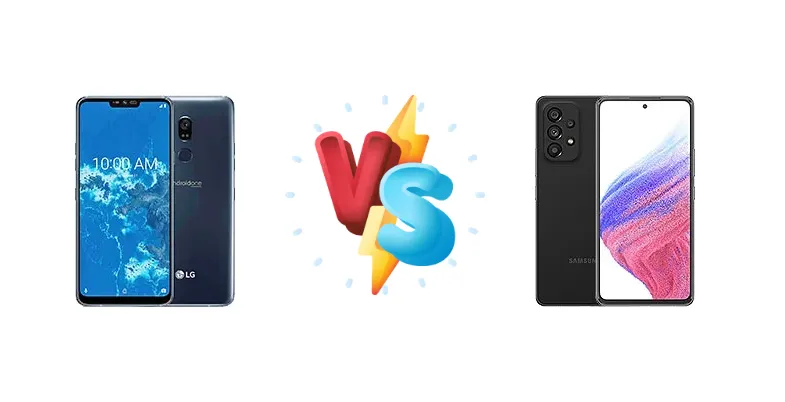
The LG G7 One, a late-era flagship offering, now finds itself competing with newer mid-range devices like the Samsung Galaxy A53 5G. This comparison examines whether the G7 One’s older, but powerful, Snapdragon 835 can still hold its own against the more modern, efficiency-focused Exynos 1280, and how these differences translate to real-world user experience.
🏆 Quick Verdict
For the average user in 2024, the Samsung Galaxy A53 5G is the better choice. While the LG G7 One boasts a more powerful processor on paper, the A53 5G’s superior battery efficiency, brighter display, and continued software support offer a more balanced and future-proof experience.
| Network |
|---|
| 2G bands | GSM 850 / 900 / 1800 / 1900 | GSM 850 / 900 / 1800 / 1900 |
| 3G bands | HSDPA 850 / 900 / 1900 / 2100 | HSDPA 850 / 900 / 1700(AWS) / 1900 / 2100 |
| 4G bands | 1, 3, 5, 7, 8, 20 | 1, 2, 3, 4, 5, 7, 12, 14, 20, 29, 30, 38, 39, 40, 41, 46, 48, 66 - SM-A536U |
| 5G bands | - | 2, 5, 41, 66, 77, 78 SA/NSA/Sub6/mmWave - SM-A536U |
| Speed | HSPA, LTE | HSPA, LTE, 5G |
| Technology | GSM / HSPA / LTE | GSM / HSPA / LTE / 5G |
| | - | 2, 5, 48, 66, 77, 78, 260, 261 SA/NSA/Sub6/mmWave - SM-A536V |
| Launch |
|---|
| Announced | 2018, August. Released 2018, October | 2022, March 17 |
| Status | Discontinued | Available. Released 2022, March 24 |
| Body |
|---|
| Build | - | Glass front (Gorilla Glass 5), plastic frame, plastic back |
| Dimensions | 153.2 x 71.9 x 7.9 mm (6.03 x 2.83 x 0.31 in) | 159.6 x 74.8 x 8.1 mm (6.28 x 2.94 x 0.32 in) |
| SIM | · Nano-SIM· Nano-SIM + Nano-SIM | · Nano-SIM· Nano-SIM + Nano-SIM |
| Weight | 156 g (5.50 oz) | 189 g (6.67 oz) |
| | IP68 dust/water resistant (up to 1.5m for 30 mins)
MIL-STD-810G compliant*
*does not guarantee ruggedness or use in extreme conditions | IP67 dust/water resistant (up to 1m for 30 min) |
| Display |
|---|
| Protection | - | Corning Gorilla Glass 5 |
| Resolution | 1440 x 3120 pixels, 19.5:9 ratio (~563 ppi density) | 1080 x 2400 pixels, 20:9 ratio (~405 ppi density) |
| Size | 6.1 inches, 91.3 cm2 (~82.9% screen-to-body ratio) | 6.5 inches, 102.0 cm2 (~85.4% screen-to-body ratio) |
| Type | IPS LCD, HDR10 | Super AMOLED, 120Hz, 800 nits (HBM) |
| | Always-on display | - |
| Platform |
|---|
| CPU | Octa-core (4x2.45 GHz Kryo & 4x1.9 GHz Kryo) | Octa-core (2x2.4 GHz Cortex-A78 & 6x2.0 GHz Cortex-A55) |
| Chipset | Qualcomm MSM8998 Snapdragon 835 (10 nm) | Exynos 1280 (5 nm) |
| GPU | Adreno 540 | Mali-G68 |
| OS | Android 8.1 (Oreo), upgradable to Android 10, Android One | Android 12, up to 4 major Android upgrades, One UI 8 |
| Memory |
|---|
| Card slot | microSDXC (uses shared SIM slot) | microSDXC (uses shared SIM slot) |
| Internal | 32GB 4GB RAM, 64GB 4GB RAM | 128GB 4GB RAM, 128GB 6GB RAM, 128GB 8GB RAM, 256GB 6GB RAM, 256GB 8GB RAM |
| Main Camera |
|---|
| Features | Laser AF, LED flash, HDR, panorama | LED flash, panorama, HDR |
| Quad | - | 64 MP, f/1.8, 26mm (wide), 1/1.7X", 0.8µm, PDAF, OIS
12 MP, f/2.2, 123˚ (ultrawide), 1.12µm
5 MP (macro)
Auxiliary lens |
| Single | 16 MP, f/1.6, 31mm (standard), 1/3.1", 1.0µm, PDAF, OIS | 32 MP, f/2.2, 26mm (wide), 1/2.8", 0.8µm |
| Video | 4K@30fps | 4K@30fps, 1080p@30/60fps; gyro-EIS |
| Selfie camera |
|---|
| Features | - | HDR |
| Single | 8 MP, f/1.9, 26mm (wide) | 32 MP, f/2.2, 26mm (wide), 1/2.8", 0.8µm |
| Video | 1080p@30fps | 4K@30fps, 1080p@30fps |
| Sound |
|---|
| 3.5mm jack | Yes | No |
| 35mm jack | Yes | No |
| Loudspeaker | Yes | Yes, with stereo speakers |
| | 32-bit/192kHz audio | - |
| Comms |
|---|
| Bluetooth | 5.0, A2DP, LE, aptX HD | 5.1, A2DP, LE |
| NFC | Yes | Yes (market/region dependent) |
| Positioning | GPS, GLONASS, BDS | GPS, GLONASS, GALILEO, BDS |
| Radio | FM radio | No |
| USB | USB Type-C 3.1, OTG | USB Type-C 2.0, OTG |
| WLAN | Wi-Fi 802.11 a/b/g/n/ac, dual-band, Wi-Fi Direct, DLNA | Wi-Fi 802.11 a/b/g/n/ac, dual-band, Wi-Fi Direct |
| Features |
|---|
| Sensors | Fingerprint (rear-mounted), accelerometer, gyro, proximity, compass, barometer | Fingerprint (under display, optical), accelerometer, gyro, compass, barometer (market/region dependent) |
| | - | Virtual proximity sensing |
| Battery |
|---|
| Charging | 18W wired, QC3
Wireless (USA) | 25W wired |
| Type | Li-Po 3000 mAh, non-removable | Li-Po 5000 mAh |
| Misc |
|---|
| Colors | New Aurora Black, New Moroccan Blue | Black, White, Blue, Peach |
| Models | LMQ910UM, LM-Q910, LM-X510K, LM-Q927L, LM-X510S | SM-A536B, SM-A536B/DS, SM-A536U, SM-A536U1, SM-A5360, SM-A536E, SM-A536E/DS, SM-A536V, SM-A536W, SM-A536N, SM-S536DL |
| Price | About 350 EUR | $ 151.42 / £ 185.00 / € 169.14 |
| SAR | - | 0.75 W/kg (head) 1.58 W/kg (body) |
| SAR EU | - | 0.89 W/kg (head) 1.60 W/kg (body) |
| Tests |
|---|
| Battery life | - |
Endurance rating 113h
|
| Camera | - |
Photo / Video |
| Display | - |
Contrast ratio: Infinite (nominal) |
| Loudspeaker | - |
-26.5 LUFS (Good)
|
| Performance | - |
AnTuTu: 329802 (v8), 379313 (v9)
GeekBench: 1891 (v5.1)
GFXBench: 19fps (ES 3.1 onscreen) |
LG G7 One
- Potentially higher peak CPU performance for demanding tasks.
- May be available at a significantly lower price point.
- Compact form factor (likely, based on LG's historical designs).
- Less efficient processor leading to shorter battery life.
- Limited software update support.
- Older technology and potentially outdated features.
Samsung Galaxy A53 5G
- Superior battery life and efficiency.
- Brighter and more vibrant display.
- Continued software support and updates.
- Faster charging speeds.
- Less powerful processor compared to the Snapdragon 835 (on paper).
- May be slightly more expensive than the LG G7 One.
Display Comparison
The Samsung Galaxy A53 5G’s display is a clear winner here, boasting a measured peak brightness of 830 nits compared to the LG G7 One’s unspecified brightness. This higher brightness translates to significantly better outdoor visibility. While the LG G7 One’s panel quality is likely good for its time, the A53 5G’s 'Infinite' contrast ratio (nominal) suggests a superior viewing experience with deeper blacks. The A53 5G also benefits from a larger display size, offering more screen real estate for media consumption and multitasking.
Camera Comparison
Both devices offer photo and video capabilities, but detailed sensor information for the LG G7 One is unavailable. The Samsung Galaxy A53 5G likely features a more advanced image processing pipeline and potentially a larger main sensor, leading to better image quality in various lighting conditions. The A53 5G’s camera system is designed for modern computational photography techniques, offering features like scene optimization and improved low-light performance. The LG G7 One, being an older device, will likely lack these advancements.
Performance
On paper, the LG G7 One’s Snapdragon 835 (Octa-core, 2.45 GHz Kryo) appears to outperform the Samsung Galaxy A53 5G’s Exynos 1280 (Octa-core, 2.4 GHz Cortex-A78). However, the Exynos 1280 is built on a more efficient 5nm process compared to the Snapdragon 835’s 10nm node. This means the A53 5G will likely exhibit better thermal management and sustained performance under load, reducing the risk of throttling during extended gaming sessions. The A53 5G’s Cortex-A78 cores offer a modern architecture that, while clocked slightly lower, provides competitive performance in everyday tasks and many games.
Battery Life
The Samsung Galaxy A53 5G boasts an endurance rating of 113 hours, indicating excellent battery life. While the LG G7 One’s battery capacity is unknown, the Snapdragon 835’s less efficient 10nm process will likely result in shorter battery life compared to the A53 5G. The A53 5G also supports 25W wired charging, allowing for faster top-ups than the LG G7 One’s 18W QC3 charging. This faster charging speed is a significant convenience factor for users who need to quickly replenish their battery.
Buying Guide
Buy the LG G7 One if you prioritize raw processing power for demanding applications and don't mind potentially shorter battery life and limited software updates. It's a good option for those who can find it at a significantly lower price. Buy the Samsung Galaxy A53 5G if you value all-day battery life, a vibrant and easily visible display, and the peace of mind that comes with a more modern device and ongoing software support.
Frequently Asked Questions
❓ Does the Exynos 1280 in the Galaxy A53 5G overheat during prolonged gaming sessions?
The Exynos 1280’s 5nm process and efficient architecture significantly reduce the risk of overheating. While some throttling may occur during extremely demanding games, it’s unlikely to be a major issue, and the phone is designed to manage heat effectively, providing sustained performance over longer periods.
❓ Is the LG G7 One still a viable option for mobile gaming in 2024?
The Snapdragon 835 is still a capable processor, but its age and less efficient design mean it's prone to throttling under sustained load. While it can handle many games, you may experience frame drops or reduced performance in graphically intensive titles compared to the A53 5G.
❓ How does the software support compare between these two devices?
The Samsung Galaxy A53 5G will continue to receive software updates and security patches for several years, ensuring a secure and up-to-date user experience. The LG G7 One, however, has likely reached the end of its software support lifecycle, leaving it vulnerable to security risks and lacking new features.
❓ What kind of charging speeds can I expect with each phone?
The Samsung Galaxy A53 5G supports 25W wired charging, allowing for a relatively quick top-up. The LG G7 One supports 18W wired charging with Quick Charge 3.0, which is slower and may require a compatible charger to achieve optimal speeds.