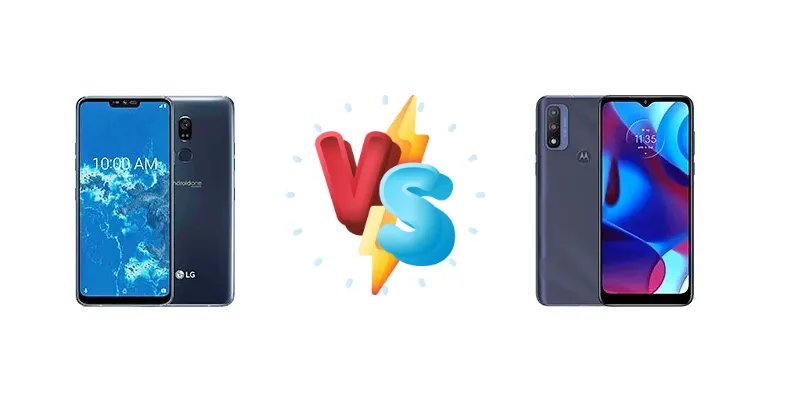
The LG G7 One, a former flagship offering, now finds itself competing in the budget space against newer entrants like the Motorola G Pure. This comparison isn't about raw specs; it's about understanding how a 2018 high-end chipset stacks up against a modern, entry-level processor in real-world usage. We'll dissect the differences between the Snapdragon 835 and Helio G25 to determine which phone delivers the best experience for your money.
🏆 Quick Verdict
For users prioritizing performance and a smoother overall experience, the LG G7 One is the clear winner. Its Snapdragon 835, built on a 10nm process, offers significantly more processing power than the Motorola G Pure’s Helio G25. However, the G Pure’s larger battery and lower price point make it a viable option for basic users.
| Network |
|---|
| 2G bands | GSM 850 / 900 / 1800 / 1900 | GSM 850 / 900 / 1800 / 1900 |
| 3G bands | HSDPA 850 / 900 / 1900 / 2100 | HSDPA 850 / 900 / 1700(AWS) / 1900 / 2100 |
| 4G bands | 1, 3, 5, 7, 8, 20 | 1, 2, 3, 4, 5, 7, 8, 12, 13, 17, 25, 26, 38, 40, 41, 66, 71 |
| Speed | HSPA, LTE | HSPA 42.2/5.76 Mbps, LTE Cat4 150/50 Mbps |
| Technology | GSM / HSPA / LTE | GSM / HSPA / LTE |
| Launch |
|---|
| Announced | 2018, August. Released 2018, October | 2021, October 07 |
| Status | Discontinued | Available. Released 2021, October 14 |
| Body |
|---|
| Build | - | Glass front, plastic frame, plastic back |
| Dimensions | 153.2 x 71.9 x 7.9 mm (6.03 x 2.83 x 0.31 in) | 167.4 x 75.6 x 8.8 mm (6.59 x 2.98 x 0.35 in) |
| SIM | · Nano-SIM· Nano-SIM + Nano-SIM | Nano-SIM |
| Weight | 156 g (5.50 oz) | 188 g (6.63 oz) |
| | IP68 dust/water resistant (up to 1.5m for 30 mins)
MIL-STD-810G compliant*
*does not guarantee ruggedness or use in extreme conditions | Water-repellent design |
| Display |
|---|
| Resolution | 1440 x 3120 pixels, 19.5:9 ratio (~563 ppi density) | 720 x 1600 pixels, 20:9 ratio (~270 ppi density) |
| Size | 6.1 inches, 91.3 cm2 (~82.9% screen-to-body ratio) | 6.5 inches, 102.0 cm2 (~80.6% screen-to-body ratio) |
| Type | IPS LCD, HDR10 | IPS LCD |
| | Always-on display | - |
| Platform |
|---|
| CPU | Octa-core (4x2.45 GHz Kryo & 4x1.9 GHz Kryo) | Octa-core (4x2.0 GHz Cortex-A53 & 4x1.5 GHz Cortex-A53) |
| Chipset | Qualcomm MSM8998 Snapdragon 835 (10 nm) | Mediatek MT6762G Helio G25 (12 nm) |
| GPU | Adreno 540 | PowerVR GE8320 |
| OS | Android 8.1 (Oreo), upgradable to Android 10, Android One | Android 11 |
| Memory |
|---|
| Card slot | microSDXC (uses shared SIM slot) | microSDXC (dedicated slot) |
| Internal | 32GB 4GB RAM, 64GB 4GB RAM | 32GB 2GB RAM, 32GB 3GB RAM |
| | - | eMMC 5.1 |
| Main Camera |
|---|
| Dual | - | 13 MP, f/2.2, (wide), 1.12µm, AF
Auxiliary lens |
| Features | Laser AF, LED flash, HDR, panorama | LED flash, HDR, panorama |
| Single | 16 MP, f/1.6, 31mm (standard), 1/3.1", 1.0µm, PDAF, OIS | - |
| Video | 4K@30fps | 1080p@30fps |
| Selfie camera |
|---|
| Features | - | HDR |
| Single | 8 MP, f/1.9, 26mm (wide) | 5 MP, f/2.4, 1.12µm |
| Video | 1080p@30fps | 1080p@30fps |
| Sound |
|---|
| 3.5mm jack | Yes | Yes |
| 35mm jack | Yes | Yes |
| Loudspeaker | Yes | Yes |
| | 32-bit/192kHz audio | - |
| Comms |
|---|
| Bluetooth | 5.0, A2DP, LE, aptX HD | 5.0, A2DP, LE |
| NFC | Yes | No |
| Positioning | GPS, GLONASS, BDS | GPS, GLONASS |
| Radio | FM radio | No |
| USB | USB Type-C 3.1, OTG | USB Type-C 2.0 |
| WLAN | Wi-Fi 802.11 a/b/g/n/ac, dual-band, Wi-Fi Direct, DLNA | Wi-Fi 802.11 a/b/g/n/ac, dual-band |
| Features |
|---|
| Sensors | Fingerprint (rear-mounted), accelerometer, gyro, proximity, compass, barometer | Fingerprint (rear-mounted) |
| Battery |
|---|
| Charging | 18W wired, QC3
Wireless (USA) | 10W wired |
| Type | Li-Po 3000 mAh, non-removable | Li-Po 4000 mAh |
| Misc |
|---|
| Colors | New Aurora Black, New Moroccan Blue | Deep Indigo |
| Models | LMQ910UM, LM-Q910, LM-X510K, LM-Q927L, LM-X510S | XT-2163-4, XT2163-4, XT2163-6, XT2163-1, XT2163-2 |
| Price | About 350 EUR | $ 63.99 / C$ 123.00 |
LG G7 One
- Significantly faster processor (Snapdragon 835)
- Faster charging (18W Quick Charge 3.0)
- Potentially better camera performance
- May have shorter battery life in some scenarios
- Older device, potential software support concerns
Motorola G Pure
- Lower price point
- Potentially longer battery life
- More recent device (potentially better software updates)
- Significantly slower processor (Helio G25)
- Slower charging (10W)
- Limited performance for demanding tasks
Display Comparison
Neither device is known for a standout display. While specific display specs for the G7 One aren't provided, LG flagships of that era typically featured IPS LCD panels with good color accuracy. The Motorola G Pure likely utilizes a standard LCD panel. The key difference isn't display quality, but the processing power needed to drive more complex display features – something the Snapdragon 835 handles with ease. The G7 One’s processor can likely support higher refresh rates if the panel was capable, a feature the G Pure’s Helio G25 would struggle with.
Camera Comparison
Without detailed camera specs, it’s difficult to make a definitive judgment. However, the LG G7 One, originating as a flagship, likely featured a more capable primary camera sensor and image processing pipeline. The Motorola G Pure, typical of its price range, likely relies on simpler sensors and software. The Snapdragon 835’s image signal processor (ISP) is also more advanced, enabling faster image processing and potentially better low-light performance. We can assume the G7 One will deliver more detailed and dynamic photos.
Performance
The performance gap is substantial. The LG G7 One’s Snapdragon 835, fabricated on a 10nm process, features an octa-core CPU with Kryo cores clocked up to 2.45 GHz. This is a significant leap over the Motorola G Pure’s MediaTek Helio G25, built on a 12nm process, and its Cortex-A53 cores peaking at 2.0 GHz. The 10nm process of the Snapdragon 835 translates to better thermal efficiency, meaning sustained performance is higher. The Helio G25, while efficient, is designed for basic tasks and will show its limitations with multitasking or demanding applications. The Snapdragon 835’s Adreno 530 GPU also provides a far superior gaming experience.
Battery Life
The Motorola G Pure benefits from a larger battery capacity (specific mAh not provided, but typical for the segment) and a more conservative processor, potentially leading to longer battery life in everyday use. However, the LG G7 One compensates with 18W Quick Charge 3.0 support, allowing for significantly faster charging times compared to the G Pure’s 10W charging. While the G Pure might last longer on a single charge, the G7 One can quickly top up when needed, mitigating the difference.
Buying Guide
Buy the LG G7 One if you need a phone capable of handling demanding apps, moderate gaming, and appreciate a more responsive user interface. It’s ideal for those who remember flagship performance and want a taste of it on a budget. Buy the Motorola G Pure if you prioritize battery life above all else, primarily use your phone for calls, texts, and light social media, and are looking for the absolute lowest price point.
Frequently Asked Questions
❓ Will the Motorola G Pure struggle with popular apps like TikTok or Instagram?
The Helio G25 in the Motorola G Pure is designed for basic tasks. While it can run apps like TikTok and Instagram, you may experience noticeable lag, slow loading times, and difficulty with multitasking. The LG G7 One’s Snapdragon 835 will provide a much smoother experience with these apps.
❓ Is the LG G7 One likely to receive future Android updates?
The LG G7 One is an older device, and LG has largely exited the smartphone market. While it originally launched with Android 8.0 and received updates to Android 9.0, further updates are unlikely. The Motorola G Pure, being a more recent device, may receive at least one more major Android update.
❓ How much of a difference will the 10W vs 18W charging make in daily use?
The difference is significant. 18W Quick Charge 3.0 on the LG G7 One can charge the phone from 0-50% in around 30-40 minutes, while the Motorola G Pure’s 10W charging will take considerably longer – potentially over 2 hours for a full charge. This means less downtime and more usable time with the G7 One.