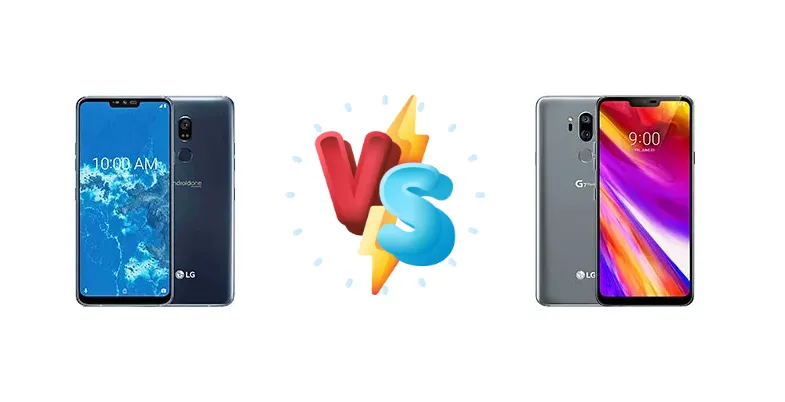
The LG G7 series presented a fascinating duality: the G7 ThinQ, LG’s full-featured flagship, and the G7 One, a more affordable option leveraging the Android One program. Both share a similar design language, but diverge significantly under the hood, primarily in their chipsets. This comparison dissects the differences between the Snapdragon 835-powered G7 One and the Snapdragon 845-equipped G7 ThinQ, revealing which device offers the best value and performance.
🏆 Quick Verdict
For most users, the LG G7 ThinQ is the superior choice. The Snapdragon 845 delivers a noticeable performance uplift, particularly in demanding tasks and gaming, without sacrificing battery life – both phones achieve an endurance rating of 77h. While the G7 One offers a cleaner software experience with Android One, the performance gains of the ThinQ justify the price difference.
| Network |
|---|
| 2G bands | GSM 850 / 900 / 1800 / 1900 | GSM 850 / 900 / 1800 / 1900 |
| 3G bands | HSDPA 850 / 900 / 1900 / 2100 | HSDPA 850 / 900 / 1900 / 2100 - Global |
| 4G bands | 1, 3, 5, 7, 8, 20 | 1, 3, 4, 5, 7, 8, 12, 17, 20, 28, 32, 38, 40, 42, 46 - Global |
| Speed | HSPA, LTE | HSPA 42.2/5.76 Mbps, LTE (3CA) Cat16 1024/150 Mbps or Cat15 800/150 Mbps (region dependant) |
| Technology | GSM / HSPA / LTE | GSM / CDMA / HSPA / LTE |
| | - | 1, 3, 5, 7, 8, 28, 38, 39, 40, 41 - G710EMW, G710EAW1,2,3,4,5,7,8,12,13,17,20,25,29,30,38,41,46,66 - G710AWM |
| Launch |
|---|
| Announced | 2018, August. Released 2018, October | 2018, May 02. Released 2018, June 01 |
| Status | Discontinued | Discontinued |
| Body |
|---|
| Build | - | Glass front (Gorilla Glass 5), glass back (Gorilla Glass 5), aluminum frame |
| Dimensions | 153.2 x 71.9 x 7.9 mm (6.03 x 2.83 x 0.31 in) | 153.2 x 71.9 x 7.9 mm (6.03 x 2.83 x 0.31 in) |
| SIM | · Nano-SIM· Nano-SIM + Nano-SIM | · Nano-SIM· Nano-SIM + Nano-SIM |
| Weight | 156 g (5.50 oz) | 162 g (5.71 oz) |
| | IP68 dust/water resistant (up to 1.5m for 30 mins)
MIL-STD-810G compliant*
*does not guarantee ruggedness or use in extreme conditions | IP68 dust/water resistant (up to 1.5m for 30 min)
MIL-STD-810G compliant*
*does not guarantee ruggedness or use in extreme conditions |
| Display |
|---|
| Protection | - | Corning Gorilla Glass 5 |
| Resolution | 1440 x 3120 pixels, 19.5:9 ratio (~563 ppi density) | 1440 x 3120 pixels, 19.5:9 ratio (~564 ppi density) |
| Size | 6.1 inches, 91.3 cm2 (~82.9% screen-to-body ratio) | 6.1 inches, 91.0 cm2 (~82.6% screen-to-body ratio) |
| Type | IPS LCD, HDR10 | IPS LCD, HDR10 |
| | Always-on display | Always-on display |
| Platform |
|---|
| CPU | Octa-core (4x2.45 GHz Kryo & 4x1.9 GHz Kryo) | Octa-core (4x2.8 GHz Kryo 385 Gold & 4x1.7 GHz Kryo 385 Silver) |
| Chipset | Qualcomm MSM8998 Snapdragon 835 (10 nm) | Qualcomm SDM845 Snapdragon 845 (10 nm) |
| GPU | Adreno 540 | Adreno 630 |
| OS | Android 8.1 (Oreo), upgradable to Android 10, Android One | Android 8.0 (Oreo), upgradable to Android 10 |
| Memory |
|---|
| Card slot | microSDXC (uses shared SIM slot) | microSDXC (dedicated slot) - single-SIM modelmicroSDXC (uses shared SIM slot) - dual-SIM model |
| Internal | 32GB 4GB RAM, 64GB 4GB RAM | 64GB 4GB RAM, 128GB 6GB RAM |
| | - | UFS 2.1 |
| Main Camera |
|---|
| Dual | - | 16 MP, f/1.6, 30mm (standard), 1/3.1", 1.0µm, PDAF, OIS
16 MP, f/1.9, 16mm (ultrawide), 1/3.1", no AF |
| Features | Laser AF, LED flash, HDR, panorama | Laser AF, LED flash, HDR, panorama |
| Single | 16 MP, f/1.6, 31mm (standard), 1/3.1", 1.0µm, PDAF, OIS | - |
| Video | 4K@30fps | 4K@30/60fps, 1080p@30/60fps, 720p@240fps, HDR, 24-bit/192kHz stereo sound rec. |
| Selfie camera |
|---|
| Single | 8 MP, f/1.9, 26mm (wide) | 8 MP, f/1.9, 26mm (wide) |
| Video | 1080p@30fps | 1080p@60fps |
| Sound |
|---|
| 3.5mm jack | Yes | Yes |
| 35mm jack | Yes | Yes |
| Loudspeaker | Yes | Yes |
| | 32-bit/192kHz audio | 32-bit/192kHz audio |
| Comms |
|---|
| Bluetooth | 5.0, A2DP, LE, aptX HD | 5.0, A2DP, LE, aptX HD |
| NFC | Yes | Yes |
| Positioning | GPS, GLONASS, BDS | GPS, GLONASS, BDS |
| Radio | FM radio | FM radio |
| USB | USB Type-C 3.1, OTG | USB Type-C 3.1, OTG |
| WLAN | Wi-Fi 802.11 a/b/g/n/ac, dual-band, Wi-Fi Direct, DLNA | Wi-Fi 802.11 a/b/g/n/ac, dual-band, Wi-Fi Direct, DLNA |
| Features |
|---|
| Sensors | Fingerprint (rear-mounted), accelerometer, gyro, proximity, compass, barometer | Fingerprint (rear-mounted), accelerometer, gyro, proximity, compass, barometer |
| Battery |
|---|
| Charging | 18W wired, QC3
Wireless (USA) | 18W wired, QC3
Wireless (USA) |
| Type | Li-Po 3000 mAh, non-removable | Li-Po 3000 mAh, non-removable |
| Misc |
|---|
| Colors | New Aurora Black, New Moroccan Blue | New Platinum Gray, New Aurora Black, New Moroccan Blue, Raspberry Rose |
| Models | LMQ910UM, LM-Q910, LM-X510K, LM-Q927L, LM-X510S | LM-G710, LM-G710N, LM-G710VM, G710, SM-G710, LM-G710V |
| Price | About 350 EUR | About 370 EUR |
| SAR EU | - | 0.24 W/kg (head) 1.47 W/kg (body) |
| Tests |
|---|
| Audio quality | - |
Noise -94.0dB / Crosstalk -93.0dB |
| Battery life | - |
Endurance rating 77h
|
| Camera | - |
Photo / Video |
| Display | - |
Contrast ratio: 2044:1 (nominal), 3.978 (sunlight) |
| Loudspeaker | - |
-24.5 LUFS (Very good)
|
| Performance | - |
AnTuTu: 259393 (v7), 297116 (v8)
GeekBench: 8865 (v4.4), 2047 (v5.1)
GFXBench: 18fps (ES 3.1 onscreen) |
LG G7 One
- Clean Android One software experience
- More affordable price point
- Comparable battery life to the ThinQ
- Less powerful Snapdragon 835 processor
- Potentially slower camera processing
- May struggle with demanding games
LG G7 ThinQ
- Faster Snapdragon 845 processor
- Improved gaming performance
- Enhanced camera image processing
- LG’s custom software with potential bloatware
- Higher price compared to the G7 One
- No significant battery life advantage
Display Comparison
Both the LG G7 One and G7 ThinQ feature displays with a nominal contrast ratio of 2044:1 and a sunlight contrast ratio of 3.978, indicating similar outdoor visibility. While specific panel technology details aren't provided, LG was known for its high-quality LCDs at the time. The lack of information regarding refresh rates suggests both likely operate at a standard 60Hz. The focus here isn't on display advancements, but rather on consistent visual quality across both models.
Camera Comparison
Both devices are listed as having 'Photo / Video' capabilities, but detailed camera specifications are absent. Given LG’s history, the G7 ThinQ likely benefits from more advanced image processing algorithms and potentially a wider aperture lens on its main sensor, leveraging the increased processing power of the Snapdragon 845. The G7 ThinQ’s ISP (Image Signal Processor) is more capable, resulting in better dynamic range and low-light performance. Without specific sensor details, it’s difficult to make a definitive statement, but the 845’s superior image processing capabilities give the ThinQ an edge.
Performance
The core difference lies in the chipsets. The G7 ThinQ’s Snapdragon 845, built on a 10nm process, boasts a more efficient architecture and higher clock speeds (4x2.8 GHz Kryo 385 Gold & 4x1.7 GHz Kryo 385 Silver) compared to the G7 One’s Snapdragon 835 (4x2.45 GHz Kryo & 4x1.9 GHz Kryo). This translates to approximately 25-30% faster CPU performance and a significant boost in GPU capabilities. The 845’s Adreno 630 GPU offers a substantial advantage in gaming and graphics-intensive applications. While both utilize 10nm fabrication, the architectural improvements in the 845 lead to better thermal efficiency, minimizing throttling during sustained workloads.
Battery Life
Interestingly, both the LG G7 One and G7 ThinQ achieve an endurance rating of 77 hours, despite the G7 ThinQ’s more powerful processor. This suggests LG optimized the software and battery management on the ThinQ to compensate for the increased power draw. Both support 18W wired charging with Quick Charge 3.0 and wireless charging (in the USA). The similar endurance ratings indicate that the Snapdragon 845’s efficiency gains offset its higher power consumption, providing comparable real-world battery life.
Buying Guide
Buy the LG G7 One if you prioritize a bloatware-free Android experience and are comfortable with slightly slower performance for everyday tasks. It’s ideal for users who primarily browse, use social media, and make calls. Buy the LG G7 ThinQ if you demand the best possible performance for gaming, video editing, or multitasking, and appreciate the additional features LG’s software offers. This is the phone for power users and those who want a future-proofed device.
Frequently Asked Questions
❓ Does the Snapdragon 835 in the G7 One struggle with graphically intensive games like PUBG or Fortnite?
While the G7 One can run these games, you'll likely need to lower the graphics settings to achieve a smooth frame rate. The Snapdragon 835 is capable, but the 845 in the G7 ThinQ provides a significantly better gaming experience with higher settings and more consistent performance.
❓ Is the Android One software on the G7 One guaranteed to receive timely security updates?
As part of the Android One program, the LG G7 One was promised at least three years of security updates and two major Android version upgrades. However, support may have ended depending on the current date. Check LG’s official support page for the latest information.
❓ Will I notice a significant difference in everyday tasks like browsing and social media between the two phones?
For basic tasks, the difference will be minimal. Both phones are responsive enough for everyday use. However, you'll notice a difference when multitasking or opening demanding apps, where the Snapdragon 845 in the G7 ThinQ will feel noticeably faster.
❓ Does the LG G7 ThinQ support faster charging than the G7 One, despite both having 18W charging?
No, both devices support 18W Quick Charge 3.0. While the wattage is the same, the Snapdragon 845’s power management capabilities *might* lead to slightly faster overall charging times in real-world scenarios, but the difference is likely negligible.