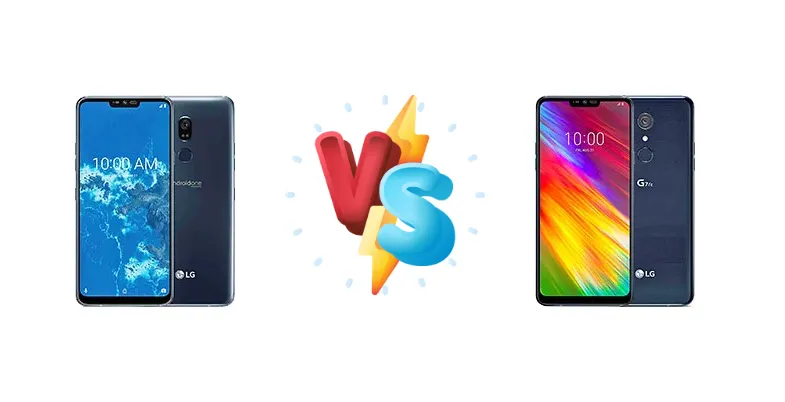
The LG G7 One and G7 Fit represent a fascinating point in LG's smartphone history – a move towards offering compelling features at more accessible price points. Both phones share a similar design language, but diverge significantly under the hood with different Qualcomm Snapdragon processors. This comparison dissects those differences, helping you determine which G7 variant best suits your needs in today's market.
🏆 Quick Verdict
For most users, the LG G7 One emerges as the superior choice. The Snapdragon 835 offers a noticeable performance uplift over the 821 in the G7 Fit, coupled with a more efficient 10nm manufacturing process. While the price difference may be minimal on the used market, the G7 One provides a smoother, more future-proof experience.
| Network |
|---|
| 2G bands | GSM 850 / 900 / 1800 / 1900 | GSM 850 / 900 / 1800 / 1900 |
| 3G bands | HSDPA 850 / 900 / 1900 / 2100 | HSDPA 850 / 900 / 1900 / 2100 |
| 4G bands | 1, 3, 5, 7, 8, 20 | 1, 2, 3, 4, 5, 7, 8, 12, 13, 17, 20, 25, 26, 28, 40, 41, 46, 48, 66 - USA |
| Speed | HSPA, LTE | HSPA 42.2/5.76 Mbps, LTE (3CA) Cat11 600/75 Mbps |
| Technology | GSM / HSPA / LTE | GSM / HSPA / LTE |
| | - | 1, 3, 5, 7, 8, 20, 28, 38, 40 - EU |
| Launch |
|---|
| Announced | 2018, August. Released 2018, October | 2018, August. Released 2018, November |
| Status | Discontinued | Discontinued |
| Body |
|---|
| Build | - | Glass front (Gorilla Glass 5), glass back (Gorilla Glass 5), aluminum frame |
| Dimensions | 153.2 x 71.9 x 7.9 mm (6.03 x 2.83 x 0.31 in) | 153.2 x 71.9 x 8 mm (6.03 x 2.83 x 0.31 in) |
| SIM | · Nano-SIM· Nano-SIM + Nano-SIM | · Nano-SIM· Nano-SIM + Nano-SIM |
| Weight | 156 g (5.50 oz) | 156 g (5.50 oz) |
| | IP68 dust/water resistant (up to 1.5m for 30 mins)
MIL-STD-810G compliant*
*does not guarantee ruggedness or use in extreme conditions | IP68 dust/water resistant (up to 1.5m for 30 mins)
MIL-STD-810G compliant*
*does not guarantee ruggedness or use in extreme conditions |
| Display |
|---|
| Protection | - | Corning Gorilla Glass 5 |
| Resolution | 1440 x 3120 pixels, 19.5:9 ratio (~563 ppi density) | 1440 x 3120 pixels, 19.5:9 ratio (~563 ppi density) |
| Size | 6.1 inches, 91.3 cm2 (~82.9% screen-to-body ratio) | 6.1 inches, 91.3 cm2 (~82.9% screen-to-body ratio) |
| Type | IPS LCD, HDR10 | IPS LCD, HDR10 |
| | Always-on display | Always-on display |
| Platform |
|---|
| CPU | Octa-core (4x2.45 GHz Kryo & 4x1.9 GHz Kryo) | Quad-core (2x2.35 GHz Kryo & 2x1.6 GHz Kryo) |
| Chipset | Qualcomm MSM8998 Snapdragon 835 (10 nm) | Qualcomm MSM8996 Snapdragon 821 (14 nm) |
| GPU | Adreno 540 | Adreno 530 |
| OS | Android 8.1 (Oreo), upgradable to Android 10, Android One | Android 8.1 (Oreo) |
| Memory |
|---|
| Card slot | microSDXC (uses shared SIM slot) | microSDXC (uses shared SIM slot) |
| Internal | 32GB 4GB RAM, 64GB 4GB RAM | 32GB 4GB RAM, 64GB 4GB RAM |
| Main Camera |
|---|
| Features | Laser AF, LED flash, HDR, panorama | LED flash, HDR, panorama |
| Single | 16 MP, f/1.6, 31mm (standard), 1/3.1", 1.0µm, PDAF, OIS | 16 MP, f/2.2, 28mm (wide), 1/3.1", 1.0µm, PDAF |
| Video | 4K@30fps | 4K@24/30fps, 1080p@30fps |
| Selfie camera |
|---|
| Features | - | HDR |
| Single | 8 MP, f/1.9, 26mm (wide) | 8 MP, f/1.9, 26mm (wide), 1/4.0", 1.12µm |
| Video | 1080p@30fps | 1080p@30fps |
| Sound |
|---|
| 3.5mm jack | Yes | Yes |
| 35mm jack | Yes | Yes |
| Loudspeaker | Yes | Yes |
| | 32-bit/192kHz audio | 32-bit/192kHz audio |
| Comms |
|---|
| Bluetooth | 5.0, A2DP, LE, aptX HD | 4.2, A2DP, LE |
| NFC | Yes | Yes |
| Positioning | GPS, GLONASS, BDS | GPS, GLONASS, BDS |
| Radio | FM radio | FM radio |
| USB | USB Type-C 3.1, OTG | USB Type-C 3.1, OTG |
| WLAN | Wi-Fi 802.11 a/b/g/n/ac, dual-band, Wi-Fi Direct, DLNA | Wi-Fi 802.11 a/b/g/n/ac, dual-band, Wi-Fi Direct, DLNA |
| Features |
|---|
| Sensors | Fingerprint (rear-mounted), accelerometer, gyro, proximity, compass, barometer | Fingerprint (rear-mounted), accelerometer, gyro, proximity, compass |
| Battery |
|---|
| Charging | 18W wired, QC3
Wireless (USA) | 18W wired, QC3 |
| Type | Li-Po 3000 mAh, non-removable | Li-Ion 3000 mAh, non-removable |
| Misc |
|---|
| Colors | New Aurora Black, New Moroccan Blue | New Aurora Black, New Platinum Gray |
| Models | LMQ910UM, LM-Q910, LM-X510K, LM-Q927L, LM-X510S | LM-Q850, LMQ850EM, LMQ850QM, LMQ850EMW |
| Price | About 350 EUR | About 200 EUR |
LG G7 One
- Superior performance with Snapdragon 835
- More power-efficient 10nm process
- Potentially better camera image processing
- May be slightly more expensive on the used market
- No significant advantages in display technology over the G7 Fit
LG G7 Fit
- Lower price point (likely)
- Still capable for everyday tasks
- Similar display quality to the G7 One
- Less powerful Snapdragon 821 processor
- Less efficient 14nm process leads to shorter battery life
- Potential for throttling under heavy load
Display Comparison
Both the LG G7 One and G7 Fit feature a 6.1-inch QHD+ (3120 x 1440) IPS LCD display with a 19.5:9 aspect ratio. However, detailed panel specifications like peak brightness and color gamut coverage are not provided. The shared resolution ensures sharpness, but the G7 One’s more capable processor can better handle graphically intensive UI elements and smoother animations on this display. The lack of OLED technology in both models means black levels won't be as deep as competing devices.
Camera Comparison
Detailed camera specifications beyond the presence of a camera are unavailable. However, given the market positioning, it’s reasonable to assume both phones feature similar camera setups. The Snapdragon 835 in the G7 One offers a more powerful ISP (Image Signal Processor), potentially leading to faster image processing, improved low-light performance, and better video stabilization. The 821 in the G7 Fit is still capable, but will likely exhibit slightly slower processing times and potentially more noise in challenging lighting conditions.
Performance
The core difference lies in the chipsets. The LG G7 One boasts the Qualcomm MSM8998 Snapdragon 835, fabricated on a 10nm process, featuring an octa-core CPU (4x2.45 GHz Kryo & 4x1.9 GHz Kryo). The G7 Fit utilizes the older MSM8996 Snapdragon 821, built on a less efficient 14nm process, with a quad-core CPU (2x2.35 GHz Kryo & 2x1.6 GHz Kryo). This translates to a significant advantage for the G7 One in multi-core performance and sustained workloads. The 835’s Kryo cores, combined with the smaller manufacturing node, deliver better thermal efficiency, reducing the likelihood of throttling during extended gaming sessions. While both support Quick Charge 3.0, the 835’s efficiency contributes to better overall battery life.
Battery Life
Both devices support 18W wired charging with Quick Charge 3.0. While battery capacity isn’t specified, the Snapdragon 835’s 10nm process in the G7 One provides a clear advantage in power efficiency. This means the G7 One will likely achieve longer screen-on times and overall battery life compared to the G7 Fit, even with a similar battery capacity. The more efficient processor reduces power draw during both active use and standby, resulting in a more reliable all-day experience.
Buying Guide
Buy the LG G7 One if you prioritize sustained performance for demanding tasks like gaming or video editing, and value the benefits of a more power-efficient processor for longer battery life. Buy the LG G7 Fit if you are on a very tight budget and primarily use your phone for basic tasks like calling, texting, and light social media browsing, and are willing to accept some performance compromises.
Frequently Asked Questions
❓ Will the Snapdragon 821 in the G7 Fit struggle with modern apps and games?
While the Snapdragon 821 was a flagship processor in its time, it will show its age with demanding modern applications and graphically intensive games. Expect lower frame rates, longer loading times, and potential stuttering compared to the G7 One's Snapdragon 835. It's suitable for casual gaming and everyday tasks, but not ideal for power users.
❓ How much of a real-world battery life difference can I expect between the G7 One and G7 Fit?
Due to the Snapdragon 835's superior power efficiency, the G7 One will likely offer approximately 1-2 hours of additional screen-on time compared to the G7 Fit under similar usage conditions. This difference will be more pronounced during demanding tasks like gaming or video streaming.
❓ Is the difference in performance between these two phones noticeable for everyday use?
For basic tasks like browsing, social media, and calling, the difference may be subtle. However, when multitasking, launching apps, or playing games, the G7 One's Snapdragon 835 will provide a noticeably smoother and more responsive experience.