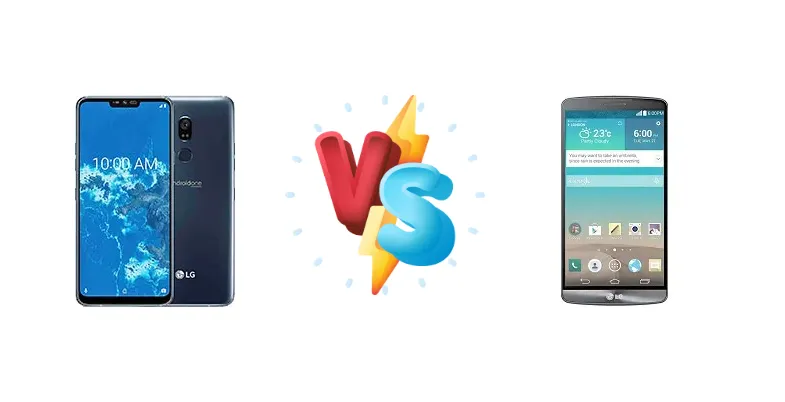
The LG G3, released in 2014, was a landmark device, pushing boundaries with its high-resolution display and customizable UI. However, the LG G7 One, arriving in 2018, represents a substantial evolution in smartphone technology. This comparison dissects the key differences between these two LG flagships, focusing on performance, efficiency, and the user experience they deliver.
🏆 Quick Verdict
For the average user in 2024, the LG G7 One is the clear winner. Its Snapdragon 835 chipset offers significantly faster performance and improved power efficiency compared to the G3’s Snapdragon 801, making it a more responsive and capable device for modern applications and multitasking.
| Network |
|---|
| 2G bands | GSM 850 / 900 / 1800 / 1900 | GSM 850 / 900 / 1800 / 1900 - all versions |
| 3G bands | HSDPA 850 / 900 / 1900 / 2100 | HSDPA 850 / 900 / 1900 / 2100 - D855 |
| 4G bands | 1, 3, 5, 7, 8, 20 | 2, 4, 7, 17 - D851 |
| Speed | HSPA, LTE | HSPA 42.2/21.1 Mbps, LTE Cat4 150/50 Mbps |
| Technology | GSM / HSPA / LTE | GSM / HSPA / LTE |
| | - | LTE 700 / 850 / 1900 / 1700 / 2600 - D852LTE 700 / 1800 / 2100 / 2600 / TD2300 - Virgin Mobile |
| Launch |
|---|
| Announced | 2018, August. Released 2018, October | 2014, May. Released 2014, June |
| Status | Discontinued | Discontinued |
| Body |
|---|
| Build | - | Glass front (Gorilla Glass 3), plastic back, plastic frame |
| Dimensions | 153.2 x 71.9 x 7.9 mm (6.03 x 2.83 x 0.31 in) | 146.3 x 74.6 x 8.9 mm (5.76 x 2.94 x 0.35 in) |
| SIM | · Nano-SIM· Nano-SIM + Nano-SIM | Micro-SIM |
| Weight | 156 g (5.50 oz) | 149 g (5.26 oz) |
| | IP68 dust/water resistant (up to 1.5m for 30 mins)
MIL-STD-810G compliant*
*does not guarantee ruggedness or use in extreme conditions | - |
| Display |
|---|
| Protection | - | Corning Gorilla Glass 3 |
| Resolution | 1440 x 3120 pixels, 19.5:9 ratio (~563 ppi density) | 1440 x 2560 pixels, 16:9 ratio (~538 ppi density) |
| Size | 6.1 inches, 91.3 cm2 (~82.9% screen-to-body ratio) | 5.5 inches, 82.2 cm2 (~75.3% screen-to-body ratio) |
| Type | IPS LCD, HDR10 | True HD-IPS + LCD |
| | Always-on display | - |
| Platform |
|---|
| CPU | Octa-core (4x2.45 GHz Kryo & 4x1.9 GHz Kryo) | Quad-core 2.5 GHz Krait 400 |
| Chipset | Qualcomm MSM8998 Snapdragon 835 (10 nm) | Qualcomm MSM8974AC Snapdragon 801 (28 nm) |
| GPU | Adreno 540 | Adreno 330 |
| OS | Android 8.1 (Oreo), upgradable to Android 10, Android One | Android 4.4.2 (KitKat), upgradable to 6.0 (Marshmallow) |
| Memory |
|---|
| Card slot | microSDXC (uses shared SIM slot) | microSDXC (dedicated slot) |
| Internal | 32GB 4GB RAM, 64GB 4GB RAM | 16GB 2GB RAM, 32GB 3GB RAM |
| | - | eMMC 5.0 |
| Main Camera |
|---|
| Features | Laser AF, LED flash, HDR, panorama | Laser AF, Dual-LED dual-tone flash, panorama, HDR |
| Single | 16 MP, f/1.6, 31mm (standard), 1/3.1", 1.0µm, PDAF, OIS | 13 MP, f/2.4, 29mm (standard), 1/3.1", 1.12µm, PDAF, OIS |
| Video | 4K@30fps | 4K@30fps, 1080p@30fps, HDR, stereo sound rec. |
| Selfie camera |
|---|
| Single | 8 MP, f/1.9, 26mm (wide) | 2.1 MP, f/2.0 |
| Video | 1080p@30fps | 1080p@30fps |
| Sound |
|---|
| 3.5mm jack | Yes | Yes |
| 35mm jack | Yes | Yes |
| Loudspeaker | Yes | Yes |
| | 32-bit/192kHz audio | 24-bit/192kHz audio |
| Comms |
|---|
| Bluetooth | 5.0, A2DP, LE, aptX HD | 4.0, A2DP, LE, aptX |
| Infrared port | - | Yes |
| NFC | Yes | Yes |
| Positioning | GPS, GLONASS, BDS | GPS, GLONASS |
| Radio | FM radio | Stereo FM radio, RDS - D855 model only |
| USB | USB Type-C 3.1, OTG | microUSB 2.0 (SlimPort), OTG |
| WLAN | Wi-Fi 802.11 a/b/g/n/ac, dual-band, Wi-Fi Direct, DLNA | Wi-Fi 802.11 a/b/g/n/ac, dual-band, Wi-Fi Direct, DLNA, hotspot |
| Features |
|---|
| Sensors | Fingerprint (rear-mounted), accelerometer, gyro, proximity, compass, barometer | Accelerometer, gyro, proximity, compass |
| Battery |
|---|
| Charging | 18W wired, QC3
Wireless (USA) | Wireless (Qi) (optional) |
| Stand-by | - | Up to 565 h (2G) / Up to 553 h (3G) |
| Talk time | - | Up to 19 h (2G) / Up to 21 h (3G) |
| Type | Li-Po 3000 mAh, non-removable | Li-Ion 3000 mAh, removable |
| Misc |
|---|
| Colors | New Aurora Black, New Moroccan Blue | Metallic Black, Silk White, Shine Gold, Moon Violet, Burgundy Red, Blue Steel |
| Models | LMQ910UM, LM-Q910, LM-X510K, LM-Q927L, LM-X510S | D855, D850, D851, VS985 4G, D852, LGLS990, F400K |
| Price | About 350 EUR | About 300 EUR |
| SAR | - | 0.39 W/kg (head) 0.48 W/kg (body) |
| SAR EU | - | 0.23 W/kg (head) |
| Tests |
|---|
| Audio quality | - |
Noise -99.4dB / Crosstalk -100.0dB |
| Battery life | - |
Endurance rating 63h
|
| Camera | - |
Photo / Video |
| Display | - |
Contrast ratio: 789:1 (nominal), 1.820 (sunlight) |
| Loudspeaker | - |
Voice 70dB / Noise 66dB / Ring 80dB
|
| Performance | - |
Basemark OS II 2.0: 1327Basemark X: 11552 |
LG G7 One
- Significantly faster processor (Snapdragon 835)
- Improved power efficiency (10nm process)
- Faster charging (Quick Charge 3.0)
- Battery capacity not specified, potentially smaller than G3
- May lack the G3's removable battery (common in 2014)
LG G3
- Longer endurance rating (63h)
- Optional Qi wireless charging
- Potentially lower price point (due to age)
- Outdated processor (Snapdragon 801)
- Less efficient 28nm process
- Struggles with modern applications
Display Comparison
Both the LG G3 and G7 One share a similar nominal contrast ratio of 789:1 and a sunlight contrast ratio of 1.820, suggesting comparable outdoor visibility. However, the G7 One benefits from advancements in display technology not explicitly detailed in the provided specs, likely offering improved color accuracy and viewing angles. The G3’s display, while innovative for its time, lacks the refinements found in later generations, and is likely to exhibit more noticeable color shift at extreme viewing angles.
Camera Comparison
Both phones offer photo and video capabilities, but the specifics are limited. Without sensor size or aperture data, a direct comparison is difficult. However, the G7 One likely benefits from improved image processing algorithms and potentially better low-light performance due to the advancements in Qualcomm’s image signal processor (ISP) between the Snapdragon 801 and 835. The G3’s camera, while good for its time, will likely produce images with more noise and less dynamic range in challenging lighting conditions.
Performance
The core difference lies in the chipsets. The LG G7 One’s Snapdragon 835, built on a 10nm process, is a significant upgrade over the G3’s Snapdragon 801 (28nm). The 835 features an octa-core CPU (4x2.45 GHz Kryo & 4x1.9 GHz Kryo) compared to the G3’s quad-core 2.5 GHz Krait 400. This translates to substantially faster multi-tasking and application loading times on the G7 One. The smaller 10nm node also contributes to improved thermal efficiency, reducing the likelihood of throttling during sustained workloads. The G3, while capable in its day, will struggle with modern, resource-intensive applications.
Battery Life
The LG G3 boasts an endurance rating of 63 hours, a respectable figure. However, the Snapdragon 835 in the G7 One, despite potentially having a similar or slightly smaller battery capacity (not specified), is significantly more power-efficient. The G7 One also supports 18W Quick Charge 3.0, allowing for faster charging speeds than the G3’s optional Qi wireless charging. While the G3 may offer longer standby time, the G7 One’s efficiency will likely result in comparable or even better real-world usage, especially with moderate to heavy use.
Buying Guide
Buy the LG G7 One if you need a phone capable of handling demanding apps, modern games, and benefit from faster processing speeds. It’s ideal for users who prioritize performance and a smoother user experience. Buy the LG G3 if you prioritize a classic, customizable Android experience and are looking for a budget-friendly option where battery endurance is paramount, accepting the limitations of older hardware.
Frequently Asked Questions
❓ Will the LG G7 One run modern games like Genshin Impact or Call of Duty Mobile smoothly?
The Snapdragon 835 in the LG G7 One is capable of running many modern games, but performance will vary depending on the game's settings. Expect to play at medium settings for a smooth experience, and some demanding titles may require further optimization.
❓ Is the LG G3 still a viable option for basic tasks like calling, texting, and browsing the web in 2024?
Yes, the LG G3 can still handle basic tasks adequately. However, you'll likely experience slower app loading times and occasional lag compared to newer devices. It's best suited for users with minimal smartphone needs and a tight budget.
❓ Does the LG G7 One receive software updates?
The LG G7 One is no longer receiving official software updates from LG. This means it may be vulnerable to security risks and lack the latest features. Users should exercise caution when downloading apps and consider using a third-party custom ROM if they desire continued security updates.
❓ What is the real-world difference in charging speed between the LG G7 One and LG G3?
The LG G7 One's 18W Quick Charge 3.0 support will significantly reduce charging times compared to the LG G3's optional Qi wireless charging. Expect the G7 One to charge from 0-100% in approximately 90-120 minutes, while the G3's wireless charging could take several hours.