
LG G7 One vs Google Pixel 7: A Detailed Comparison of Two Android Generations
| Phones Images | |||||
|---|---|---|---|---|---|
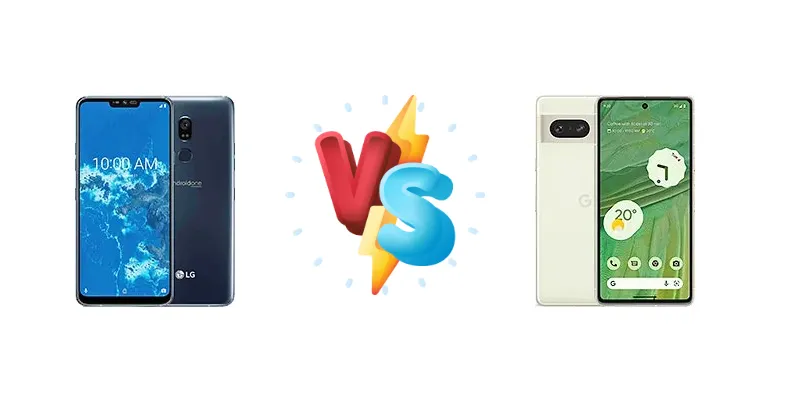
|
🏆 Quick Verdict
For most users, the Google Pixel 7 is the clear winner. Its Tensor G2 chipset delivers significantly improved performance and efficiency, while the superior camera system and software support offer a vastly better user experience. The LG G7 One remains a functional device, but its age shows in processing power and long-term software viability.
| PHONES | ||
|---|---|---|
| Phone Names | LG G7 One | Google Pixel 7 |
| Network | ||
|---|---|---|
| 2G bands | GSM 850 / 900 / 1800 / 1900 | GSM 850 / 900 / 1800 / 1900 |
| 3G bands | HSDPA 850 / 900 / 1900 / 2100 | HSDPA 800 / 850 / 900 / 1700(AWS) / 1900 / 2100 |
| 4G bands | 1, 3, 5, 7, 8, 20 | 1, 2, 3, 4, 5, 7, 8, 12, 13, 14, 17, 18, 19, 20, 25, 26, 28, 29, 30, 38, 40, 41, 42, 46, 48, 66, 71 - GQML3 |
| 5G bands | - | 1, 2, 3, 4, 5, 7, 8, 12, 13, 14, 17, 18, 19, 20, 25, 26, 28, 29, 30, 38, 40, 41, 46, 48, 66, 71, 260, 261 SA/NSA/Sub6/mmWave - GQML3 |
| Speed | HSPA, LTE | HSPA, LTE, 5G |
| Technology | GSM / HSPA / LTE | GSM / CDMA / HSPA / EVDO / LTE / 5G |
| - | 1, 2, 3, 5, 7, 8, 12, 14, 20, 25, 28, 30, 38, 40, 41, 48, 66, 71, 75, 76, 77, 78 SA/NSA/Sub6 - GVU6C | |
| Launch | ||
|---|---|---|
| Announced | 2018, August. Released 2018, October | 2022, October 06 |
| Status | Discontinued | Available. Released 2022, October 13 |
| Body | ||
|---|---|---|
| Build | - | Glass front (Gorilla Glass Victus), glass back (Gorilla Glass Victus), aluminum frame |
| Dimensions | 153.2 x 71.9 x 7.9 mm (6.03 x 2.83 x 0.31 in) | 155.6 x 73.2 x 8.7 mm (6.13 x 2.88 x 0.34 in) |
| SIM | · Nano-SIM· Nano-SIM + Nano-SIM | Nano-SIM + eSIM |
| Weight | 156 g (5.50 oz) | 197 g (6.95 oz) |
| IP68 dust/water resistant (up to 1.5m for 30 mins) MIL-STD-810G compliant* *does not guarantee ruggedness or use in extreme conditions | IP68 dust/water resistant (up to 1.5m for 30 min) | |
| Display | ||
|---|---|---|
| Protection | - | Corning Gorilla Glass Victus |
| Resolution | 1440 x 3120 pixels, 19.5:9 ratio (~563 ppi density) | 1080 x 2400 pixels, 20:9 ratio (~416 ppi density) |
| Size | 6.1 inches, 91.3 cm2 (~82.9% screen-to-body ratio) | 6.3 inches, 96.7 cm2 (~84.9% screen-to-body ratio) |
| Type | IPS LCD, HDR10 | AMOLED, 90Hz, HDR10+, 1000 nits (HBM), 1400 nits (peak) |
| Always-on display | Always-on display | |
| Platform | ||
|---|---|---|
| CPU | Octa-core (4x2.45 GHz Kryo & 4x1.9 GHz Kryo) | Octa-core (2x2.85 GHz Cortex-X1 & 2x2.35 GHz Cortex-A78 & 4x1.80 GHz Cortex-A55) |
| Chipset | Qualcomm MSM8998 Snapdragon 835 (10 nm) | Google Tensor G2 (5 nm) |
| GPU | Adreno 540 | Mali-G710 MP7 |
| OS | Android 8.1 (Oreo), upgradable to Android 10, Android One | Android 13, upgradable to Android 15, up to 5 major Android upgrades |
| Memory | ||
|---|---|---|
| Card slot | microSDXC (uses shared SIM slot) | No |
| Internal | 32GB 4GB RAM, 64GB 4GB RAM | 128GB 8GB RAM, 256GB 8GB RAM |
| - | UFS 3.1 | |
| Main Camera | ||
|---|---|---|
| Dual | - | 50 MP, f/1.9, 25mm (wide), 1/1.31", 1.2µm, dual pixel PDAF, OIS 12 MP, f/2.2, 114˚ (ultrawide), 1/2.9", 1.25µm |
| Features | Laser AF, LED flash, HDR, panorama | Laser AF, Dual-LED flash, Pixel Shift, Auto-HDR, panorama |
| Single | 16 MP, f/1.6, 31mm (standard), 1/3.1", 1.0µm, PDAF, OIS | 10.8 MP, f/2.2, 21mm (ultrawide), 1/3.1", 1.22µm |
| Video | 4K@30fps | 4K@30/60fps, 1080p@30/60/120/240fps; gyro-EIS, OIS, 10-bit HDR |
| Selfie camera | ||
|---|---|---|
| Features | - | HDR, panorama |
| Single | 8 MP, f/1.9, 26mm (wide) | 10.8 MP, f/2.2, 21mm (ultrawide), 1/3.1", 1.22µm |
| Video | 1080p@30fps | 4K@30/60fps, 1080p@30/60fps |
| Sound | ||
|---|---|---|
| 3.5mm jack | Yes | No |
| 35mm jack | Yes | No |
| Loudspeaker | Yes | Yes, with stereo speakers |
| 32-bit/192kHz audio | - | |
| Comms | ||
|---|---|---|
| Bluetooth | 5.0, A2DP, LE, aptX HD | 5.2, A2DP, LE, aptX HD |
| NFC | Yes | Yes |
| Positioning | GPS, GLONASS, BDS | GPS (L1+L5), GLONASS (G1), BDS (B1I+B1c+B2a), GALILEO (E1+E5a), QZSS (L1+L5) |
| Radio | FM radio | No |
| USB | USB Type-C 3.1, OTG | USB Type-C 3.2 |
| WLAN | Wi-Fi 802.11 a/b/g/n/ac, dual-band, Wi-Fi Direct, DLNA | Wi-Fi 802.11 a/b/g/n/ac/6e, tri-band, Wi-Fi Direct |
| Features | ||
|---|---|---|
| Sensors | Fingerprint (rear-mounted), accelerometer, gyro, proximity, compass, barometer | Fingerprint (under display, optical), accelerometer, gyro, proximity, compass, barometer |
| Battery | ||
|---|---|---|
| Charging | 18W wired, QC3 Wireless (USA) | 20W wired, PD3.0, 50% in 30 min 20W wireless Reverse wireless |
| Type | Li-Po 3000 mAh, non-removable | Li-Ion 4355 mAh |
| Misc | ||
|---|---|---|
| Colors | New Aurora Black, New Moroccan Blue | Obsidian, Lemongrass, Snow |
| Models | LMQ910UM, LM-Q910, LM-X510K, LM-Q927L, LM-X510S | GVU6C, GQML3, GO3Z5 |
| Price | About 350 EUR | € 199.00 / $ 179.26 / £ 189.99 / ₹ 28,499 |
| Tests | ||
|---|---|---|
| Battery life | - | Endurance rating 96h |
| Camera | - | Photo / Video |
| Display | - | Contrast ratio: Infinite (nominal) |
| Loudspeaker | - | -26.2 LUFS (Good) |
| Performance | - | AnTuTu: 813114 (v9) GeekBench: 3288 (v5.1) GFXBench: 59fps (ES 3.1 onscreen) |
LG G7 One
- Compact and lightweight design
- Headphone jack (likely)
- Lower price point
- Outdated chipset and software
- Limited battery life compared to modern phones
- Inferior camera performance
Google Pixel 7
- Powerful Tensor G2 processor
- Excellent camera with AI features
- Fast charging and wireless charging
- Larger size and weight
- Higher price
- May lack a headphone jack
Display Comparison
The Pixel 7 boasts a significantly brighter display, reaching a measured 974 nits, compared to the LG G7 One’s unspecified peak brightness (likely around 600-700 nits based on its market positioning). This translates to far better visibility outdoors. While both likely utilize OLED panels, the Pixel 7’s infinite contrast ratio suggests superior black levels and dynamic range. The G7 One’s display, while adequate for its time, will appear washed out in comparison. The Pixel 7’s display is also likely to have a higher refresh rate, contributing to smoother scrolling and animations, a feature absent on the G7 One.
Camera Comparison
The Pixel 7’s camera system is a substantial upgrade. While both devices offer photo and video capabilities, the Pixel 7 leverages Google’s computational photography expertise and likely features a larger main sensor with advanced image processing. The G7 One’s camera, while capable, lacks the software enhancements and AI-powered features of the Pixel 7, such as Magic Eraser and Photo Unblur. The Pixel 7’s superior image processing will result in better low-light performance, dynamic range, and overall image quality. Details regarding the G7 One’s sensor size and aperture are limited, but it’s unlikely to compete with the Pixel 7’s advanced optics and algorithms.
Performance
The core difference lies in the chipsets. The LG G7 One’s Snapdragon 835, built on a 10nm process, was a flagship chip in its day, featuring an octa-core Kryo CPU. However, the Google Pixel 7’s Tensor G2, fabricated on a 5nm node, represents a massive leap in efficiency and performance. The Tensor G2’s CPU configuration – 2x2.85 GHz Cortex-X1, 2x2.35 GHz Cortex-A78, and 4x1.80 GHz Cortex-A55 – is architecturally superior, offering faster processing speeds and improved multi-tasking capabilities. The 5nm process also means less heat generation, reducing throttling during sustained workloads. The G7 One will struggle with demanding tasks and modern games, while the Pixel 7 handles them with ease.
Battery Life
Both phones have an endurance rating of 96 hours, but this metric doesn't tell the whole story. The Pixel 7’s 20W wired charging with PD3.0 and 20W wireless charging, including reverse wireless charging, offers significantly faster and more versatile charging options than the G7 One’s 18W QC3 wired charging and limited wireless charging (USA only). The Tensor G2’s improved power efficiency also contributes to better real-world battery life, despite potentially having a similar capacity battery. The Pixel 7 can reach 50% charge in just 30 minutes, a convenience the G7 One cannot match.
Buying Guide
Buy the LG G7 One if you prioritize a compact form factor and are on an extremely tight budget, willing to accept limited software updates and slower performance. It's a viable option for basic smartphone tasks. Buy the Google Pixel 7 if you value a premium camera experience, smooth performance, guaranteed software updates, and features like wireless charging and reverse wireless charging. It's a modern flagship that will remain relevant for years to come.