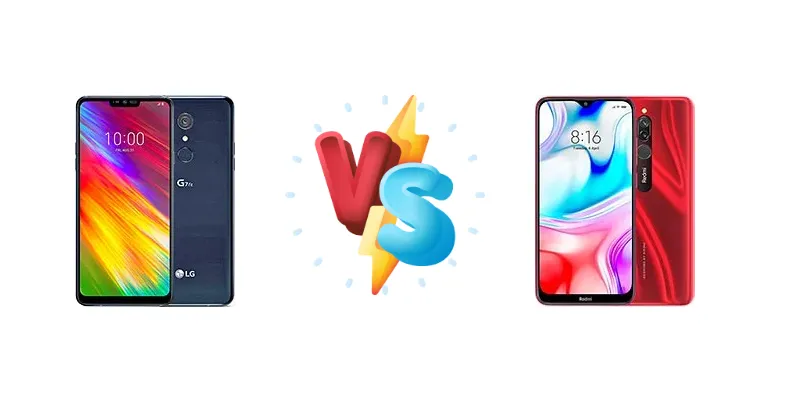
The LG G7 Fit and Xiaomi Redmi 8 represent different approaches to the budget and mid-range smartphone market. The G7 Fit, released as a more affordable variant of the flagship G7, leverages older but powerful hardware. The Redmi 8, on the other hand, opts for a newer, more efficient chipset, prioritizing battery life and everyday usability. This comparison dissects the core differences between these two devices, focusing on performance, efficiency, and overall value.
🏆 Quick Verdict
For users prioritizing raw performance and occasional gaming, the LG G7 Fit is the clear winner thanks to its Snapdragon 821. However, the Xiaomi Redmi 8 offers a more balanced experience with better efficiency and a potentially longer software support lifespan, making it ideal for everyday tasks and budget-conscious buyers.
| Network |
|---|
| 2G bands | GSM 850 / 900 / 1800 / 1900 | GSM 850 / 900 / 1800 / 1900 |
| 3G bands | HSDPA 850 / 900 / 1900 / 2100 | HSDPA 850 / 900 / 1700(AWS) / 1900 / 2100 - Global |
| 4G bands | 1, 2, 3, 4, 5, 7, 8, 12, 13, 17, 20, 25, 26, 28, 40, 41, 46, 48, 66 - USA | 1, 2, 3, 4, 5, 7, 8, 20, 38, 40 - Global |
| Speed | HSPA 42.2/5.76 Mbps, LTE (3CA) Cat11 600/75 Mbps | HSPA, LTE |
| Technology | GSM / HSPA / LTE | GSM / HSPA / LTE |
| | 1, 3, 5, 7, 8, 20, 28, 38, 40 - EU | 1, 3, 5, 8, 40, 41 - India |
| Launch |
|---|
| Announced | 2018, August. Released 2018, November | 2019, October 09. Released 2019, October 12 |
| Status | Discontinued | Discontinued |
| Body |
|---|
| Build | Glass front (Gorilla Glass 5), glass back (Gorilla Glass 5), aluminum frame | Glass front (Gorilla Glass 5), plastic back, plastic frame |
| Dimensions | 153.2 x 71.9 x 8 mm (6.03 x 2.83 x 0.31 in) | 156.5 x 75.4 x 9.4 mm (6.16 x 2.97 x 0.37 in) |
| SIM | · Nano-SIM· Nano-SIM + Nano-SIM | Nano-SIM + Nano-SIM |
| Weight | 156 g (5.50 oz) | 188 g (6.63 oz) |
| | IP68 dust/water resistant (up to 1.5m for 30 mins)
MIL-STD-810G compliant*
*does not guarantee ruggedness or use in extreme conditions | Water-repellent coating |
| Display |
|---|
| Protection | Corning Gorilla Glass 5 | Corning Gorilla Glass 5 |
| Resolution | 1440 x 3120 pixels, 19.5:9 ratio (~563 ppi density) | 720 x 1520 pixels, 19:9 ratio (~270 ppi density) |
| Size | 6.1 inches, 91.3 cm2 (~82.9% screen-to-body ratio) | 6.22 inches, 96.6 cm2 (~81.8% screen-to-body ratio) |
| Type | IPS LCD, HDR10 | IPS LCD, 400 nits (typ) |
| | Always-on display | - |
| Platform |
|---|
| CPU | Quad-core (2x2.35 GHz Kryo & 2x1.6 GHz Kryo) | Octa-core (4x1.95 GHz Cortex-A53 & 4x1.45 GHz Cortex A53) |
| Chipset | Qualcomm MSM8996 Snapdragon 821 (14 nm) | Qualcomm SDM439 Snapdragon 439 (12 nm) |
| GPU | Adreno 530 | Adreno 505 |
| OS | Android 8.1 (Oreo) | Android 9.0 (Pie), upgradable to Android 10, MIUI 12 |
| Memory |
|---|
| Card slot | microSDXC (uses shared SIM slot) | microSDXC (dedicated slot) |
| Internal | 32GB 4GB RAM, 64GB 4GB RAM | 32GB 3GB RAM, 64GB 4GB RAM |
| | - | eMMC 5.1 |
| Main Camera |
|---|
| Features | LED flash, HDR, panorama | LED flash, HDR, panorama |
| Single | 16 MP, f/2.2, 28mm (wide), 1/3.1", 1.0µm, PDAF | 12 MP, f/1.8, 1/2.55", 1.4µm, dual pixel PDAF
Auxiliary lens |
| Video | 4K@24/30fps, 1080p@30fps | 1080p@30fps |
| Selfie camera |
|---|
| Features | HDR | HDR |
| Single | 8 MP, f/1.9, 26mm (wide), 1/4.0", 1.12µm | 8 MP, f/2.0, 1/4.0", 1.12µm |
| Video | 1080p@30fps | 1080p@30fps |
| Sound |
|---|
| 3.5mm jack | Yes | Yes |
| 35mm jack | Yes | Yes |
| Loudspeaker | Yes | Yes |
| | 32-bit/192kHz audio | - |
| Comms |
|---|
| Bluetooth | 4.2, A2DP, LE | 4.2, A2DP, LE |
| Infrared port | - | Yes |
| NFC | Yes | No |
| Positioning | GPS, GLONASS, BDS | GPS, GLONASS, GALILEO, BDS |
| Radio | FM radio | Wireless FM radio (no wired headphones required) |
| USB | USB Type-C 3.1, OTG | USB Type-C 2.0, OTG |
| WLAN | Wi-Fi 802.11 a/b/g/n/ac, dual-band, Wi-Fi Direct, DLNA | Wi-Fi 802.11 b/g/n, Wi-Fi Direct |
| Features |
|---|
| Sensors | Fingerprint (rear-mounted), accelerometer, gyro, proximity, compass | Fingerprint (rear-mounted), accelerometer, proximity, compass |
| Battery |
|---|
| Charging | 18W wired, QC3 | 18W wired |
| Type | Li-Ion 3000 mAh, non-removable | Li-Po 5000 mAh, non-removable |
| Misc |
|---|
| Colors | New Aurora Black, New Platinum Gray | Onyx Black, Ruby Red, Sapphire Blue, Phantom Red |
| Models | LM-Q850, LMQ850EM, LMQ850QM, LMQ850EMW | M1908C3IC, MZB8255IN, M1908C3IG, M1908C3IH |
| Price | About 200 EUR | About 210 EUR |
| SAR | - | 0.34 W/kg (head) 1.00 W/kg (body) |
| SAR EU | - | 0.23 W/kg (head) 1.48 W/kg (body) |
LG G7 Fit
- Significantly faster processor for gaming and demanding apps
- Potentially better camera image quality
- More responsive user experience
- Higher power consumption, potentially shorter battery life
- Older chipset, potentially limited software updates
Xiaomi Redmi 8
- Better battery life due to efficient chipset
- Lower price point
- Potentially longer software support
- Noticeably slower performance in demanding tasks
- Less capable camera system
Display Comparison
Neither device is known for a standout display. While specific display specs (resolution, panel type) aren't provided, the LG G7 Fit, originating from a higher-tier lineage, likely benefits from slightly better color accuracy and brightness. The Redmi 8's display is likely optimized for power efficiency. The difference in display quality will be minimal for typical use cases, but the G7 Fit may offer a more pleasant viewing experience for media consumption.
Camera Comparison
Without detailed camera specifications, a direct comparison is difficult. However, given the G7 Fit’s origins, it likely features a more capable primary camera sensor and image processing pipeline. The Redmi 8 likely focuses on providing adequate image quality for social media sharing. The G7 Fit’s ISP (Image Signal Processor) within the Snapdragon 821 will likely offer faster processing and better dynamic range. The presence of OIS (Optical Image Stabilization) on the G7 Fit, a common feature in LG flagships, would further enhance its camera capabilities, though this is unconfirmed.
Performance
The core difference lies in the chipsets. The LG G7 Fit’s Snapdragon 821, built on a 14nm process, features a quad-core Kryo architecture with a peak clock speed of 2.35 GHz. This is a significant step up in performance compared to the Xiaomi Redmi 8’s Snapdragon 439 (12nm). The 439 utilizes an octa-core Cortex-A53 configuration, split into two clusters of 1.95 GHz and 1.45 GHz cores. While the 439 has more cores, the 821’s Kryo cores are architecturally superior, delivering higher single-core performance crucial for responsiveness and app loading times. The 12nm process of the 439 offers better power efficiency, but the 821’s raw processing power will be noticeable in demanding tasks. The G7 Fit will handle graphically intensive games with higher frame rates and smoother performance.
Battery Life
Both devices support 18W wired charging, offering comparable charging speeds. However, the Snapdragon 439’s superior power efficiency in the Redmi 8 translates to potentially longer battery life during typical usage. While the G7 Fit’s Snapdragon 821 is powerful, it consumes more power, potentially requiring more frequent charging. The Redmi 8’s 12nm process gives it an edge in sustained battery performance, making it a better choice for users who prioritize all-day battery life.
Buying Guide
Buy the LG G7 Fit if you need a phone capable of handling demanding applications, enjoy mobile gaming, and appreciate the responsiveness of a flagship-level processor, even if it's a generation old. Buy the Xiaomi Redmi 8 if you prioritize battery life, a smooth experience for basic tasks like browsing and social media, and a lower price point, accepting a trade-off in processing power.
Frequently Asked Questions
❓ Will the Snapdragon 821 in the LG G7 Fit overheat during extended gaming sessions?
The Snapdragon 821 is known to throttle under sustained load, meaning performance may decrease slightly after prolonged gaming. However, the G7 Fit's cooling system, while not cutting-edge, should mitigate this to some extent. Expect some performance dip, but it will still outperform the Redmi 8 in gaming.
❓ Is the Snapdragon 439 in the Redmi 8 powerful enough for multitasking and social media?
Yes, the Snapdragon 439 is perfectly adequate for everyday tasks like browsing, social media, and light multitasking. While it won't excel at demanding applications, it provides a smooth and responsive experience for typical smartphone usage.
❓ How does the software update situation differ between the LG G7 Fit and the Xiaomi Redmi 8?
The LG G7 Fit is likely nearing the end of its software update cycle, potentially receiving only security patches. The Xiaomi Redmi 8, being a more recent device, may receive more substantial software updates, including MIUI feature enhancements, for a longer period.
❓ Does the Redmi 8's 18W charging significantly reduce charging times compared to older, slower chargers?
Yes, 18W charging is a substantial improvement over older 5W or 10W chargers. While not the fastest charging available, it will significantly reduce the time it takes to charge the Redmi 8 from 0% to 100%, typically taking around 2-3 hours.