
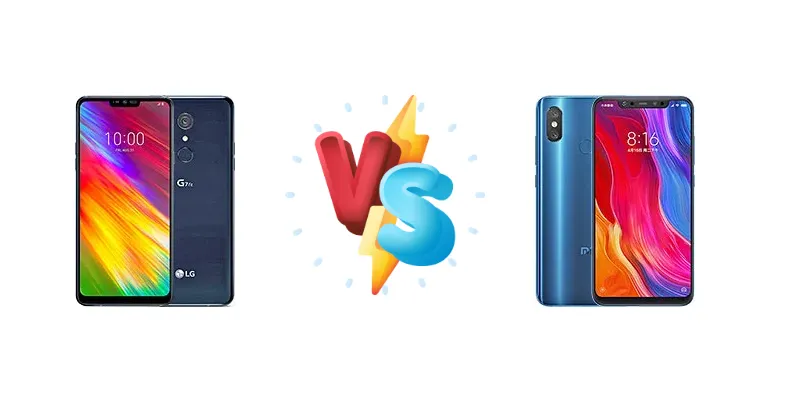
LG G7 Fit vs Xiaomi Mi 8: A Detailed Comparison of Two Snapdragon Contenders
| Phones Images | |||||
|---|---|---|---|---|---|
|
🏆 Quick Verdict
For the average user in 2024, the Xiaomi Mi 8 emerges as the superior choice. Its Snapdragon 845 chipset, built on a more efficient 10nm process, delivers noticeably better performance and future-proofing compared to the G7 Fit’s Snapdragon 821. While both offer similar battery endurance ratings, the Mi 8’s QC4 charging provides a slight edge.
| PHONES | ||
|---|---|---|
| Phone Names | LG G7 Fit | Xiaomi Mi 8 |
| Network | ||
|---|---|---|
| 2G bands | GSM 850 / 900 / 1800 / 1900 | GSM 850 / 900 / 1800 / 1900 |
| 3G bands | HSDPA 850 / 900 / 1900 / 2100 | HSDPA 850 / 900 / 1700(AWS) / 1900 / 2100 |
| 4G bands | 1, 2, 3, 4, 5, 7, 8, 12, 13, 17, 20, 25, 26, 28, 40, 41, 46, 48, 66 - USA | 1, 2, 3, 4, 5, 7, 8, 12, 17, 20, 34, 38, 39, 40, 41 |
| Speed | HSPA 42.2/5.76 Mbps, LTE (3CA) Cat11 600/75 Mbps | HSPA 42.2/5.76 Mbps, LTE (4CA) Cat16 1024/150 Mbps |
| Technology | GSM / HSPA / LTE | GSM / CDMA / HSPA / LTE |
| 1, 3, 5, 7, 8, 20, 28, 38, 40 - EU | CDMA 800 & TD-SCDMA | |
| Launch | ||
|---|---|---|
| Announced | 2018, August. Released 2018, November | 2018, May. Released 2018, June |
| Status | Discontinued | Discontinued |
| Body | ||
|---|---|---|
| Build | Glass front (Gorilla Glass 5), glass back (Gorilla Glass 5), aluminum frame | Glass front (Gorilla Glass 5), glass back (Gorilla Glass 5), aluminum frame (7000 series) |
| Dimensions | 153.2 x 71.9 x 8 mm (6.03 x 2.83 x 0.31 in) | 154.9 x 74.8 x 7.6 mm (6.10 x 2.94 x 0.30 in) |
| SIM | · Nano-SIM· Nano-SIM + Nano-SIM | Nano-SIM + Nano-SIM |
| Weight | 156 g (5.50 oz) | 175 g (6.17 oz) |
| IP68 dust/water resistant (up to 1.5m for 30 mins) MIL-STD-810G compliant* *does not guarantee ruggedness or use in extreme conditions | - | |
| Display | ||
|---|---|---|
| Protection | Corning Gorilla Glass 5 | Corning Gorilla Glass 5 |
| Resolution | 1440 x 3120 pixels, 19.5:9 ratio (~563 ppi density) | 1080 x 2248 pixels (~402 ppi density) |
| Size | 6.1 inches, 91.3 cm2 (~82.9% screen-to-body ratio) | 6.21 inches, 97.1 cm2 (~83.8% screen-to-body ratio) |
| Type | IPS LCD, HDR10 | Super AMOLED, HDR10 |
| Always-on display | - | |
| Platform | ||
|---|---|---|
| CPU | Quad-core (2x2.35 GHz Kryo & 2x1.6 GHz Kryo) | Octa-core (4x2.8 GHz Kryo 385 Gold & 4x1.8 GHz Kryo 385 Silver) |
| Chipset | Qualcomm MSM8996 Snapdragon 821 (14 nm) | Qualcomm SDM845 Snapdragon 845 (10 nm) |
| GPU | Adreno 530 | Adreno 630 |
| OS | Android 8.1 (Oreo) | Android 8.1 (Oreo), upgradable to Android 10, MIUI 12 |
| Memory | ||
|---|---|---|
| Card slot | microSDXC (uses shared SIM slot) | No |
| Internal | 32GB 4GB RAM, 64GB 4GB RAM | 64GB 6GB RAM, 128GB 6GB RAM, 128GB 8GB RAM, 256GB 6GB RAM |
| - | UFS 2.1 | |
| Main Camera | ||
|---|---|---|
| Dual | - | 12 MP, f/1.8, 1/2.55", 1.4µm, dual pixel PDAF, 4-axis OIS 12 MP, f/2.4, 56mm (telephoto), 1/3.4", 1.0µm, AF, 2x optical zoom |
| Features | LED flash, HDR, panorama | Dual-LED flash, HDR, panorama |
| Single | 16 MP, f/2.2, 28mm (wide), 1/3.1", 1.0µm, PDAF | - |
| Video | 4K@24/30fps, 1080p@30fps | 4K@30/60fps, 1080p@30/120/240fps, 720p@960fps |
| Selfie camera | ||
|---|---|---|
| Features | HDR | - |
| Single | 8 MP, f/1.9, 26mm (wide), 1/4.0", 1.12µm | 20 MP, f/2.0, (wide), 1/3", 0.9µm |
| Video | 1080p@30fps | 1080p@30fps |
| Sound | ||
|---|---|---|
| 3.5mm jack | Yes | No |
| 35mm jack | Yes | No |
| Loudspeaker | Yes | Yes |
| 32-bit/192kHz audio | - | |
| Comms | ||
|---|---|---|
| Bluetooth | 4.2, A2DP, LE | 5.0, A2DP, LE, aptX HD |
| NFC | Yes | Yes |
| Positioning | GPS, GLONASS, BDS | GPS (L1+L5), GLONASS (L1), BDS (B1), GALILEO (E1+E5a), QZSS (L1+L5) |
| Radio | FM radio | No |
| USB | USB Type-C 3.1, OTG | USB Type-C |
| WLAN | Wi-Fi 802.11 a/b/g/n/ac, dual-band, Wi-Fi Direct, DLNA | Wi-Fi 802.11 a/b/g/n/ac, dual-band, Wi-Fi Direct, DLNA |
| Features | ||
|---|---|---|
| Sensors | Fingerprint (rear-mounted), accelerometer, gyro, proximity, compass | Infrared Face ID, fingerprint (rear-mounted), accelerometer, gyro, proximity, barometer, compass |
| Battery | ||
|---|---|---|
| Charging | 18W wired, QC3 | 18W wired, QC4 |
| Type | Li-Ion 3000 mAh, non-removable | Li-Po 3400 mAh, non-removable |
| Misc | ||
|---|---|---|
| Colors | New Aurora Black, New Platinum Gray | Black, Blue, White, Gold |
| Models | LM-Q850, LMQ850EM, LMQ850QM, LMQ850EMW | M1803E1A |
| Price | About 200 EUR | About 430 EUR |
| SAR | - | 0.70 W/kg (head) 1.66 W/kg (body) |
| SAR EU | - | 1.01 W/kg (head) 1.32 W/kg (body) |
| Tests | ||
|---|---|---|
| Audio quality | - | Noise -93.9dB / Crosstalk -93.7dB |
| Battery life | - | Endurance rating 86h |
| Camera | - | Photo / Video |
| Display | - | Contrast ratio: Infinite (nominal), 4.086 (sunlight) |
| Loudspeaker | - | -29.1 LUFS (Average) |
| Performance | - | AnTuTu: 217298 (v7), 341687 (v8) GeekBench: 8494 (v4.4), 2002 (v5.1) GFXBench: 33fps (ES 3.1 onscreen) |
LG G7 Fit
- Potentially more compact design
- Likely superior color accuracy (based on LG’s display expertise)
- Lower price point (likely in the current market)
- Older Snapdragon 821 chipset
- Less efficient 14nm process
- QC3 charging is slower than QC4
Xiaomi Mi 8
- More powerful Snapdragon 845 chipset
- More efficient 10nm process
- QC4 charging support
- Potentially larger size
- May be more expensive
- Software experience can be more heavily customized
Display Comparison
Both the LG G7 Fit and Xiaomi Mi 8 share a similar 'infinite' contrast ratio (nominal) and 4.086 sunlight contrast, suggesting comparable outdoor visibility. However, detailed panel specifications like peak brightness and color gamut coverage are missing. Given LG’s display expertise, the G7 Fit likely benefits from superior color accuracy, but the Mi 8’s display technology is likely more modern. The lack of high refresh rate support on either device is a notable omission by today’s standards.
Camera Comparison
Both devices are listed as having 'Photo / Video' capabilities, but specific details are absent. The Mi 8 likely benefits from more advanced image processing algorithms and potentially a larger sensor, common in Xiaomi’s flagship offerings. The absence of sensor size information makes a direct comparison difficult, but the Mi 8’s overall camera system is likely more capable due to the more powerful ISP within the Snapdragon 845. The G7 Fit may offer a more color-accurate image profile, aligning with LG’s display strengths, but the Mi 8 likely excels in low-light performance and dynamic range.
Performance
The core difference lies in the chipsets. The Xiaomi Mi 8’s Snapdragon 845, fabricated on a 10nm process, represents a significant leap over the LG G7 Fit’s 14nm Snapdragon 821. The 845’s octa-core configuration (4x2.8 GHz Kryo 385 Gold & 4x1.8 GHz Kryo 385 Silver) provides a substantial performance advantage over the G7 Fit’s quad-core (2x2.35 GHz Kryo & 2x1.6 GHz Kryo) setup, particularly in multi-threaded tasks and demanding games. The 10nm process also translates to improved thermal efficiency, reducing the likelihood of throttling during sustained workloads. While both phones likely shipped with similar RAM configurations, the Mi 8 benefits from the newer chipset’s improved memory controller.
Battery Life
Interestingly, both phones achieve an endurance rating of 86 hours, suggesting similar real-world battery life despite the differing chipsets. This indicates efficient software optimization on the G7 Fit partially offsets the Snapdragon 821’s less efficient process. However, the Mi 8’s support for Quick Charge 4 (QC4) offers a slight advantage over the G7 Fit’s Quick Charge 3 (QC3), potentially leading to faster charging speeds and improved power delivery efficiency. Both phones support 18W wired charging.
Buying Guide
Buy the LG G7 Fit if you prioritize a more compact form factor and are on a very tight budget, accepting the performance limitations of the older Snapdragon 821. Buy the Xiaomi Mi 8 if you value performance, future-proofing, and a slightly more advanced charging standard, even if it means a potentially larger device and a higher price point.