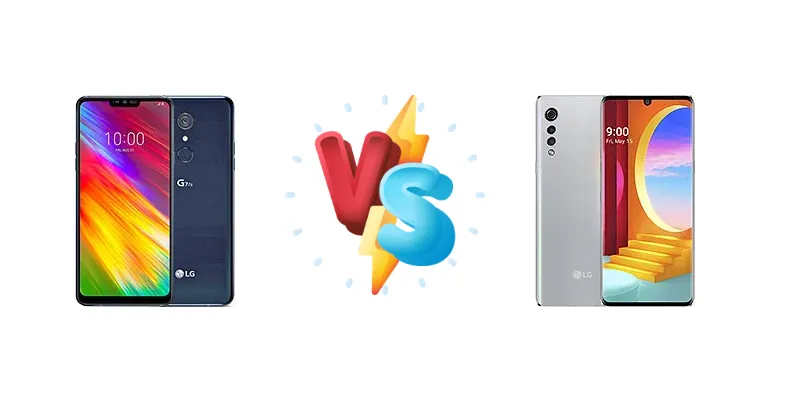
The LG G7 Fit and LG Velvet represent different points in LG’s smartphone strategy. The G7 Fit, released as a more affordable variant of the G7, aimed to deliver flagship-adjacent performance. The Velvet, arriving later, signaled a design shift and a focus on a more refined user experience. Both rely on Qualcomm Snapdragon chipsets, but a generation gap exists. This comparison dissects the differences between the Snapdragon 821 in the G7 Fit and the Snapdragon 845 in the Velvet, revealing which phone offers the best balance of power, features, and value.
🏆 Quick Verdict
For most users, the LG Velvet is the superior choice. While the G7 Fit offers a compelling price point, the Snapdragon 845 in the Velvet provides a noticeable performance uplift, particularly in sustained workloads and gaming, alongside the added convenience of wireless charging. The Velvet’s more modern architecture translates to a smoother, more future-proof experience.
| Network |
|---|
| 2G bands | GSM 850 / 900 / 1800 / 1900 | GSM 850 / 900 / 1800 / 1900 |
| 3G bands | HSDPA 850 / 900 / 1900 / 2100 | HSDPA 850 / 900 / 1900 / 2100 |
| 4G bands | 1, 2, 3, 4, 5, 7, 8, 12, 13, 17, 20, 25, 26, 28, 40, 41, 46, 48, 66 - USA | 1, 3, 7, 8, 20, 28, 38, 40 |
| Speed | HSPA 42.2/5.76 Mbps, LTE (3CA) Cat11 600/75 Mbps | HSPA, LTE |
| Technology | GSM / HSPA / LTE | GSM / HSPA / LTE |
| | 1, 3, 5, 7, 8, 20, 28, 38, 40 - EU | - |
| Launch |
|---|
| Announced | 2018, August. Released 2018, November | 2020, July 28. Released 2020, July 31 |
| Status | Discontinued | Discontinued |
| Body |
|---|
| Build | Glass front (Gorilla Glass 5), glass back (Gorilla Glass 5), aluminum frame | Glass front, glass back, aluminum frame |
| Dimensions | 153.2 x 71.9 x 8 mm (6.03 x 2.83 x 0.31 in) | 167.1 x 74.1 x 7.9 mm (6.58 x 2.92 x 0.31 in) |
| SIM | · Nano-SIM· Nano-SIM + Nano-SIM | Nano-SIM + Nano-SIM |
| Weight | 156 g (5.50 oz) | 180 g (6.35 oz) |
| | IP68 dust/water resistant (up to 1.5m for 30 mins)
MIL-STD-810G compliant*
*does not guarantee ruggedness or use in extreme conditions | IP68 dust/water resistant (up to 1.5m for 30 min)
MIL-STD-810G compliant*
*does not guarantee ruggedness or use in extreme conditions |
| Display |
|---|
| Protection | Corning Gorilla Glass 5 | - |
| Resolution | 1440 x 3120 pixels, 19.5:9 ratio (~563 ppi density) | 1080 x 2460 pixels (~395 ppi density) |
| Size | 6.1 inches, 91.3 cm2 (~82.9% screen-to-body ratio) | 6.8 inches, 109.8 cm2 (~88.7% screen-to-body ratio) |
| Type | IPS LCD, HDR10 | P-OLED |
| | Always-on display | - |
| Platform |
|---|
| CPU | Quad-core (2x2.35 GHz Kryo & 2x1.6 GHz Kryo) | Octa-core (4x2.8 GHz Kryo 385 Gold & 4x1.8 GHz Kryo 385 Silver) |
| Chipset | Qualcomm MSM8996 Snapdragon 821 (14 nm) | Qualcomm SDM845 Snapdragon 845 (10 nm) |
| GPU | Adreno 530 | Adreno 630 |
| OS | Android 8.1 (Oreo) | Android 10, upgradable to Android 12 |
| Memory |
|---|
| Card slot | microSDXC (uses shared SIM slot) | microSDXC (uses shared SIM slot) |
| Internal | 32GB 4GB RAM, 64GB 4GB RAM | 128GB 6GB RAM |
| | - | UFS 2.1 |
| Main Camera |
|---|
| Features | LED flash, HDR, panorama | LED flash, panorama, HDR |
| Single | 16 MP, f/2.2, 28mm (wide), 1/3.1", 1.0µm, PDAF | - |
| Triple | - | 48 MP, f/1.8, 26mm (wide), 1/2.0", 0.8µm, PDAF
8 MP, f/2.2, 120˚, 15mm (ultrawide), 1/4.0", 1.12µm
Auxiliary lens |
| Video | 4K@24/30fps, 1080p@30fps | 4K@30fps, 1080p@30/60fps, gyro-EIS |
| Selfie camera |
|---|
| Features | HDR | HDR |
| Single | 8 MP, f/1.9, 26mm (wide), 1/4.0", 1.12µm | 16 MP, f/1.9, 29mm (standard), 1/3.06, 1.0µm |
| Video | 1080p@30fps | 4K@30fps, 1080p@30fps |
| Sound |
|---|
| 3.5mm jack | Yes | Yes |
| 35mm jack | Yes | Yes |
| Loudspeaker | Yes | Yes, with stereo speakers |
| | 32-bit/192kHz audio | - |
| Comms |
|---|
| Bluetooth | 4.2, A2DP, LE | 5.1, A2DP, LE |
| NFC | Yes | Yes |
| Positioning | GPS, GLONASS, BDS | GPS |
| Radio | FM radio | FM radio |
| USB | USB Type-C 3.1, OTG | USB Type-C, OTG |
| WLAN | Wi-Fi 802.11 a/b/g/n/ac, dual-band, Wi-Fi Direct, DLNA | Wi-Fi 802.11 a/b/g/n/ac, dual-band, Wi-Fi Direct |
| Features |
|---|
| Sensors | Fingerprint (rear-mounted), accelerometer, gyro, proximity, compass | Fingerprint (under display, optical), accelerometer, gyro, proximity, compass, barometer |
| Battery |
|---|
| Charging | 18W wired, QC3 | 15W wired, QC3
9W wireless |
| Type | Li-Ion 3000 mAh, non-removable | Li-Po 4300 mAh |
| Misc |
|---|
| Colors | New Aurora Black, New Platinum Gray | Black, Aurora Silver |
| Models | LM-Q850, LMQ850EM, LMQ850QM, LMQ850EMW | LMG910EMW, LM-G910EMW |
| Price | About 200 EUR | About 360 EUR |
LG G7 Fit
- More affordable price point
- Compact and lightweight design
- Quick Charge 3.0 support
- Older Snapdragon 821 chipset
- Less efficient 14nm process
- No wireless charging
LG Velvet
- More powerful Snapdragon 845 chipset
- More efficient 10nm process
- Wireless charging support
- Potentially higher price
- May be larger and heavier
- Slightly slower wired charging (15W vs 18W)
Display Comparison
Neither LG provides detailed display specs in the provided data. However, given the G7 Fit’s positioning, it likely features an LCD panel, while the Velvet’s marketing emphasized a more premium experience, suggesting an OLED display. The Velvet’s newer design likely incorporates slimmer bezels. The difference in panel technology will impact contrast ratios and color accuracy, favoring the Velvet. While both likely support similar resolutions, the Velvet’s display is expected to be more visually appealing.
Camera Comparison
Without detailed camera specifications, a direct comparison is limited. However, the Velvet, being a later model, likely benefits from improved image processing algorithms and potentially larger sensor sizes. While both phones likely feature similar camera setups in terms of megapixel count, the Velvet’s newer ISP (Image Signal Processor) within the Snapdragon 845 will result in better dynamic range, noise reduction, and overall image quality. The G7 Fit’s camera will still be capable, but the Velvet will offer a more refined and versatile photography experience.
Performance
The core difference lies in the chipsets. The LG G7 Fit’s Snapdragon 821, built on a 14nm process, features a quad-core CPU. The LG Velvet’s Snapdragon 845, fabricated on a more efficient 10nm process, boasts an octa-core CPU. This translates to a significant performance advantage for the Velvet. The 845’s Kryo 385 cores, with higher clock speeds (2.8 GHz Gold vs 2.35 GHz Kryo), and increased core count, deliver faster processing speeds and improved multitasking capabilities. The 10nm process also contributes to better thermal efficiency, reducing the likelihood of throttling during extended gaming sessions. The Velvet will demonstrably outperform the G7 Fit in CPU-intensive tasks and graphically demanding games.
Battery Life
The G7 Fit offers 18W wired charging with Quick Charge 3.0 support. The Velvet steps up the convenience with 15W wired charging (also QC3 compatible) *and* 9W wireless charging. While the wired charging speeds are comparable, the addition of wireless charging on the Velvet is a significant advantage for users who prefer cable-free convenience. Battery life will depend on usage patterns, but the Snapdragon 845’s improved efficiency could partially offset any capacity differences, potentially leading to similar real-world battery performance despite unknown mAh values.
Buying Guide
Buy the LG G7 Fit if you prioritize affordability and are primarily a casual user who values a compact form factor and doesn't demand peak performance for demanding games or applications. Buy the LG Velvet if you prefer a more modern design, require better performance for multitasking and gaming, and appreciate the convenience of wireless charging. The Velvet is the better option for users who plan to keep their phone for several years.
Frequently Asked Questions
❓ Will the Snapdragon 821 in the G7 Fit struggle with modern, graphically intensive games like Genshin Impact?
Yes, the Snapdragon 821 will likely struggle with demanding titles like Genshin Impact, even at lower settings. The 821’s GPU is significantly less powerful than the 845’s Adreno 630, and the 14nm process is prone to thermal throttling, leading to performance drops during extended gaming sessions. The Velvet’s Snapdragon 845 will provide a much smoother and more enjoyable gaming experience.
❓ Does the LG Velvet’s wireless charging significantly impact its battery health over time?
Wireless charging generally generates more heat than wired charging, which *can* contribute to slightly faster battery degradation over the long term. However, the impact is usually minimal with modern smartphones and charging controllers. The Velvet’s 9W wireless charging isn’t particularly fast, which helps mitigate heat buildup. Using a high-quality wireless charger and avoiding overnight charging can further prolong battery life.
❓ Is the difference in CPU performance between the Snapdragon 821 and 845 noticeable in everyday tasks like browsing and social media?
While both chips are capable of handling everyday tasks, the Snapdragon 845 in the Velvet will provide a noticeably smoother and more responsive experience. App launch times will be faster, multitasking will be more fluid, and animations will be less likely to stutter. The 845’s increased core count and higher clock speeds contribute to a more seamless user experience.