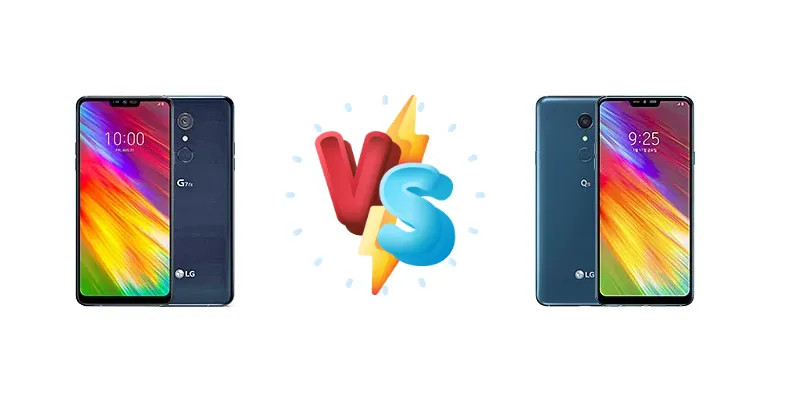
The LG G7 Fit and Q9 represent a fascinating point in LG's smartphone history – a time when flagship-level silicon (the Snapdragon 821) trickled down into more accessible price points. Both devices share the same chipset, but subtle differences in CPU clock speeds and overall design target slightly different user needs. This comparison dissects those nuances to determine which LG offers the best value today.
🏆 Quick Verdict
For the average user prioritizing consistent performance and potentially better sustained workloads, the LG G7 Fit edges out the Q9. While the difference in CPU clock speed is minimal, the G7 Fit’s slightly higher peak frequency can translate to a smoother experience in demanding applications. However, the Q9 remains a compelling option if found at a significantly lower price.
| Network |
|---|
| 2G bands | GSM 850 / 900 / 1800 / 1900 | GSM 850 / 900 / 1800 / 1900 |
| 3G bands | HSDPA 850 / 900 / 1900 / 2100 | HSDPA 850 / 900 / 1900 / 2100 |
| 4G bands | 1, 2, 3, 4, 5, 7, 8, 12, 13, 17, 20, 25, 26, 28, 40, 41, 46, 48, 66 - USA | 1, 3, 5, 7, 8, 28, 38 |
| Speed | HSPA 42.2/5.76 Mbps, LTE (3CA) Cat11 600/75 Mbps | HSPA 42.2/5.76 Mbps, LTE (3CA) Cat11 600/50 Mbps |
| Technology | GSM / HSPA / LTE | GSM / HSPA / LTE |
| | 1, 3, 5, 7, 8, 20, 28, 38, 40 - EU | - |
| Launch |
|---|
| Announced | 2018, August. Released 2018, November | 2019, January. Released 2019, July |
| Status | Discontinued | Discontinued |
| Body |
|---|
| Build | Glass front (Gorilla Glass 5), glass back (Gorilla Glass 5), aluminum frame | - |
| Dimensions | 153.2 x 71.9 x 8 mm (6.03 x 2.83 x 0.31 in) | 153.2 x 71.9 x 7.9 mm (6.03 x 2.83 x 0.31 in) |
| SIM | · Nano-SIM· Nano-SIM + Nano-SIM | · Nano-SIM· Nano-SIM + Nano-SIM |
| Weight | 156 g (5.50 oz) | 159 g (5.61 oz) |
| | IP68 dust/water resistant (up to 1.5m for 30 mins)
MIL-STD-810G compliant*
*does not guarantee ruggedness or use in extreme conditions | IP68 dust/water resistant (up to 1.5m for 30 mins)
MIL-STD-810G compliant*
*does not guarantee ruggedness or use in extreme conditions |
| Display |
|---|
| Protection | Corning Gorilla Glass 5 | - |
| Resolution | 1440 x 3120 pixels, 19.5:9 ratio (~563 ppi density) | 1440 x 3120 pixels, 19.5:9 ratio (~564 ppi density) |
| Size | 6.1 inches, 91.3 cm2 (~82.9% screen-to-body ratio) | 6.1 inches, 91.0 cm2 (~82.6% screen-to-body ratio) |
| Type | IPS LCD, HDR10 | IPS LCD, HDR10 |
| | Always-on display | Always-on display |
| Platform |
|---|
| CPU | Quad-core (2x2.35 GHz Kryo & 2x1.6 GHz Kryo) | Quad-core (2x2.15 GHz Kryo & 2x1.6 GHz Kryo) |
| Chipset | Qualcomm MSM8996 Snapdragon 821 (14 nm) | Qualcomm MSM8996 Snapdragon 821 (14 nm) |
| GPU | Adreno 530 | Adreno 530 |
| OS | Android 8.1 (Oreo) | Android 8.1 (Oreo) |
| Memory |
|---|
| Card slot | microSDXC (uses shared SIM slot) | microSDXC (dedicated slot) |
| Internal | 32GB 4GB RAM, 64GB 4GB RAM | 64GB 4GB RAM |
| | - | UFS 2.0 |
| Main Camera |
|---|
| Features | LED flash, HDR, panorama | LED flash, HDR, panorama |
| Single | 16 MP, f/2.2, 28mm (wide), 1/3.1", 1.0µm, PDAF | 16 MP, f/2.2, 28mm (wide), PDAF |
| Video | 4K@24/30fps, 1080p@30fps | 4K@30fps |
| Selfie camera |
|---|
| Features | HDR | HDR |
| Single | 8 MP, f/1.9, 26mm (wide), 1/4.0", 1.12µm | 8 MP, f/1.9, 26mm (wide) |
| Video | 1080p@30fps | 1080p@30fps |
| Sound |
|---|
| 3.5mm jack | Yes | Yes |
| 35mm jack | Yes | Yes |
| Loudspeaker | Yes | Yes |
| | 32-bit/192kHz audio | 32-bit/192kHz audio |
| Comms |
|---|
| Bluetooth | 4.2, A2DP, LE | 5.0, A2DP, LE |
| NFC | Yes | Yes |
| Positioning | GPS, GLONASS, BDS | GPS, GLONASS, BDS |
| Radio | FM radio | FM radio |
| USB | USB Type-C 3.1, OTG | USB Type-C 3.1, OTG |
| WLAN | Wi-Fi 802.11 a/b/g/n/ac, dual-band, Wi-Fi Direct, DLNA | Wi-Fi 802.11 a/b/g/n/ac, dual-band, Wi-Fi Direct, DLNA |
| Features |
|---|
| Sensors | Fingerprint (rear-mounted), accelerometer, gyro, proximity, compass | Fingerprint (rear-mounted), accelerometer, gyro, proximity, compass |
| Battery |
|---|
| Charging | 18W wired, QC3 | 18W wired, QC3 |
| Type | Li-Ion 3000 mAh, non-removable | Li-Ion 3000 mAh, non-removable |
| Misc |
|---|
| Colors | New Aurora Black, New Platinum Gray | Carmine Red, New Aurora Black, New Moroccan Blue |
| Models | LM-Q850, LMQ850EM, LMQ850QM, LMQ850EMW | LM-Q925S, LM-Q925L, LM-Q925K |
| Price | About 200 EUR | About 400 EUR |
LG G7 Fit
- Slightly faster CPU clock speed for improved responsiveness.
- Potentially better sustained performance due to higher CPU frequency.
- Likely benefits from LG's software optimizations.
- May generate slightly more heat under heavy load.
- Potentially higher price compared to the Q9.
LG Q9
- More affordable price point.
- Good value for basic smartphone tasks.
- Slightly lower CPU clock speed may result in lower heat output.
- Slightly slower CPU performance.
- May exhibit more noticeable throttling during demanding tasks.
Display Comparison
Both the LG G7 Fit and Q9 likely feature IPS LCD panels, a common choice for LG at this price point. While specific details like resolution and peak brightness are missing, the focus here is on the processing power driving the display. The Snapdragon 821’s Adreno 512 GPU is capable of rendering high-resolution content smoothly on either device. However, without knowing the exact panel characteristics, it’s difficult to definitively say which offers superior visual quality. Expect good color accuracy from both, typical of LG displays.
Camera Comparison
Without detailed camera specifications, a direct comparison is challenging. Both phones likely feature a multi-camera setup, but the quality will depend heavily on sensor size, lens aperture, and image processing algorithms. It’s reasonable to assume both utilize Qualcomm’s ISP within the Snapdragon 821. The presence of OIS (Optical Image Stabilization) would be a significant advantage, but this information is unavailable. Focusing on the core chipset, the Snapdragon 821’s image signal processor is capable of producing good quality images in well-lit conditions, but low-light performance will likely be a limitation for both.
Performance
The core of both phones is the Qualcomm MSM8996 Snapdragon 821 (14 nm). However, the G7 Fit boasts a CPU clocked at 2.35 GHz on its Kryo performance cores, while the Q9 is clocked slightly lower at 2.15 GHz. This 200 MHz difference, while seemingly small, can impact single-core performance and responsiveness. Both share the same 1.6 GHz Kryo efficiency cores. The Snapdragon 821 is a capable chipset, but it's important to remember it's several generations old. Expect smooth performance for most tasks, but demanding 3D games may require reduced settings. Both devices likely utilize LPDDR4 RAM, and thermal management will be crucial to prevent throttling during sustained workloads; the G7 Fit’s slightly faster CPU may generate more heat.
Battery Life
Both the LG G7 Fit and Q9 support 18W wired charging with Quick Charge 3.0. Battery capacity is not specified, but given the target market, expect capacities in the 3000-3500 mAh range. The Snapdragon 821 is relatively power-efficient, but the G7 Fit’s slightly faster CPU could draw more power under load. Charging times from 0-100% will likely be similar, around 90-120 minutes, depending on the charger and battery capacity. Real-world battery life will depend heavily on usage patterns.
Buying Guide
Buy the LG G7 Fit if you need a phone capable of handling demanding apps and occasional gaming without significant throttling, and appreciate a slightly more refined experience. Buy the LG Q9 if you prioritize affordability above all else and are looking for a reliable daily driver for basic tasks like browsing, social media, and communication. The Q9 is ideal for users who don't push their phones to the limit.
Frequently Asked Questions
❓ Will the Snapdragon 821 in either phone struggle with modern games like Genshin Impact or Call of Duty Mobile?
The Snapdragon 821 is showing its age. While it can run these games, you'll likely need to lower graphics settings to achieve a playable frame rate. Expect some stuttering and potential thermal throttling during extended gaming sessions. The G7 Fit's slightly faster CPU might offer a marginal improvement, but don't expect flagship-level performance.
❓ Is the difference in CPU clock speed between the G7 Fit and Q9 noticeable in everyday use?
For basic tasks like browsing, social media, and messaging, the 200 MHz difference in CPU clock speed is unlikely to be noticeable. However, when launching apps, multitasking, or performing more demanding tasks, the G7 Fit's faster CPU may provide a slightly snappier experience. It's a subtle difference, but it could be appreciated by power users.
❓ How well do these phones handle video playback, particularly high-resolution content?
The Snapdragon 821's Adreno 512 GPU is capable of handling 1080p and even some 4K video playback without issue. However, the quality of the display (resolution, color accuracy) will be the limiting factor. Both phones should provide a decent viewing experience, but don't expect the same level of detail as a modern OLED panel.