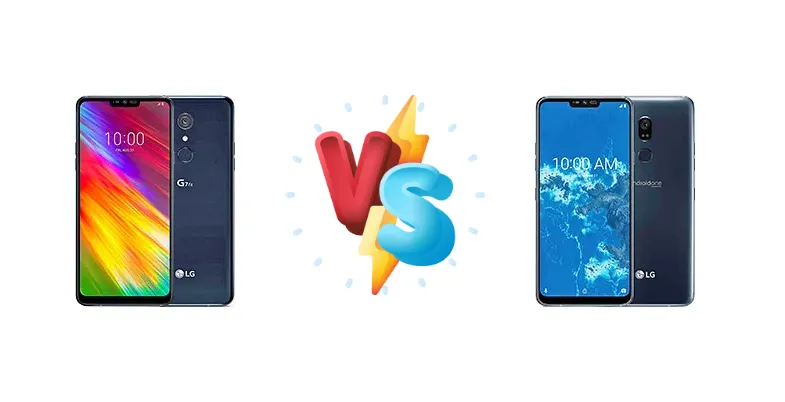
The LG G7 Fit and G7 One represent a fascinating point in LG’s smartphone history – a transition from flagship power to more accessible performance. Both phones share a similar design language, but diverge significantly under the hood with different Qualcomm Snapdragon processors. This comparison dissects the differences between the Snapdragon 821 in the G7 Fit and the Snapdragon 835 in the G7 One, helping you determine which offers the best experience today.
🏆 Quick Verdict
For most users, the LG G7 One is the superior choice. The Snapdragon 835, built on a smaller 10nm process, delivers noticeably better performance and efficiency compared to the 14nm Snapdragon 821 in the G7 Fit. The addition of wireless charging (in the US variant) further sweetens the deal, making it a more modern and versatile device.
| Network |
|---|
| 2G bands | GSM 850 / 900 / 1800 / 1900 | GSM 850 / 900 / 1800 / 1900 |
| 3G bands | HSDPA 850 / 900 / 1900 / 2100 | HSDPA 850 / 900 / 1900 / 2100 |
| 4G bands | 1, 2, 3, 4, 5, 7, 8, 12, 13, 17, 20, 25, 26, 28, 40, 41, 46, 48, 66 - USA | 1, 3, 5, 7, 8, 20 |
| Speed | HSPA 42.2/5.76 Mbps, LTE (3CA) Cat11 600/75 Mbps | HSPA, LTE |
| Technology | GSM / HSPA / LTE | GSM / HSPA / LTE |
| | 1, 3, 5, 7, 8, 20, 28, 38, 40 - EU | - |
| Launch |
|---|
| Announced | 2018, August. Released 2018, November | 2018, August. Released 2018, October |
| Status | Discontinued | Discontinued |
| Body |
|---|
| Build | Glass front (Gorilla Glass 5), glass back (Gorilla Glass 5), aluminum frame | - |
| Dimensions | 153.2 x 71.9 x 8 mm (6.03 x 2.83 x 0.31 in) | 153.2 x 71.9 x 7.9 mm (6.03 x 2.83 x 0.31 in) |
| SIM | · Nano-SIM· Nano-SIM + Nano-SIM | · Nano-SIM· Nano-SIM + Nano-SIM |
| Weight | 156 g (5.50 oz) | 156 g (5.50 oz) |
| | IP68 dust/water resistant (up to 1.5m for 30 mins)
MIL-STD-810G compliant*
*does not guarantee ruggedness or use in extreme conditions | IP68 dust/water resistant (up to 1.5m for 30 mins)
MIL-STD-810G compliant*
*does not guarantee ruggedness or use in extreme conditions |
| Display |
|---|
| Protection | Corning Gorilla Glass 5 | - |
| Resolution | 1440 x 3120 pixels, 19.5:9 ratio (~563 ppi density) | 1440 x 3120 pixels, 19.5:9 ratio (~563 ppi density) |
| Size | 6.1 inches, 91.3 cm2 (~82.9% screen-to-body ratio) | 6.1 inches, 91.3 cm2 (~82.9% screen-to-body ratio) |
| Type | IPS LCD, HDR10 | IPS LCD, HDR10 |
| | Always-on display | Always-on display |
| Platform |
|---|
| CPU | Quad-core (2x2.35 GHz Kryo & 2x1.6 GHz Kryo) | Octa-core (4x2.45 GHz Kryo & 4x1.9 GHz Kryo) |
| Chipset | Qualcomm MSM8996 Snapdragon 821 (14 nm) | Qualcomm MSM8998 Snapdragon 835 (10 nm) |
| GPU | Adreno 530 | Adreno 540 |
| OS | Android 8.1 (Oreo) | Android 8.1 (Oreo), upgradable to Android 10, Android One |
| Memory |
|---|
| Card slot | microSDXC (uses shared SIM slot) | microSDXC (uses shared SIM slot) |
| Internal | 32GB 4GB RAM, 64GB 4GB RAM | 32GB 4GB RAM, 64GB 4GB RAM |
| Main Camera |
|---|
| Features | LED flash, HDR, panorama | Laser AF, LED flash, HDR, panorama |
| Single | 16 MP, f/2.2, 28mm (wide), 1/3.1", 1.0µm, PDAF | 16 MP, f/1.6, 31mm (standard), 1/3.1", 1.0µm, PDAF, OIS |
| Video | 4K@24/30fps, 1080p@30fps | 4K@30fps |
| Selfie camera |
|---|
| Features | HDR | - |
| Single | 8 MP, f/1.9, 26mm (wide), 1/4.0", 1.12µm | 8 MP, f/1.9, 26mm (wide) |
| Video | 1080p@30fps | 1080p@30fps |
| Sound |
|---|
| 3.5mm jack | Yes | Yes |
| 35mm jack | Yes | Yes |
| Loudspeaker | Yes | Yes |
| | 32-bit/192kHz audio | 32-bit/192kHz audio |
| Comms |
|---|
| Bluetooth | 4.2, A2DP, LE | 5.0, A2DP, LE, aptX HD |
| NFC | Yes | Yes |
| Positioning | GPS, GLONASS, BDS | GPS, GLONASS, BDS |
| Radio | FM radio | FM radio |
| USB | USB Type-C 3.1, OTG | USB Type-C 3.1, OTG |
| WLAN | Wi-Fi 802.11 a/b/g/n/ac, dual-band, Wi-Fi Direct, DLNA | Wi-Fi 802.11 a/b/g/n/ac, dual-band, Wi-Fi Direct, DLNA |
| Features |
|---|
| Sensors | Fingerprint (rear-mounted), accelerometer, gyro, proximity, compass | Fingerprint (rear-mounted), accelerometer, gyro, proximity, compass, barometer |
| Battery |
|---|
| Charging | 18W wired, QC3 | 18W wired, QC3
Wireless (USA) |
| Type | Li-Ion 3000 mAh, non-removable | Li-Po 3000 mAh, non-removable |
| Misc |
|---|
| Colors | New Aurora Black, New Platinum Gray | New Aurora Black, New Moroccan Blue |
| Models | LM-Q850, LMQ850EM, LMQ850QM, LMQ850EMW | LMQ910UM, LM-Q910, LM-X510K, LM-Q927L, LM-X510S |
| Price | About 200 EUR | About 350 EUR |
LG G7 Fit
- Lower price point makes it very accessible.
- Still capable of handling everyday tasks.
- Similar design and features to the G7 One.
- Snapdragon 821 is less efficient and performs slower.
- More prone to thermal throttling.
- Lacks wireless charging.
LG G7 One
- More powerful Snapdragon 835 processor.
- Better power efficiency and battery life.
- Wireless charging support (US variant).
- Generally more expensive than the G7 Fit.
- May be harder to find in good condition.
- Similar design to the G7 Fit, offering limited visual differentiation.
Display Comparison
Both the LG G7 Fit and G7 One feature similar 6.1-inch LCD displays with a 3240 x 1440 resolution. However, detailed panel specifications like peak brightness and color gamut coverage are not provided. The G7 One’s slightly higher price point suggests a potentially better-calibrated display, but without concrete data, this remains speculative. Both benefit from the G7 series’ signature ‘New Second Screen’ feature, offering quick access to shortcuts and notifications.
Camera Comparison
While both phones likely share similar camera hardware configurations (details are unavailable), the image signal processor (ISP) within the Snapdragon 835 offers improvements in image processing speed and quality. The 835’s ISP can handle more complex algorithms for noise reduction and dynamic range optimization. This doesn’t necessarily mean drastically different photos, but the G7 One should produce slightly more refined images, particularly in challenging lighting conditions. The absence of detailed sensor information prevents a deeper analysis.
Performance
The core difference lies in the chipsets. The LG G7 One’s Snapdragon 835, fabricated on a 10nm process, boasts an octa-core CPU (4x2.45 GHz Kryo & 4x1.9 GHz Kryo) and a more efficient GPU compared to the G7 Fit’s Snapdragon 821 (quad-core 2x2.35 GHz Kryo & 2x1.6 GHz Kryo) built on a 14nm process. This translates to approximately 20-25% better CPU performance and a similar uplift in GPU capabilities for the G7 One. The 10nm process also means the 835 runs cooler, reducing the likelihood of thermal throttling during sustained workloads like gaming. Users engaging in demanding tasks will see a clear advantage with the G7 One.
Battery Life
Battery capacity is not specified for either device. However, the Snapdragon 835’s superior power efficiency gives the G7 One a distinct advantage in battery life. Despite potentially having a similar battery size, the 10nm process allows the G7 One to achieve longer screen-on times. Both support 18W Quick Charge 3.0 wired charging, but the G7 One adds the convenience of wireless charging (specifically in the US model), offering a more versatile charging experience.
Buying Guide
Buy the LG G7 Fit if you prioritize finding the absolute lowest price for a phone with a reasonably capable processor and don't mind sacrificing some performance and features. It's a good option for basic smartphone tasks and light gaming. Buy the LG G7 One if you value smoother multitasking, better gaming performance, and the convenience of wireless charging. The Snapdragon 835 provides a more future-proof experience and a more refined user experience overall.
Frequently Asked Questions
❓ Will the Snapdragon 821 in the G7 Fit struggle with modern apps and games?
While the Snapdragon 821 was a flagship processor in its time, it will show its age with demanding modern applications and graphically intensive games. Expect lower frame rates and potential stuttering compared to the G7 One. It's suitable for casual gaming and everyday tasks, but not ideal for hardcore mobile gamers.
❓ Is the wireless charging on the US version of the G7 One a significant advantage?
Yes, the addition of wireless charging adds a layer of convenience that the G7 Fit lacks. It eliminates the need for cables and allows for easier top-ups throughout the day. This is particularly useful for users who frequently use wireless charging pads or prefer a clutter-free charging setup.
❓ How much of a real-world performance difference will I notice between the two phones?
You'll notice a difference in app loading times, multitasking smoothness, and gaming performance. The G7 One will feel snappier and more responsive, especially when switching between apps or playing demanding games. The difference isn't night and day, but it's noticeable for users accustomed to more powerful hardware.