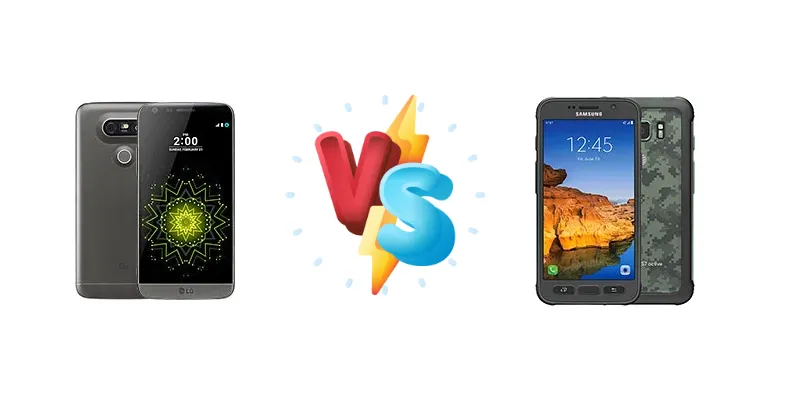
The LG G5 SE and Samsung Galaxy S7 Active represent different approaches to Android smartphones. The G5 SE aimed for a more compact and affordable flagship experience, while the S7 Active prioritized ruggedness and extended battery life. Let's dive into a detailed comparison to see which phone holds up best today.
🏆 Quick Verdict
The Samsung Galaxy S7 Active emerges as the winner thanks to its superior Snapdragon 820 chipset, exceptional battery life, and rugged design. While the G5 SE offered a modular approach, the S7 Active's overall performance and durability make it the more compelling choice.
| Network |
|---|
| 2G bands | GSM 850 / 900 / 1800 / 1900 - SIM 1 & SIM 2 (dual-SIM model only) | GSM 850 / 900 / 1800 / 1900 |
| 3G bands | HSDPA 850 / 900 / 1700(AWS) / 1900 / 2100 - H840 | HSDPA 850 / 1900 / 2100 |
| 4G bands | 1, 2, 3, 4, 5, 7, 8, 12, 17, 20, 28, 38, 40 - H840 | 1, 2, 3, 4, 5, 7, 8, 12, 20, 29, 30, 38, 39, 40, 41 |
| Speed | HSPA 42.2/5.76 Mbps, LTE (2CA) Cat6 300/50 Mbps | HSPA 42.2/5.76 Mbps, LTE (3CA) Cat9 450/50 Mbps |
| Technology | GSM / HSPA / LTE | GSM / HSPA / LTE |
| Launch |
|---|
| Announced | 2016, April. Released 2016, June | 2016, June. Released 2016, June |
| Status | Discontinued | Discontinued |
| Body |
|---|
| Build | - | Glass front (Gorilla Glass 4), plastic back, aluminum frame |
| Dimensions | 149.4 x 73.9 x 7.3 mm (5.88 x 2.91 x 0.29 in) | 148.8 x 74.9 x 9.9 mm (5.86 x 2.95 x 0.39 in) |
| SIM | · Nano-SIM· Nano-SIM + Nano-SIM | Nano-SIM |
| Weight | 156 g (5.50 oz) | 184.8 g (6.53 oz) |
| | - | IP68 dust/water resistant (up to 1.5m for 30 mins)
MIL-STD-810G compliant |
| Display |
|---|
| Protection | Corning Gorilla Glass 4 | Corning Gorilla Glass 4 |
| Resolution | 1440 x 2560 pixels, 16:9 ratio (~554 ppi density) | 1440 x 2560 pixels, 16:9 ratio (~576 ppi density) |
| Size | 5.3 inches, 77.4 cm2 (~70.1% screen-to-body ratio) | 5.1 inches, 71.7 cm2 (~64.3% screen-to-body ratio) |
| Type | IPS LCD | Super AMOLED |
| | Always-on display | Always-on display |
| Platform |
|---|
| CPU | Octa-core (4x1.8 GHz Cortex-A72 & 4x1.2 GHz Cortex-A53) | Quad-core (2x2.15 GHz Kryo & 2x1.6 GHz Kryo) |
| Chipset | Qualcomm MSM8976 Snapdragon 652 (28 nm) | Qualcomm MSM8996 Snapdragon 820 (14 nm) |
| GPU | Adreno 510 | Adreno 530 |
| OS | Android 6.0.1 (Marshmallow), upgradable to 7.0 (Nougat), LG Optimus UX UI 5 | Android 6.0 (Marshmallow), upgradable to 7.0 (Nougat), TouchWiz UI |
| Memory |
|---|
| Card slot | microSDXC (uses shared SIM slot) - dual SIM model only | microSDXC (dedicated slot) |
| Internal | 32GB 3GB RAM | 32GB 4GB RAM |
| | eMMC 5.1 | - |
| Main Camera |
|---|
| Dual | 16 MP, f/1.8, 29mm (standard), 1/2.6", 3-axis OIS
8 MP, f/2.4, 12mm (ultrawide), 1/3.2" | - |
| Features | Laser AF, color spectrum sensor, LED flash, panorama, HDR | LED flash, auto-HDR, panorama |
| Single | - | 12 MP, f/1.7, 26mm (wide), 1/2.55", 1.4µm, dual pixel PDAF, OIS |
| Video | 4K@30fps, 1080p@30fps, HDR, stereo sound rec. | 4K@30fps, 1080p@30fps (gyro-EIS), 1080p@60fps, 720p@240fps, HDR, stereo sound rec., OIS |
| Selfie camera |
|---|
| Features | - | HDR |
| Single | 8 MP, f/2.0 | 5 MP, f/1.7, 22mm (wide), 1/4.1", 1.34µm |
| Video | 1080p@30fps | - |
| Sound |
|---|
| 3.5mm jack | Yes | Yes |
| 35mm jack | Yes | Yes |
| Loudspeaker | Yes | Yes |
| Comms |
|---|
| Bluetooth | 4.2, A2DP, LE, aptX | 4.2, A2DP, LE, aptX |
| Infrared port | Yes | - |
| NFC | Yes | Yes |
| Positioning | GPS, GLONASS | GPS, GLONASS |
| Radio | FM radio | Stereo FM radio, RDS |
| USB | USB Type-C 2.0, OTG | microUSB 2.0, OTG |
| WLAN | Wi-Fi 802.11 a/b/g/n/ac, dual-band, Wi-Fi Direct, DLNA | Wi-Fi 802.11 a/b/g/n/ac, dual-band, Wi-Fi Direct |
| Features |
|---|
| Sensors | Fingerprint (rear-mounted), accelerometer, gyro, proximity, compass, barometer | Fingerprint (front-mounted), accelerometer, gyro, proximity, compass, barometer, heart rate, SpO2 |
| | - | ANT+
S-Voice natural language commands and dictation
Samsung Pay (Visa, MasterCard certified) |
| Battery |
|---|
| Charging | 18W wired, QC3 | 15W wired, QC2
Wireless (Qi) (market dependent) |
| Music play | - | Up to 110 h |
| Stand-by | Up to 380 h (3G) | Up to 384 h (3G) |
| Talk time | Up to 20 h (3G) | Up to 32 h (3G) |
| Type | Li-Ion 2800 mAh, removable | Li-Ion 4000 mAh, non-removable |
| Misc |
|---|
| Colors | Silver, Titan, Gold | Camo Green, Titanium Gray, Sandy Gold |
| Models | H845, H840, H848 | SM-G891A |
| Price | About 350 EUR | About 360 EUR |
| SAR | - | 0.92 W/kg (head) 0.75 W/kg (body) |
| SAR EU | - | 0.32 W/kg (head) 0.98 W/kg (body) |
| Tests |
|---|
| Audio quality | - |
Noise -94.3dB / Crosstalk -93.4dB |
| Battery life | - | Endurance rating 96h |
| Loudspeaker | - |
Voice 72dB / Noise 66dB / Ring 78dB |
| Performance | - |
Basemark OS II 2.0: 2487Basemark X: 32362 |
LG G5 SE
- Compact size
- Modular design (though limited support now)
- Decent camera
- Weaker processor
- Shorter battery life
- Limited software updates
Samsung Galaxy S7 active
- Excellent battery life
- Rugged design
- Powerful processor
- Vibrant display
- Larger size
- Less modern design
- QC2 charging
Display Comparison
The LG G5 SE features a 5.3-inch IPS LCD display, while the S7 Active boasts a 5.1-inch Super AMOLED display. The S7 Active's AMOLED screen offers richer colors, deeper blacks, and better contrast, making it the clear winner for visual quality. Both have decent resolution, but the S7 Active's vibrancy is noticeable.
Camera Comparison
Both phones offer capable cameras, but the S7 Active generally produces better images. The S7 Active's camera benefits from Samsung's image processing, resulting in more vibrant and detailed photos. Low-light performance is also slightly better on the S7 Active. The G5 SE's camera is still respectable, but lacks the S7 Active's polish.
Performance
The Samsung Galaxy S7 Active's Snapdragon 820 chipset significantly outperforms the LG G5 SE's Snapdragon 652. The 820's superior processing power translates to smoother multitasking, faster app loading times, and better overall responsiveness. The S7 Active handles demanding games and applications with ease, while the G5 SE can show signs of lag.
Battery Life
The Samsung Galaxy S7 Active's battery life is a standout feature, consistently achieving impressive endurance ratings. The G5 SE's battery is adequate, but falls short of the S7 Active's longevity. The S7 Active's larger battery capacity and efficient chipset contribute to its exceptional battery performance.
Buying Guide
The LG G5 SE is a good option for users prioritizing a smaller form factor and a slightly more modern design, but are willing to compromise on performance and battery. The Samsung Galaxy S7 Active is ideal for those needing a durable phone with outstanding battery life and reliable performance, especially in demanding environments.
Frequently Asked Questions
❓ Is the LG G5 SE's modular design still useful?
The modular design was innovative, but support for modules is extremely limited now, making it largely irrelevant.
❓ Which phone is more durable?
The Samsung Galaxy S7 Active is significantly more durable thanks to its ruggedized design and water/dust resistance.
❓ Which phone has better software support?
Neither phone receives active software updates anymore. However, the S7 Active's more powerful hardware might allow it to run slightly newer apps.