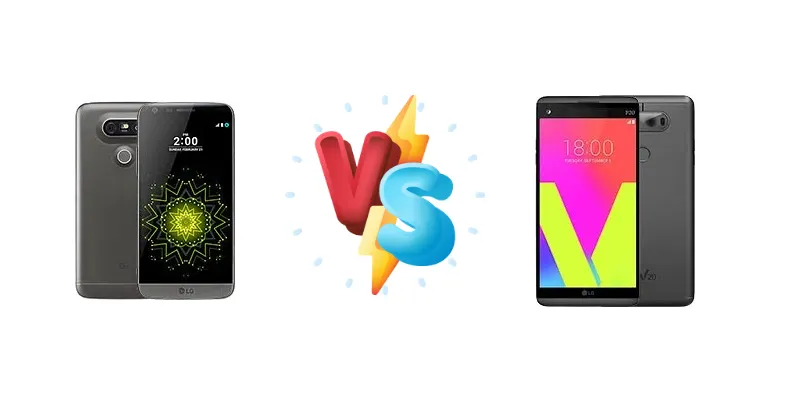
LG's G5 SE and V20 represent different points in the company's smartphone history. The G5 SE aimed for affordability, while the V20 was a flagship powerhouse. But which one holds up better today? Let's dive into a comprehensive comparison to help you decide.
🏆 Quick Verdict
The LG V20 wins overall thanks to its superior Snapdragon 820 chipset, better camera capabilities, and slightly more premium build. While the G5 SE offers a more budget-friendly option, the V20's performance and features justify its higher price point, especially considering its age.
| Network |
|---|
| 2G bands | GSM 850 / 900 / 1800 / 1900 - SIM 1 & SIM 2 (dual-SIM model only) | GSM 850 / 900 / 1800 / 1900 - SIM 1 & SIM 2 (dual-SIM model only) |
| 3G bands | HSDPA 850 / 900 / 1700(AWS) / 1900 / 2100 - H840 | HSDPA 850 / 900 / 1700(AWS) / 1900 / 2100 |
| 4G bands | 1, 2, 3, 4, 5, 7, 8, 12, 17, 20, 28, 38, 40 - H840 | 1, 2, 3, 4, 5, 7, 8, 12, 17, 20, 26, 28, 38, 39, 40, 41 |
| Speed | HSPA 42.2/5.76 Mbps, LTE (2CA) Cat6 300/50 Mbps | HSPA 42.2/5.76 Mbps, LTE Cat6, Cat9 (3CA) or LTE Cat12 (3CA) 600/150 Mbps |
| Technology | GSM / HSPA / LTE | GSM / HSPA / LTE |
| Launch |
|---|
| Announced | 2016, April. Released 2016, June | 2016, September 07. Released 2016, October 21 |
| Status | Discontinued | Discontinued |
| Body |
|---|
| Build | - | Glass front (Gorilla Glass 4), aluminum back, aluminum frame (6000 series) |
| Dimensions | 149.4 x 73.9 x 7.3 mm (5.88 x 2.91 x 0.29 in) | 159.7 x 78.1 x 7.6 mm (6.29 x 3.07 x 0.30 in) |
| SIM | · Nano-SIM· Nano-SIM + Nano-SIM | · Nano-SIM· Nano-SIM + Nano-SIM |
| Weight | 156 g (5.50 oz) | 174 g (6.14 oz) |
| | - | MIL-STD-810G compliant*
*does not guarantee ruggedness or use in extreme conditions |
| Display |
|---|
| Protection | Corning Gorilla Glass 4 | Corning Gorilla Glass 4 |
| Resolution | 1440 x 2560 pixels, 16:9 ratio (~554 ppi density) | 1440 x 2560 pixels, 16:9 ratio (~513 ppi density) |
| Size | 5.3 inches, 77.4 cm2 (~70.1% screen-to-body ratio) | 5.7 inches, 90.3 cm2 (~72.4% screen-to-body ratio) |
| Type | IPS LCD | IPS LCD |
| | Always-on display | Secondary display, 160 x 1040 pixels, 2.1 inches |
| Platform |
|---|
| CPU | Octa-core (4x1.8 GHz Cortex-A72 & 4x1.2 GHz Cortex-A53) | Quad-core (2x2.15 GHz Kryo & 2x1.6 GHz Kryo) |
| Chipset | Qualcomm MSM8976 Snapdragon 652 (28 nm) | Qualcomm MSM8996 Snapdragon 820 (14 nm) |
| GPU | Adreno 510 | Adreno 530 |
| OS | Android 6.0.1 (Marshmallow), upgradable to 7.0 (Nougat), LG Optimus UX UI 5 | Android 7.0 (Nougat), upgradable to Android 9.0 (Pie) |
| Memory |
|---|
| Card slot | microSDXC (uses shared SIM slot) - dual SIM model only | microSDXC (dedicated slot) |
| Internal | 32GB 3GB RAM | 32GB 4GB RAM, 64GB 4GB RAM |
| | eMMC 5.1 | UFS 2.1 |
| Main Camera |
|---|
| Dual | 16 MP, f/1.8, 29mm (standard), 1/2.6", 3-axis OIS
8 MP, f/2.4, 12mm (ultrawide), 1/3.2" | 16 MP, f/1.8, 29mm (standard), 1/2.6", 3-axis OIS
8 MP, f/2.4, 12mm (ultrawide), 1/3.2", no AF |
| Features | Laser AF, color spectrum sensor, LED flash, panorama, HDR | Laser AF, color spectrum sensor, Dual-LED flash, panorama, HDR |
| Video | 4K@30fps, 1080p@30fps, HDR, stereo sound rec. | 4K@30fps, 1080p@30fps, 720p@120fps, 24-bit/192kHz stereo sound rec. |
| Selfie camera |
|---|
| Single | 8 MP, f/2.0 | 5 MP, f/1.9 |
| Video | 1080p@30fps | 1080p@30fps |
| Sound |
|---|
| 3.5mm jack | Yes | Yes |
| 35mm jack | Yes | Yes |
| Loudspeaker | Yes | Yes |
| | - | 32-bit/192kHz audio
24-bit/192kHz audio recording
B&O Play certified
|
| Comms |
|---|
| Bluetooth | 4.2, A2DP, LE, aptX | 4.2, A2DP, LE, aptX HD |
| Infrared port | Yes | Yes |
| NFC | Yes | Yes |
| Positioning | GPS, GLONASS | GPS, GLONASS |
| Radio | FM radio | FM radio, RDS (market dependent) |
| USB | USB Type-C 2.0, OTG | USB Type-C 2.0 |
| WLAN | Wi-Fi 802.11 a/b/g/n/ac, dual-band, Wi-Fi Direct, DLNA | Wi-Fi 802.11 a/b/g/n/ac, dual-band, Wi-Fi Direct, DLNA |
| Features |
|---|
| Sensors | Fingerprint (rear-mounted), accelerometer, gyro, proximity, compass, barometer | Fingerprint (rear-mounted), accelerometer, gyro, proximity, compass, barometer |
| Battery |
|---|
| Charging | 18W wired, QC3 | 18W wired, PD, QC3 |
| Stand-by | Up to 380 h (3G) | - |
| Talk time | Up to 20 h (3G) | - |
| Type | Li-Ion 2800 mAh, removable | Li-Ion 3200 mAh, removable |
| Misc |
|---|
| Colors | Silver, Titan, Gold | Titan, Silver, Pink |
| Models | H845, H840, H848 | H990, H918, H910, LS997, US996, VS995, F800L, F800S, F800K, H915, H910PR |
| Price | About 350 EUR | About 190 EUR |
| Tests |
|---|
| Audio quality | - |
Noise -93.0dB / Crosstalk -93.7dB |
| Battery life | - | Endurance rating 68h |
| Camera | - |
Photo / Video |
| Display | - |
Contrast ratio: 1097 (nominal), 3.402 (sunlight) |
| Loudspeaker | - |
Voice 68dB / Noise 68dB / Ring 80dB |
| Performance | - |
AnTuTu: 126973 (v7)
GFXBench: 12fps (ES 3.1 onscreen) |
LG G5 SE
- More affordable
- Compact size
- Decent performance for everyday tasks
- Quick Charge 3.0
- Weaker chipset
- Less impressive camera
- Older software support
- Plastic build
LG V20
- Powerful Snapdragon 820 chipset
- Excellent camera with dual-lens setup
- Secondary always-on display
- Premium metal and glass build
- Quick Charge 3.0, Power Delivery
- Higher price (when new)
- Older software support
- Finding a good condition unit can be difficult
- Larger size
Display Comparison
Both phones feature a 5.5-inch display with a 1097:1 contrast ratio and excellent sunlight readability (3.402). However, the V20's display is slightly brighter and offers more vibrant colors. The V20 also boasts a secondary, always-on display above the main screen, providing quick access to notifications and information.
Camera Comparison
The V20's camera system is a clear winner. It features a dual-lens setup on the rear, allowing for optical zoom and depth effects. While both phones capture decent photos, the V20's images are generally sharper, more detailed, and have better dynamic range. The V20 also offers more advanced video recording features.
Performance
The V20's Snapdragon 820 chipset is significantly faster and more efficient than the G5 SE's Snapdragon 652. This translates to smoother multitasking, faster app loading times, and better overall responsiveness. The V20's quad-core Kryo CPU outperforms the G5 SE's octa-core Cortex-A72/A53 combination in demanding tasks.
Battery Life
Both phones boast an endurance rating of 68 hours, suggesting comparable battery life. However, the V20's more efficient Snapdragon 820 chipset might provide slightly longer real-world usage, especially under heavy load.
Buying Guide
The LG G5 SE is a good choice for budget-conscious users who prioritize a compact size and decent performance for everyday tasks. The LG V20 is ideal for photography enthusiasts, power users who need a snappy experience, and those who appreciate a more robust build and dual-screen functionality (though finding one in good condition can be challenging).
Frequently Asked Questions
❓ Is the LG G5 SE still worth buying?
It can be a decent budget option for basic usage, but be aware of its limitations in performance and camera quality. Software support is also limited.
❓ What is the main difference between the LG G5 and G5 SE?
The 'SE' in G5 SE stands for 'Special Edition.' It uses a less powerful Snapdragon 652 chipset compared to the flagship G5's Snapdragon 808.
❓ Does the LG V20 still receive software updates?
LG has officially ended software support for the V20. You'll need to rely on custom ROMs for any further updates.