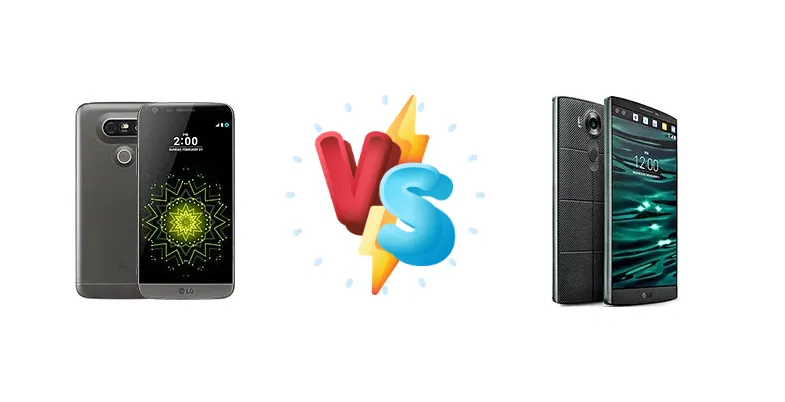
LG's G5 SE and V10 represent different eras of smartphone design and performance. The G5 SE aimed for affordability, while the V10 prioritized features and a unique design. But which one holds up best today? Let's dive into a comprehensive comparison.
🏆 Quick Verdict
The LG V10 edges out the G5 SE thanks to its superior battery life, slightly better performance, and the innovative dual-screen design. While the G5 SE offers a more modern chipset, the V10's overall package provides a more compelling experience, especially considering its age.
| Network |
|---|
| 2G bands | GSM 850 / 900 / 1800 / 1900 - SIM 1 & SIM 2 (dual-SIM model only) | GSM 850 / 900 / 1800 / 1900 - SIM 1 & SIM 2 (dual-SIM model only) |
| 3G bands | HSDPA 850 / 900 / 1700(AWS) / 1900 / 2100 - H840 | HSDPA 850 / 900 / 1900 / 2100 |
| 4G bands | 1, 2, 3, 4, 5, 7, 8, 12, 17, 20, 28, 38, 40 - H840 | 1, 3, 7, 8, 20 |
| Speed | HSPA 42.2/5.76 Mbps, LTE (2CA) Cat6 300/50 Mbps | HSPA 42.2/5.76 Mbps, LTE Cat6 300/50 Mbps |
| Technology | GSM / HSPA / LTE | GSM / HSPA / LTE |
| Launch |
|---|
| Announced | 2016, April. Released 2016, June | 2015, October. Released 2015, October |
| Status | Discontinued | Discontinued |
| Body |
|---|
| Build | - | Glass front (Gorilla Glass 4), plastic back, stainless steel/plastic frame |
| Dimensions | 149.4 x 73.9 x 7.3 mm (5.88 x 2.91 x 0.29 in) | 159.6 x 79.3 x 8.6 mm (6.28 x 3.12 x 0.34 in) |
| SIM | · Nano-SIM· Nano-SIM + Nano-SIM | · Nano-SIM· Nano-SIM + Nano-SIM |
| Weight | 156 g (5.50 oz) | 192 g (6.77 oz) |
| | - | MIL-STD-810G compliant*
*does not guarantee ruggedness or use in extreme conditions |
| Display |
|---|
| Protection | Corning Gorilla Glass 4 | Corning Gorilla Glass 4 |
| Resolution | 1440 x 2560 pixels, 16:9 ratio (~554 ppi density) | 1440 x 2560 pixels, 16:9 ratio (~515 ppi density) |
| Size | 5.3 inches, 77.4 cm2 (~70.1% screen-to-body ratio) | 5.7 inches, 89.6 cm2 (~70.8% screen-to-body ratio) |
| Type | IPS LCD | IPS LCD |
| | Always-on display | Secondary display, 160 x 1040 pixels, 2.1 inches |
| Platform |
|---|
| CPU | Octa-core (4x1.8 GHz Cortex-A72 & 4x1.2 GHz Cortex-A53) | Hexa-core (4x1.4 GHz Cortex-A53 & 2x1.8 GHz Cortex-A57) |
| Chipset | Qualcomm MSM8976 Snapdragon 652 (28 nm) | Qualcomm MSM8992 Snapdragon 808 (20 nm) |
| GPU | Adreno 510 | Adreno 418 |
| OS | Android 6.0.1 (Marshmallow), upgradable to 7.0 (Nougat), LG Optimus UX UI 5 | Android 5.1.1 (Lollipop), upgradable to 7.0 (Nougat) |
| Memory |
|---|
| Card slot | microSDXC (uses shared SIM slot) - dual SIM model only | microSDXC (dedicated slot) |
| Internal | 32GB 3GB RAM | 32GB 4GB RAM, 64GB 4GB RAM |
| | eMMC 5.1 | eMMC 5.0 |
| Main Camera |
|---|
| Dual | 16 MP, f/1.8, 29mm (standard), 1/2.6", 3-axis OIS
8 MP, f/2.4, 12mm (ultrawide), 1/3.2" | - |
| Features | Laser AF, color spectrum sensor, LED flash, panorama, HDR | Laser AF, color spectrum sensor, LED flash, panorama, HDR |
| Single | - | 16 MP, f/1.8, 1/2.6", OIS |
| Video | 4K@30fps, 1080p@30fps, HDR, stereo sound rec. | 4K@30fps, 1080p@30fps, 720p@120fps, HDR, stereo sound rec. |
| Selfie camera |
|---|
| Dual | - | 5 MP, f/2.2
5 MP |
| Single | 8 MP, f/2.0 | - |
| Video | 1080p@30fps | 1080p |
| Sound |
|---|
| 3.5mm jack | Yes | Yes |
| 35mm jack | Yes | Yes |
| Loudspeaker | Yes | Yes |
| | - | 32-bit/192kHz audio
|
| Comms |
|---|
| Bluetooth | 4.2, A2DP, LE, aptX | 4.1, A2DP, LE, aptX |
| Infrared port | Yes | Yes |
| NFC | Yes | Yes |
| Positioning | GPS, GLONASS | GPS, GLONASS |
| Radio | FM radio | FM radio |
| USB | USB Type-C 2.0, OTG | microUSB 2.0 (SlimPort 4K), OTG |
| WLAN | Wi-Fi 802.11 a/b/g/n/ac, dual-band, Wi-Fi Direct, DLNA | Wi-Fi 802.11 a/b/g/n/ac, dual-band, Wi-Fi Direct, DLNA, hotspot |
| Features |
|---|
| Sensors | Fingerprint (rear-mounted), accelerometer, gyro, proximity, compass, barometer | Fingerprint (rear-mounted), accelerometer, gyro, proximity, compass, barometer |
| Battery |
|---|
| Charging | 18W wired, QC3 | 18W wired, QC2, 50% in 40 min |
| Stand-by | Up to 380 h (3G) | Up to 150 h (2G) / Up to 150 h (3G) |
| Talk time | Up to 20 h (3G) | Up to 22 h (2G) / Up to 18 h (3G) |
| Type | Li-Ion 2800 mAh, removable | Li-Ion 3000 mAh, removable |
| Misc |
|---|
| Colors | Silver, Titan, Gold | Space Black, Luxe White, Modern Beige, Ocean Blue, Opal Blue |
| Models | H845, H840, H848 | VS990, f600, H900, H901, H960, H961, H962, H968, H961N, F600L, F600S, F600K, F600, H961AN |
| Price | About 350 EUR | About 250 EUR |
| SAR EU | - | 0.59 W/kg (head) |
| Tests |
|---|
| Audio quality | - |
Noise -93.3dB / Crosstalk -93.0dB |
| Battery life | - | Endurance rating 56h |
| Camera | - |
Photo / Video |
| Display | - |
Contrast ratio: 1490 (nominal), 2.744 (sunlight) |
| Loudspeaker | - |
Voice 66dB / Noise 64dB / Ring 70dB |
| Performance | - |
Basemark OS II 2.0: 1383Basemark X: 15161 |
LG G5 SE
- Slightly newer chipset
- More compact design
- QC3 fast charging
- Shorter battery life
- Less versatile camera
- Fewer features
LG V10
- Excellent battery life
- Unique dual-screen design
- Versatile camera system
- Robust build quality
- Older chipset
- Larger size
- QC2 fast charging
Display Comparison
Both phones feature a 5.3-inch Quad HD (2560 x 1440) IPS LCD display with a remarkable 1490:1 contrast ratio and excellent sunlight readability (2.744). However, the V10's secondary display adds a layer of functionality for notifications and shortcuts, a feature the G5 SE lacks. The V10's display feels slightly more refined.
Camera Comparison
The V10 boasts a more versatile camera system with dual 16MP rear cameras (one standard, one wide-angle) and a 5MP front-facing camera. The G5 SE has a single 16MP rear camera and a 5MP front camera. The V10's camera software is more mature and offers more features. Image quality is generally better on the V10, especially in low light.
Performance
The G5 SE's Snapdragon 652 offers a slight edge in raw processing power due to its newer Cortex-A72 cores. However, the V10's Snapdragon 808, while older, is still capable and benefits from more RAM (typically 4GB vs 3GB in the G5 SE). Real-world performance is generally comparable for everyday tasks.
Battery Life
The V10's battery life is a significant advantage, boasting an impressive endurance rating of 56 hours. The G5 SE's battery life is noticeably shorter, likely due to the more power-hungry chipset and smaller battery capacity. This is a key differentiator.
Buying Guide
The LG G5 SE is a good choice for budget-conscious users who prioritize a slightly newer chipset and a more compact design. The LG V10 is ideal for those seeking a unique dual-screen experience, excellent battery life, and a robust camera system, even if it means accepting an older device.
Frequently Asked Questions
❓ Is the LG V10 still worth buying in 2024?
Yes, if you value battery life, a unique dual-screen design, and a capable camera system. However, be aware that it's an older device and software updates are no longer available.
❓ Which phone has better performance?
The LG G5 SE has a slightly newer chipset, but the V10's overall performance is comparable for most everyday tasks. The V10's RAM advantage helps.