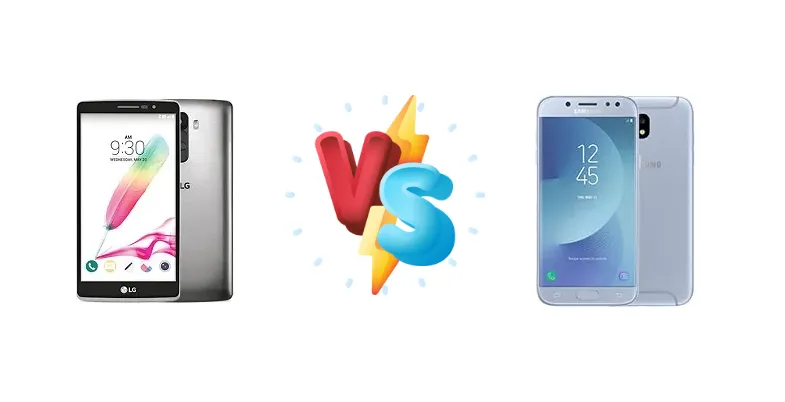
Choosing between two older Android phones can be tricky. The LG G4 Stylus offered a stylus and larger screen, while the Samsung Galaxy J5 (2017) focused on battery life and a more streamlined experience. Let's break down which phone is the better choice in 2024.
🏆 Quick Verdict
The Samsung Galaxy J5 (2017) edges out the LG G4 Stylus thanks to its more efficient chipset, longer battery life, and generally smoother performance. While the Stylus offers a unique stylus feature, the J5's overall package is more compelling for most users.
| Network |
|---|
| 2G bands | GSM 850 / 900 / 1800 / 1900 - SIM 1 & SIM 2 (optional) | GSM 850 / 900 / 1800 / 1900 - SIM 1 & SIM 2 (dual-SIM model only) |
| 3G bands | HSDPA 850 / 1900 / 2100 - H631 | HSDPA 850 / 900 / 1700(AWS) / 1900 / 2100 |
| 4G bands | 1, 3, 7, 8, 20 - H635 | 1, 3, 5, 7, 8, 20, 40 |
| Speed | HSPA 42.2/5.76 Mbps, LTE Cat4 150/50 Mbps | HSPA 42.2/5.76 Mbps, LTE (2CA) Cat6 300/50 Mbps |
| Technology | GSM / HSPA / LTE | GSM / HSPA / LTE |
| | 2, 40 - H630D | - |
| Launch |
|---|
| Announced | 2015, April. Released 2015, May | 2017, June. Released 2017, June |
| Status | Discontinued | Discontinued |
| Body |
|---|
| Build | - | Glass front, aluminum back, aluminum frame |
| Dimensions | 154.3 x 79.2 x 9.6 mm (6.07 x 3.12 x 0.38 in) | 146.2 x 71.3 x 8 mm (5.76 x 2.81 x 0.31 in) |
| SIM | · Micro-SIM - H631, H635, MS631, H542· Dual SIM (Micro-SIM, dual stand-by) - H540, H630D | · Nano-SIM· Nano-SIM + Nano-SIM |
| Weight | 163 g (5.75 oz) | 160 g (5.64 oz) |
| | Stylus | - |
| Display |
|---|
| Protection | Corning Gorilla Glass 3 | - |
| Resolution | 720 x 1280 pixels, 16:9 ratio (~258 ppi density) | 720 x 1280 pixels, 16:9 ratio (~282 ppi density) |
| Size | 5.7 inches, 89.6 cm2 (~73.3% screen-to-body ratio) | 5.2 inches, 74.5 cm2 (~71.5% screen-to-body ratio) |
| Type | IPS LCD | Super AMOLED |
| Platform |
|---|
| CPU | Quad-core 1.2 GHz Cortex-A53 - H631, H635, H630D, MS631Octa-core 1.4 GHz Cortex-A7 - H540 | Octa-core 1.6 GHz Cortex-A53 |
| Chipset | Qualcomm MSM8916 Snapdragon 410 (28 nm) - H631, H635, H630D, MS631Mediatek MT6592M - H540 | Exynos 7870 Octa (14 nm) |
| GPU | Adreno 306 - H631, H635, H630D, MS631Mali-450MP4 - H540 | Mali-T830 MP1 |
| OS | Android 5.0 (Lollipop), upgradable to 5.1 (Lollipop) | Android 7.0 (Nougat), upgradable to Android 9.0 (Pie), One UI |
| Memory |
|---|
| Card slot | microSDXC (dedicated slot) | microSDXC (dedicated slot) |
| Internal | 8GB 1GB RAM (H635,H540,H630D,H542), 16GB 2GB RAM (H631,MS631) | 16GB 2GB RAM, 32GB 2GB RAM, 32GB 3GB RAM |
| | eMMC 4.5 | eMMC 5.1 |
| Main Camera |
|---|
| Features | Laser AF, HDR, panorama, dual-LED flash (H631, H540, H630D, MS631), LED flash (H635) | LED flash, panorama, HDR |
| Single | 13 MP, f/2.4, OIS (H631, H540, H630D, MS631)
8 MP, f/2.4 (H635) | 13 MP, f/1.7, 27mm (wide), 1/3.1", 1.12µm, AF |
| Video | 1080p@30fps | 1080p@30fps |
| Selfie camera |
|---|
| Features | - | LED flash |
| Single | 5 MP | 13 MP, f/1.9, 1/3.1", 1.12µm |
| Video | - | 1080p@30fps |
| Sound |
|---|
| 3.5mm jack | Yes | Yes |
| 35mm jack | Yes | Yes |
| Loudspeaker | Yes | Yes |
| Comms |
|---|
| Bluetooth | 4.1, A2DP | 4.1, A2DP |
| NFC | Yes | Yes |
| Positioning | GPS, GLONASS | GPS, GLONASS, BDS |
| Radio | FM radio | FM radio |
| USB | microUSB 2.0 | microUSB 2.0 |
| WLAN | Wi-Fi 802.11 a/b/g/n, Wi-Fi Direct, DLNA, hotspot | Wi-Fi 802.11 a/b/g/n/ac, dual-band, Wi-Fi Direct |
| Features |
|---|
| Sensors | Accelerometer, proximity | Fingerprint (front-mounted), accelerometer, gyro, proximity, compass |
| | - | ANT+ |
| Battery |
|---|
| Music play | - | Up to 83 h |
| Stand-by | Up to 432 h (3G) | - |
| Talk time | Up to 18 h (3G) | Up to 21 h (3G) |
| Type | Li-Ion 3000 mAh, removable | Li-Ion 3000 mAh, non-removable |
| Misc |
|---|
| Colors | Metallic Silver, Floral White | Blue, Pink, Gold, Black |
| Models | H540, H631, MS631, H635, H540, H630, H542, H630D | SM-J530F, SM-J530Y, SM-J530FM, SM-J530G, SM-J530YM, SM-J530L, SM-J530S, SM-J530K, SM-J530GM |
| Price | About 250 EUR | About 130 EUR |
| SAR EU | - | 0.35 W/kg (head) 1.36 W/kg (body) |
| Tests |
|---|
| Audio quality | - |
Noise -85.0dB / Crosstalk -90.3dB |
| Battery life | - |
Endurance rating 97h
|
| Camera | - |
Photo / Video |
| Display | - |
Contrast ratio: Infinite (nominal), 3.599 (sunlight) |
| Loudspeaker | - |
Voice 68dB / Noise 70dB / Ring 82dB
|
| Performance | - |
GeekBench: 3667 (v4.4)
GFXBench: 3.8fps (ES 3.1 onscreen) |
LG G4 Stylus
- Large 5.5-inch display
- Stylus functionality for note-taking and drawing
- Expandable storage via microSD card
- Manual camera controls (depending on variant)
- Outdated chipset leads to sluggish performance
- Shorter battery life
- Older software (limited updates)
- Bulkier design
Samsung Galaxy J5 (2017)
- Excellent battery life
- More efficient chipset for smoother performance
- Better camera image quality
- More modern design (for its time)
- Generally more reliable software experience (with custom ROM)
- Stylus not included
- Limited internal storage (though expandable)
- Screen not as vibrant as some modern displays
Display Comparison
Both phones feature a 5.5-inch display, but the Galaxy J5 (2017) likely has slightly better color accuracy and viewing angles due to its more modern panel. The contrast ratio claims are nominal and not truly indicative of real-world performance. The LG G4 Stylus's screen might be slightly brighter, but the J5's display is generally more pleasant to use.
Camera Comparison
The Galaxy J5 (2017) generally offers better image quality, especially in low light. While both phones have decent cameras for their time, the J5's processing tends to produce more natural-looking photos. The LG G4 Stylus's camera might offer more manual controls, but the J5's results are more consistently good.
Performance
The Samsung Galaxy J5 (2017)'s Exynos 7870 Octa chipset is significantly more powerful and efficient than the LG G4 Stylus's Snapdragon 410 or MediaTek MT6592M. Expect smoother multitasking, faster app loading times, and better overall responsiveness on the J5. The LG G4 Stylus can feel sluggish at times.
Battery Life
The Galaxy J5 (2017) boasts an impressive endurance rating of 97 hours, indicating exceptional battery life. The LG G4 Stylus's battery life is considerably shorter, struggling to last a full day with moderate use.
Buying Guide
Who should buy the LG G4 Stylus? Users who prioritize a large screen and stylus functionality for note-taking or drawing. Who should buy the Samsung Galaxy J5 (2017)? Users seeking excellent battery life, a reliable everyday phone, and a more modern software experience (assuming it's running a recent custom ROM).
Frequently Asked Questions
❓ Is the LG G4 Stylus still worth buying?
Only if you specifically need a stylus and don't mind the outdated hardware. Otherwise, there are better options available.
❓ Can I update the software on either of these phones?
The LG G4 Stylus has largely stopped receiving updates. The Galaxy J5 (2017) might be able to run custom ROMs with newer Android versions, but this requires technical expertise.