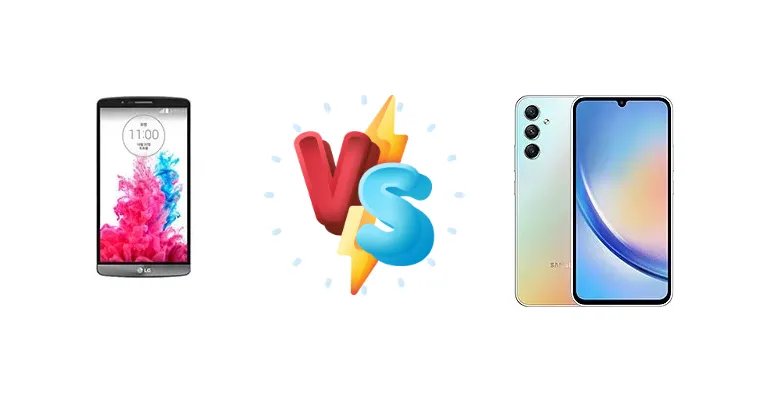
The LG G3 was a flagship of its time, boasting an impressive display and innovative features. Now, let's see how it stacks up against the modern Samsung Galaxy A34, a mid-range champion known for its battery life and vibrant screen. This comparison will help you decide which phone is right for you.
🏆 Quick Verdict
The Samsung Galaxy A34 wins overall. While the LG G3's display was revolutionary for its era, the A34's modern chipset, superior camera capabilities, and exceptional battery life make it the more compelling choice for today's users. The G3's age shows.
| Network |
|---|
| 2G bands | GSM 850 / 900 / 1800 / 1900 | GSM 850 / 900 / 1800 / 1900 |
| 3G bands | HSDPA | HSDPA 850 / 900 / 1700(AWS) / 1900 / 2100 |
| 4G bands | LTE | 1, 2, 3, 4, 5, 7, 8, 12, 17, 20, 26, 28, 32, 38, 40, 41, 66 |
| 5G bands | - | 1, 3, 7, 8, 20, 28, 38, 40, 41, 77, 78 SA/NSA/Sub6 |
| EDGE | Yes | - |
| GPRS | Yes | - |
| Speed | HSPA 42.2/5.76 Mbps, LTE (2CA) Cat6 300/50 Mbps | HSPA, LTE, 5G |
| Technology | GSM / HSPA / LTE | GSM / HSPA / LTE / 5G |
| Launch |
|---|
| Announced | 2014, October. Released 2014, December | 2023, March 14 |
| Status | Discontinued | Available. Released 2023, March 24 |
| Body |
|---|
| Build | - | Glass front (Gorilla Glass 5), plastic frame, plastic back |
| Dimensions | 157.8 x 81.8 x 9.5 mm (6.21 x 3.22 x 0.37 in) | 161.3 x 78.1 x 8.2 mm (6.35 x 3.07 x 0.32 in) |
| SIM | Micro-SIM | · Nano-SIM· Nano-SIM + Nano-SIM |
| Weight | 182 g (6.42 oz) | 199 g (7.02 oz) |
| | - | IP67 dust/water resistant (up to 1m for 30 min) |
| Display |
|---|
| Protection | - | Corning Gorilla Glass 5 |
| Resolution | 1080 x 1920 pixels, 16:9 ratio (~373 ppi density) | 1080 x 2340 pixels, 19.5:9 ratio (~390 ppi density) |
| Size | 5.9 inches, 96.0 cm2 (~74.3% screen-to-body ratio) | 6.6 inches, 106.9 cm2 (~84.9% screen-to-body ratio) |
| Type | IPS LCD | Super AMOLED, 120Hz, 1000 nits (HBM) |
| Platform |
|---|
| CPU | Octa-core (4x1.5 GHz Cortex-A15 4x1.2 GHz Cortex-A7) | Octa-core (2x2.6 GHz Cortex-A78 & 6x2.0 GHz Cortex-A55) |
| Chipset | LG Nuclun | Mediatek Dimensity 1080 (6 nm) |
| GPU | - | Mali-G68 MC4 |
| OS | Android 4.4.4 (KitKat) | Android 13, up to 4 major Android upgrades, One UI 6.1 |
| Memory |
|---|
| Card slot | microSDXC (dedicated slot) | microSDXC (uses shared SIM slot) |
| Internal | 32GB 2GB RAM | 128GB 4GB RAM, 128GB 6GB RAM, 128GB 8GB RAM, 256GB 6GB RAM, 256GB 8GB RAM |
| Main Camera |
|---|
| Features | Dual-LED flash, panorama, HDR | LED flash, panorama, HDR |
| Single | 13 MP, 1/3.0", AF, OIS | - |
| Triple | - | 48 MP, f/1.8, 26mm (wide), 1/2.0", 0.8µm, PDAF, OIS
8 MP, f/2.2, 123˚, (ultrawide), 1/4.0", 1.12µm
5 MP (macro) |
| Video | 1080p@30fps, HDR, stereo sound rec. | 4K@30fps, 1080p@30/60fps, 720p@480fps |
| Selfie camera |
|---|
| Single | 2.1 MP | 13 MP, f/2.2, 26mm (wide), 1/3.1", 1.12µm |
| Video | 1080p@30fps | 4K@30fps, 1080p@30fps |
| Sound |
|---|
| 3.5mm jack | Yes | No |
| 35mm jack | Yes | No |
| Loudspeaker | Yes | Yes, with stereo speakers |
| Comms |
|---|
| Bluetooth | 4.0, A2DP | 5.3, A2DP, LE |
| NFC | Yes | Yes (market/region dependent) |
| Positioning | GPS, GLONASS | GPS, GLONASS, GALILEO, BDS |
| Radio | No | No |
| USB | microUSB 2.0 | USB Type-C 2.0, OTG |
| WLAN | Wi-Fi 802.11 b/g/n, hotspot | Wi-Fi 802.11 a/b/g/n/ac, dual-band, Wi-Fi Direct |
| Features |
|---|
| Sensors | Accelerometer, gyro, proximity, compass | Fingerprint (under display, optical), accelerometer, gyro, compass |
| | - | Virtual proximity sensing |
| Battery |
|---|
| Charging | - | 25W wired |
| Stand-by | Up to 640 h (3G) | - |
| Talk time | Up to 13 h (3G) | - |
| Type | Li-Ion 3000 mAh, removable | Li-Ion 5000 mAh |
| Misc |
|---|
| Colors | Black, White | Lime, Graphite, Violet, Silver |
| Models | F490L | SM-A346E, SM-A346B, SM-A346B/DS, SM-A346B/DSN, SM-A346E/DS, SM-A346E/DSN, SM-A346M, SM-A346M/N, SM-A346M/DSN, SM-A3460 |
| Price | About 250 EUR | € 169.99 / $ 175.00 / £ 164.99 / ₹ 23,999 |
| SAR EU | - | 0.55 W/kg (head) 1.49 W/kg (body) |
| Tests |
|---|
| Battery life | - |
Endurance rating 133h
|
| Camera | - |
Photo / Video |
| Display | - |
Contrast ratio: Infinite (nominal) |
| Loudspeaker | - |
-26.1 LUFS (Good)
|
| Performance | - |
AnTuTu: 472126 (v9)
GeekBench: 2316 (v5.5), 2518 (v6)
GFXBench: 23fps (ES 3.1 onscreen) |
LG G3 Screen
- Innovative Quad HD display (for its time)
- Compact size
- Classic design
- Outdated chipset
- Limited software support
- Weaker camera
- Shorter battery life
Samsung Galaxy A34
- Excellent battery life
- Bright and vibrant display
- Modern chipset and performance
- Improved camera system
- 25W fast charging
- Plastic build (typical for mid-range)
- May lack premium features
Display Comparison
The LG G3 Screen was groundbreaking with its Quad HD resolution and wide viewing angles. However, the Samsung Galaxy A34's 1009 nits brightness and 'infinite' contrast ratio (likely a marketing term, but indicative of excellent contrast) offer a significantly more vibrant and visible experience, especially outdoors. The A34's display is also likely more color accurate.
Camera Comparison
While the LG G3 had a capable camera for its time, the Samsung Galaxy A34's camera system is significantly more advanced. Expect better image quality, improved low-light performance, and more versatile shooting options (likely including features like OIS and more advanced video recording).
Performance
The Galaxy A34's Mediatek Dimensity 1080 (6nm) provides a substantial performance advantage over the LG G3's older Nuclun chipset and Cortex-A15/A7 combination. The A34's newer CPU architecture and manufacturing process result in faster speeds and better efficiency. Expect smoother multitasking and gaming on the A34.
Battery Life
The Samsung Galaxy A34's endurance rating of 133h is exceptional, indicating outstanding battery life. The LG G3's battery life was respectable for its time, but it simply can't compete with the A34's modern power efficiency and larger battery capacity.
Buying Guide
The LG G3 Screen is best for enthusiasts seeking a nostalgic experience and appreciating a classic display. The Samsung Galaxy A34 is ideal for users prioritizing battery life, a modern camera, and reliable performance in a mid-range package.
Frequently Asked Questions
❓ Is the LG G3 Screen still worth buying?
Only if you're a collector or nostalgic for older Android phones. Its age limits its usefulness in today's mobile landscape.
❓ What is the biggest difference between these two phones?
The biggest difference is the age and technology. The Galaxy A34 offers a modern experience with better performance, camera, and battery life, while the G3 represents a snapshot of smartphone technology from a bygone era.