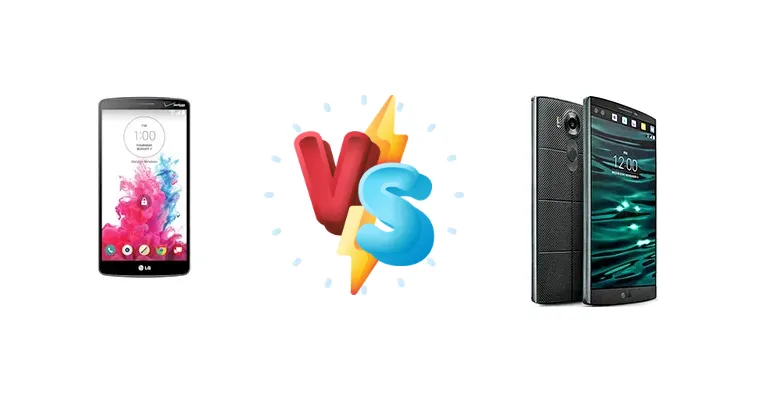
LG's G3 and V10 were both ambitious flagships, pushing the boundaries of smartphone design and features. But which one holds up better today? This comprehensive comparison will break down their strengths and weaknesses, helping you decide which device is right for you.
🏆 Quick Verdict
The LG V10 edges out the G3 thanks to its superior battery life, faster charging, and more modern processor. While the G3 boasts a slightly faster CPU, the V10's overall package, including its secondary display and improved durability, makes it the more compelling choice for most users.
| Network |
|---|
| 2G bands | GSM 850 / 900 / 1800 / 1900 - VS985, LS990 | GSM 850 / 900 / 1800 / 1900 - SIM 1 & SIM 2 (dual-SIM model only) |
| 3G bands | CDMA2000 1xEV-DO - VS985 | HSDPA 850 / 900 / 1900 / 2100 |
| 4G bands | 4, 13 - VS985 | 1, 3, 7, 8, 20 |
| Speed | HSPA, LTE Cat4 150/50 Mbps (LS990)LTE Cat4, EV-DO Rev.A 3.1 Mbps (VS985) | HSPA 42.2/5.76 Mbps, LTE Cat6 300/50 Mbps |
| Technology | GSM / CDMA / HSPA / EVDO / LTE | GSM / HSPA / LTE |
| | 25, 26, 41 - LS990 | - |
| Launch |
|---|
| Announced | 2014, July. Released 2014, July | 2015, October. Released 2015, October |
| Status | Discontinued | Discontinued |
| Body |
|---|
| Build | - | Glass front (Gorilla Glass 4), plastic back, stainless steel/plastic frame |
| Dimensions | 146.3 x 74.7 x 8.9 mm (5.76 x 2.94 x 0.35 in) | 159.6 x 79.3 x 8.6 mm (6.28 x 3.12 x 0.34 in) |
| SIM | Micro-SIM | · Nano-SIM· Nano-SIM + Nano-SIM |
| Weight | 149.7 g (5.29 oz) | 192 g (6.77 oz) |
| | - | MIL-STD-810G compliant*
*does not guarantee ruggedness or use in extreme conditions |
| Display |
|---|
| Protection | Corning Gorilla Glass 3 | Corning Gorilla Glass 4 |
| Resolution | 1440 x 2560 pixels, 16:9 ratio (~538 ppi density) | 1440 x 2560 pixels, 16:9 ratio (~515 ppi density) |
| Size | 5.5 inches, 82.2 cm2 (~75.2% screen-to-body ratio) | 5.7 inches, 89.6 cm2 (~70.8% screen-to-body ratio) |
| Type | True HD-IPS + LCD | IPS LCD |
| | - | Secondary display, 160 x 1040 pixels, 2.1 inches |
| Platform |
|---|
| CPU | Quad-core 2.5 GHz Krait 400 | Hexa-core (4x1.4 GHz Cortex-A53 & 2x1.8 GHz Cortex-A57) |
| Chipset | Qualcomm MSM8975AC Snapdragon 801 (28 nm) | Qualcomm MSM8992 Snapdragon 808 (20 nm) |
| GPU | Adreno 330 | Adreno 418 |
| OS | Android 4.4.2 (KitKat), upgradable to 6.0 (Marshmallow) | Android 5.1.1 (Lollipop), upgradable to 7.0 (Nougat) |
| Memory |
|---|
| Card slot | microSDXC (dedicated slot) | microSDXC (dedicated slot) |
| Internal | 32GB 3GB RAM | 32GB 4GB RAM, 64GB 4GB RAM |
| | eMMC 5.0 | eMMC 5.0 |
| Main Camera |
|---|
| Features | Laser AF, Dual-LED dual-tone flash, panorama, HDR | Laser AF, color spectrum sensor, LED flash, panorama, HDR |
| Single | 13 MP, 1/3.0", PDAF, OIS | 16 MP, f/1.8, 1/2.6", OIS |
| Video | 4K@30fps, 1080p@30fps, HDR, stereo sound rec. | 4K@30fps, 1080p@30fps, 720p@120fps, HDR, stereo sound rec. |
| Selfie camera |
|---|
| Dual | - | 5 MP, f/2.2
5 MP |
| Single | 2.1 MP | - |
| Video | 1080p@30fps | 1080p |
| Sound |
|---|
| 3.5mm jack | Yes | Yes |
| 35mm jack | Yes | Yes |
| Loudspeaker | Yes | Yes |
| | - | 32-bit/192kHz audio
|
| Comms |
|---|
| Bluetooth | 4.0, A2DP, LE, aptX | 4.1, A2DP, LE, aptX |
| Infrared port | Yes | Yes |
| NFC | Yes | Yes |
| Positioning | GPS/ S-GPS (VS985) | GPS, GLONASS |
| Radio | FM radio (LS990 model) | FM radio |
| USB | microUSB 2.0 (SlimPort), OTG | microUSB 2.0 (SlimPort 4K), OTG |
| WLAN | Wi-Fi 802.11 a/b/g/n/ac, dual-band, Wi-Fi Direct, DLNA, hotspot | Wi-Fi 802.11 a/b/g/n/ac, dual-band, Wi-Fi Direct, DLNA, hotspot |
| Features |
|---|
| Sensors | Accelerometer, gyro, proximity, compass | Fingerprint (rear-mounted), accelerometer, gyro, proximity, compass, barometer |
| Battery |
|---|
| Charging | - | 18W wired, QC2, 50% in 40 min |
| Stand-by | Up to 415 h (3G) | Up to 150 h (2G) / Up to 150 h (3G) |
| Talk time | Up to 18 h 40 min (3G) | Up to 22 h (2G) / Up to 18 h (3G) |
| Type | Li-Ion 3000 mAh, removable | Li-Ion 3000 mAh, removable |
| Misc |
|---|
| Colors | Metallic Black, Silk White (Verizon), Shine Gold (Sprint) | Space Black, Luxe White, Modern Beige, Ocean Blue, Opal Blue |
| Models | - | VS990, f600, H900, H901, H960, H961, H962, H968, H961N, F600L, F600S, F600K, F600, H961AN |
| Price | About 300 EUR | About 250 EUR |
| SAR EU | - | 0.59 W/kg (head) |
| Tests |
|---|
| Audio quality | - |
Noise -93.3dB / Crosstalk -93.0dB |
| Battery life | - | Endurance rating 56h |
| Camera | - |
Photo / Video |
| Display | - |
Contrast ratio: 1490 (nominal), 2.744 (sunlight) |
| Loudspeaker | - |
Voice 66dB / Noise 64dB / Ring 70dB |
| Performance | - |
Basemark OS II 2.0: 1383Basemark X: 15161 |
LG G3 (CDMA)
- Higher resolution display
- Slightly faster CPU (burst performance)
- More compact size
- Weaker battery life
- No fast charging
- Older chipset
- CDMA only
LG V10
- Excellent battery life
- Fast charging (QC2)
- Secondary display
- More durable build (stainless steel frame)
- Better camera performance
- Slightly less powerful CPU (sustained performance)
- Larger size
Display Comparison
Both phones feature excellent displays with a nominal contrast ratio of 1490 and impressive sunlight readability (2.744). The G3 has a slightly higher resolution (2560 x 1440) which results in a sharper image, but the V10's secondary display adds a unique functionality for notifications and shortcuts. The V10's screen is also slightly larger.
Camera Comparison
Both phones offer capable cameras, but the V10 generally produces more consistent and detailed images, especially in low light. The V10's camera software also offers more features and manual controls. While both record video, the V10's image stabilization is noticeably better.
Performance
The G3's Snapdragon 801 and 2.5 GHz Krait 400 CPU offer a burst of speed, but the V10's hexa-core Snapdragon 808 (4x1.4 GHz Cortex-A53 & 2x1.8 GHz Cortex-A57) provides more sustained performance and better efficiency. The V10's architecture is more modern and handles multitasking more smoothly.
Battery Life
The V10's battery life is a clear winner, boasting an endurance rating of 56 hours, significantly better than the G3. The V10 also supports 18W fast charging (QC2), allowing for a 50% charge in just 40 minutes, a feature absent in the G3.
Buying Guide
The LG G3 (CDMA) is a good option for users prioritizing raw CPU speed and a slightly smaller form factor, especially if they can find it at a very low price. The LG V10 is ideal for those who value battery life, a secondary display for notifications, a more durable build, and faster charging capabilities.
Frequently Asked Questions
❓ Is the LG G3 still worth buying?
If you can find it at a very low price and prioritize raw CPU speed, the G3 can be a decent option. However, the V10 offers a more modern and well-rounded experience.
❓ What is the purpose of the LG V10's secondary display?
The secondary display shows notifications, shortcuts, and frequently used apps, allowing you to access information without unlocking your phone.