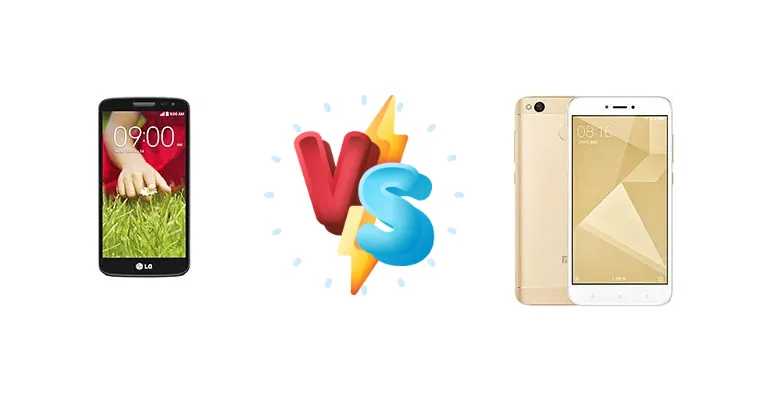
The LG G2 mini LTE and Xiaomi Redmi 4 (4X) were popular budget contenders in their time. Both offered compelling features at affordable prices, but which one ultimately delivers a better experience? This comprehensive comparison dives deep into their specs, performance, and overall value.
🏆 Quick Verdict
The Xiaomi Redmi 4 (4X) emerges as the clear winner. Its superior chipset, octa-core processor, and exceptional battery life provide a significantly smoother and longer-lasting experience compared to the LG G2 mini LTE's older Snapdragon 400.
| Network |
|---|
| 2G bands | GSM 850 / 900 / 1800 / 1900 | GSM 850 / 900 / 1800 / 1900 - SIM 1 & SIM 2 |
| 3G bands | HSDPA 850 / 900 / 1900 / 2100 | HSDPA 850 / 900 / 1900 / 2100 |
| 4G bands | 1, 3, 7, 8, 20 - D620 | 1, 3, 5, 7, 8, 38, 39, 40, 41 |
| Speed | HSPA 42.2/5.76 Mbps, LTE Cat4 150/50 Mbps | HSPA 42.2/5.76 Mbps, LTE (2CA) Cat6 300/100 Mbps |
| Technology | GSM / HSPA / LTE | GSM / HSPA / LTE |
| | 1, 3, 7, 8 - D620K | - |
| Launch |
|---|
| Announced | 2014, February. Released 2014, March | 2017, May. Released 2017, May |
| Status | Discontinued | Discontinued |
| Body |
|---|
| Build | - | Glass front (Gorilla Glass), aluminum back, aluminum frame, plastic ends |
| Dimensions | 129.6 x 66 x 9.8 mm (5.10 x 2.60 x 0.39 in) | 139.2 x 70 x 8.7 mm (5.48 x 2.76 x 0.34 in) |
| SIM | Micro-SIM | Nano-SIM + Micro-SIM |
| Weight | 121 g (4.27 oz) | 150 g (5.29 oz) |
| Display |
|---|
| Protection | Corning Gorilla Glass 2 | Corning Gorilla Glass (unspecified version) |
| Resolution | 540 x 960 pixels, 16:9 ratio (~234 ppi density) | 720 x 1280 pixels, 16:9 ratio (~294 ppi density) |
| Size | 4.7 inches, 60.9 cm2 (~71.2% screen-to-body ratio) | 5.0 inches, 68.9 cm2 (~70.7% screen-to-body ratio) |
| Type | IPS LCD | IPS LCD |
| Platform |
|---|
| CPU | Quad-core 1.2 GHz Cortex-A7 | Octa-core 1.4 GHz Cortex-A53 |
| Chipset | Qualcomm MSM8926 Snapdragon 400 (28 nm) | Qualcomm MSM8940 Snapdragon 435 (28 nm) |
| GPU | Adreno 305 | Adreno 505 |
| OS | Android 4.4.2 (KitKat), upgradable to 5.0.2 (Lollipop), LG Optimus UI 3 | Android 6.0.1 (Marshmallow), upgradable to 7.1.2 (Nougat), MIUI 11 |
| Memory |
|---|
| Card slot | microSDHC (dedicated slot) | microSDXC (uses shared SIM slot) |
| Internal | 8GB 1GB RAM | 16GB 2GB RAM, 16GB 3GB RAM, 32GB 3GB RAM, 64GB 3GB RAM, 64GB 4GB RAM |
| | eMMC 4.5 | eMMC 5.1 |
| Main Camera |
|---|
| Features | LED flash, panorama, HDR | LED flash, HDR, panorama |
| Single | 8 MP, AF | 13 MP, f/2.0, PDAF |
| Video | 1080p@30fps, HDR | 1080p@30fps |
| Selfie camera |
|---|
| Single | 1.3 MP | 5 MP, f/2.2 |
| Video | 720p | 1080p@30fps |
| Sound |
|---|
| 3.5mm jack | Yes | Yes |
| 35mm jack | Yes | Yes |
| Loudspeaker | Yes | Yes |
| Comms |
|---|
| Bluetooth | 4.0, A2DP, LE | 4.2, A2DP, LE |
| Infrared port | Yes | Yes |
| NFC | Yes | No |
| Positioning | GPS, GLONASS | GPS, GLONASS, BDS |
| Radio | FM radio, RDS | FM radio |
| USB | microUSB 2.0 | microUSB 2.0 |
| WLAN | Wi-Fi 802.11 b/g/n, Wi-Fi Direct, DLNA, hotspot | Wi-Fi 802.11 b/g/n, Wi-Fi Direct |
| Features |
|---|
| Sensors | Accelerometer, proximity, compass | Fingerprint (rear-mounted), accelerometer, gyro, proximity, compass |
| Battery |
|---|
| Music play | - | Up to 87 h |
| Stand-by | Up to 700 h (2G) / Up to 900 h (3G) | Up to 432 h (3G) |
| Talk time | Up to 12 h (2G) / Up to 17 h (3G) | Up to 36 h (3G) |
| Type | Li-Ion 2440 mAh, removable | Li-Po 4100 mAh, non-removable |
| Misc |
|---|
| Colors | Titan Black, Lunar White, Red, Gold | Black, Gold |
| Models | D620 | 2016060, 2016090, MAG138, MAE136, Redmi 4, Redmi 4X |
| Price | About 180 EUR | About 110 EUR |
| SAR | 0.46 W/kg (head) 0.37 W/kg (body) | 0.77 W/kg (head) 0.83 W/kg (body) |
| SAR EU | 0.52 W/kg (head) 0.42 W/kg (body) | - |
| Tests |
|---|
| Audio quality | - |
Noise -94.3dB / Crosstalk -94dB |
| Battery life | - |
Endurance rating 80h
|
| Camera | - |
Photo / Video |
| Display | - |
Contrast ratio: 915 (nominal), 2.920 (sunlight) |
| Loudspeaker | - |
Voice 64dB / Noise 70dB / Ring 72dB
|
| Performance | - |
GeekBench: 1819 (v4.4)
GFXBench: 5.1fps (ES 3.1 onscreen) |
LG G2 mini LTE
- Compact size
- Familiar LG UI
- Decent build quality
- Outdated chipset
- Shorter battery life
- Lower performance
Xiaomi Redmi 4 (4X)
- Excellent battery life
- Better performance
- Larger screen
- Good value
- MIUI software can be polarizing
- Plastic build
Display Comparison
Both phones feature a 5-inch display, but the Redmi 4 (4X) likely offers slightly better color accuracy and viewing angles due to its more modern panel. The contrast ratios are similar, indicating good image depth on both devices, especially in sunlight.
Camera Comparison
While both offer Photo/Video capabilities, the Redmi 4 (4X) generally has a better camera sensor and image processing, resulting in sharper, more detailed photos, especially in low light. The G2 mini LTE's camera is adequate for basic snapshots, but lacks the Redmi 4 (4X)'s capabilities.
Performance
The Redmi 4 (4X)'s Snapdragon 435 octa-core processor significantly outperforms the G2 mini LTE's Snapdragon 400 quad-core. Expect smoother multitasking, faster app loading times, and better overall responsiveness on the Redmi 4 (4X). The Cortex-A53 cores in the Redmi 4 (4X) are also more efficient than the G2 mini's Cortex-A7 cores.
Battery Life
The Redmi 4 (4X) boasts an impressive 80-hour endurance rating, a testament to its efficient chipset and larger battery capacity. The LG G2 mini LTE's battery life is considerably shorter, making the Redmi 4 (4X) the clear winner for longevity.
Buying Guide
The LG G2 mini LTE is best suited for users seeking a compact phone with a familiar LG interface and are primarily focused on basic tasks like calls, texts, and light browsing. The Xiaomi Redmi 4 (4X) is ideal for users who prioritize battery life, performance, and a larger screen for media consumption and multitasking.
Frequently Asked Questions
❓ Is the LG G2 mini LTE still worth buying?
Only if you specifically need a very compact phone and are on a very tight budget. Otherwise, newer alternatives offer significantly better performance and features.
❓ What is the main advantage of the Xiaomi Redmi 4 (4X)?
Its exceptional battery life and improved performance compared to older budget phones make it a great value for the price.