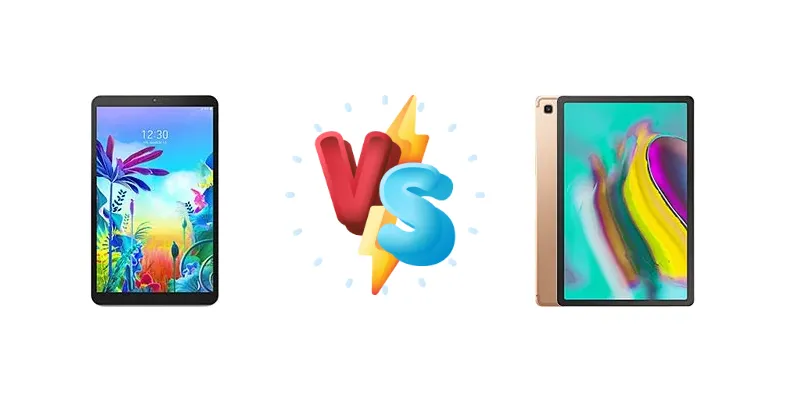
The LG G Pad 5 10.1 and Samsung Galaxy Tab S5e represent distinct approaches to the 10.1-inch Android tablet market. The LG, leveraging the older but potent Snapdragon 821, aims for a performance edge, while the Samsung opts for efficiency with the Snapdragon 670. This comparison dissects their strengths and weaknesses to determine which tablet delivers the best overall experience.
🏆 Quick Verdict
For the average user prioritizing sustained performance and occasional multitasking, the LG G Pad 5 10.1 emerges as the winner. Its Snapdragon 821, despite its age, offers a noticeable performance uplift over the Snapdragon 670 in the Tab S5e, making it better suited for demanding applications. However, the Tab S5e remains a compelling option for those prioritizing battery life and a sleek design.
| Network |
|---|
| 2G bands | GSM 850 / 900 / 1800 / 1900 | GSM 850 / 900 / 1800 / 1900 |
| 3G bands | HSDPA 850 / 900 / 2100 | HSDPA 850 / 900 / 1700(AWS) / 1900 / 2100 |
| 4G bands | LTE | 1, 2, 3, 4, 5, 7, 8, 12, 13, 17, 20, 28, 38, 40, 41, 66 |
| Speed | HSPA, LTE | HSPA, LTE - cellular model only |
| Technology | GSM / HSPA / LTE | GSM / HSPA / LTE |
| Launch |
|---|
| Announced | 2019, October. Released 2019, November | 2019, February. Released 2019, April |
| Status | Discontinued | Discontinued |
| Body |
|---|
| Build | Glass front, aluminum back, aluminum frame | Glass front, aluminum back, aluminum frame |
| Dimensions | 247.2 x 150.7 x 8 mm (9.73 x 5.93 x 0.31 in) | 245 x 160 x 5.5 mm (9.65 x 6.30 x 0.22 in) |
| SIM | Nano-SIM | Nano-SIM (cellular model only) |
| Weight | 498 g (1.10 lb) | 400 g (14.11 oz) |
| Display |
|---|
| Resolution | 1200 x 1920 pixels, 16:10 ratio (~224 ppi density) | 1600 x 2560 pixels, 16:10 ratio (~288 ppi density) |
| Size | 10.1 inches, 295.8 cm2 (~79.4% screen-to-body ratio) | 10.5 inches, 319.7 cm2 (~81.6% screen-to-body ratio) |
| Type | IPS LCD | Super AMOLED |
| Platform |
|---|
| CPU | Quad-core (2x2.15 GHz Kryo & 2x1.6 GHz Kryo) | Octa-core (2x2.0 GHz 360 Gold & 6x1.7 GHz Kryo 360 Silver) |
| Chipset | Qualcomm MSM8996 Snapdragon 821 (14 nm) | Qualcomm SDM670 Snapdragon 670 (10 nm) |
| GPU | Adreno 530 | Adreno 615 |
| OS | Android 9.0 (Pie) | Android 9.0 (Pie), upgradable to Android 11, One UI 3.1 |
| Memory |
|---|
| Card slot | microSDXC (dedicated slot) | microSDXC (dedicated slot) |
| Internal | 32GB 4GB RAM | 64GB 4GB RAM, 128GB 6GB RAM |
| | UFS 2.0 | eMMC 5.1 |
| Main Camera |
|---|
| Features | - | HDR, panorama |
| Single | 8 MP, AF | 13 MP, f/2.0, 26mm, 1/3.4", 1.0µm, AF |
| Video | 4K@30fps, 1080p@30fps | 4K@30fps |
| Selfie camera |
|---|
| Single | 5 MP | 8 MP, f/2.0, 26mm, 1/4.0", 1.12µm |
| Video | 1080p@30fps | 1080p@30fps |
| Sound |
|---|
| 3.5mm jack | Yes | No |
| 35mm jack | Yes | No |
| Loudspeaker | Yes, with stereo speakers | Yes, with stereo speakers (4 speakers) |
| | - | Tuned by AKG/HARMAN |
| Comms |
|---|
| Bluetooth | 4.2, A2DP, LE | 5.0, A2DP, LE |
| NFC | No | No |
| Positioning | GPS | GPS, GLONASS, BDS, GALILEO - cellular model only |
| Radio | No | No |
| USB | USB Type-C 2.0 | USB Type-C 3.1, magnetic connector |
| WLAN | Wi-Fi 802.11 a/b/g/n/ac, dual-band, Wi-Fi Direct | Wi-Fi 802.11 a/b/g/n/ac, dual-band, Wi-Fi Direct |
| Features |
|---|
| Sensors | Fingerprint (side-mounted), accelerometer | Fingerprint (side-mounted), accelerometer, gyro, proximity, compass |
| | - | ANT+ |
| Battery |
|---|
| Charging | 18W wired | 18W wired |
| Type | Li-Po 8200 mAh, non-removable | Li-Po 7040 mAh, non-removable |
| Misc |
|---|
| Colors | Silver | Black, Gold, Silver |
| Models | LM-T600L, T600L | SM-T725, SM-T720 |
| Price | About 340 EUR | About 410 EUR |
| SAR | 1.10 W/kg (body) | - |
| SAR EU | - | 1.03 W/kg (head) |
| Tests |
|---|
| Performance | - |
AnTuTu: 152610 (v7)
GeekBench: 5684 (v4.4)
GFXBench: 6.4fps (ES 3.1 onscreen) |
LG G Pad 5 10.1
- Stronger CPU performance with Snapdragon 821
- More capable GPU for gaming and graphics-intensive tasks
- Potentially better image processing
- Less power-efficient chipset
- Potentially shorter battery life
- Older chipset architecture
Samsung Galaxy Tab S5e
- Better battery life due to Snapdragon 670’s efficiency
- Sleek and lightweight design
- More modern chipset architecture
- Lower CPU and GPU performance
- May struggle with demanding applications
- Less responsive multitasking
Display Comparison
Neither LG nor Samsung specified display details beyond size. However, given the Tab S5e’s market positioning, it likely employs a high-quality IPS LCD panel. The LG G Pad 5 10.1, being a more budget-focused device, may utilize a slightly less refined panel. The real difference lies in the processing power driving the display; the Snapdragon 821 in the LG could potentially handle more complex visual tasks smoothly. Bezels are likely comparable, typical of tablets in this price range.
Camera Comparison
Camera performance is unlikely to be a deciding factor for either tablet. Both are likely equipped with basic camera modules suitable for casual snapshots. Without specific sensor details, it’s difficult to make a direct comparison. However, the Snapdragon 821’s image signal processor (ISP) is generally more capable than the 670’s, potentially resulting in slightly better image quality in favorable lighting conditions. Focusing on the primary camera is key, as secondary sensors are likely low resolution and of limited utility.
Performance
The core of the difference lies in the chipsets. The LG G Pad 5 10.1’s Snapdragon 821, built on a 14nm process, features a quad-core CPU with a peak clock speed of 2.15 GHz. This contrasts with the Samsung Galaxy Tab S5e’s Snapdragon 670 (10nm), an octa-core CPU clocked at 2.0 GHz. While the 670 has more cores, the 821’s Kryo cores offer superior single-core performance, crucial for responsiveness. The 10nm process of the 670 provides better power efficiency, but the 821’s raw processing power will be noticeable in demanding applications. The Snapdragon 821’s Adreno 510 GPU also surpasses the 670’s Adreno 615 in raw graphical capability, though the efficiency of the 615 is a benefit.
Battery Life
Both tablets feature 18W wired charging, suggesting similar charging speeds. The Snapdragon 670’s 10nm process inherently offers better power efficiency, meaning the Tab S5e will likely achieve longer battery life under similar usage scenarios. While the LG G Pad 5 10.1’s Snapdragon 821 is more powerful, it consumes more energy. Real-world battery life will depend heavily on usage patterns, but the Tab S5e has a clear advantage in this area.
Buying Guide
Buy the LG G Pad 5 10.1 if you need a tablet capable of handling more demanding tasks like light gaming, video editing, or running multiple apps simultaneously without significant slowdown. Buy the Samsung Galaxy Tab S5e if you prefer a tablet focused on media consumption, portability, and all-day battery life, and aren't planning on pushing its processing limits.
Frequently Asked Questions
❓ Will the Snapdragon 821 in the LG G Pad 5 10.1 experience significant thermal throttling during extended gaming sessions?
The Snapdragon 821 is known to throttle under sustained load, particularly in passively cooled devices like tablets. While the LG G Pad 5 10.1 likely doesn't have advanced cooling, the 14nm process isn't as prone to extreme heat as older 28nm chips. Expect some performance reduction after prolonged gaming, but it shouldn't render the tablet unusable.
❓ Is the Snapdragon 670 in the Samsung Galaxy Tab S5e powerful enough for multitasking with several apps open simultaneously?
The Snapdragon 670 can handle moderate multitasking, but it may exhibit slowdowns when running numerous demanding applications concurrently. It's best suited for lighter tasks like browsing, streaming video, and basic productivity. Users who frequently switch between resource-intensive apps may find the performance limiting.
❓ Which tablet is better for watching movies and streaming video content?
Both tablets are suitable for media consumption. However, the Samsung Galaxy Tab S5e’s potentially more refined display and longer battery life give it a slight edge. The LG G Pad 5 10.1’s more powerful processor could offer smoother playback of high-resolution video formats, but the difference is likely minimal.