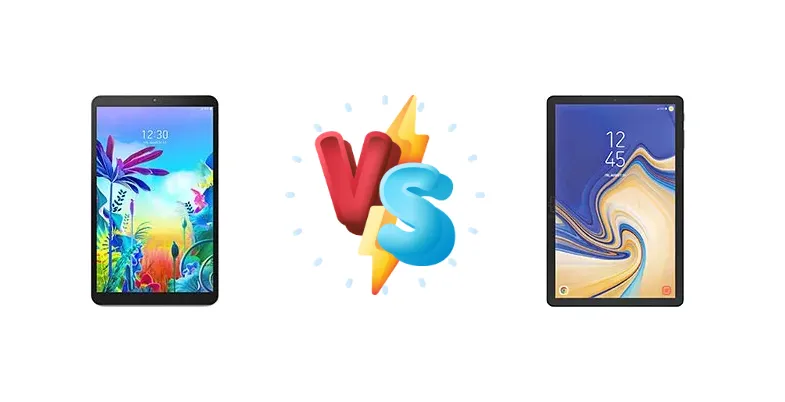
The LG G Pad 5 10.1 and Samsung Galaxy Tab S4 10.5 represent distinct points in the Android tablet landscape. The Tab S4, released in 2018, was a premium offering aiming to compete with the iPad. The G Pad 5, arriving later, targeted a more budget-conscious consumer. This comparison dissects their core differences, focusing on the impact of their respective Snapdragon chipsets and overall user experience.
🏆 Quick Verdict
For the average user prioritizing performance and a slightly more refined experience, the Samsung Galaxy Tab S4 10.5 emerges as the better choice. Its Snapdragon 835, built on a smaller 10nm process, delivers a noticeable performance advantage and improved thermal efficiency over the LG G Pad 5’s Snapdragon 821.
| Network |
|---|
| 2G bands | GSM 850 / 900 / 1800 / 1900 | GSM 850 / 900 / 1800 / 1900 |
| 3G bands | HSDPA 850 / 900 / 2100 | HSDPA 850 / 900 / 1700(AWS) / 1900 / 2100 |
| 4G bands | LTE | 1, 2, 3, 4, 5, 7, 8, 12, 13, 17, 20, 28, 38, 40, 41, 66 |
| Speed | HSPA, LTE | HSPA 42.2/5.76 Mbps, LTE (5CA) Cat16 1024/150 Mbps - cellular model only |
| Technology | GSM / HSPA / LTE | GSM / HSPA / LTE |
| Launch |
|---|
| Announced | 2019, October. Released 2019, November | 2018, August. Released 2018, August |
| Status | Discontinued | Discontinued |
| Body |
|---|
| Build | Glass front, aluminum back, aluminum frame | - |
| Dimensions | 247.2 x 150.7 x 8 mm (9.73 x 5.93 x 0.31 in) | 249.3 x 164.3 x 7.1 mm (9.81 x 6.47 x 0.28 in) |
| SIM | Nano-SIM | Nano-SIM (cellular model only) |
| Weight | 498 g (1.10 lb) | 482g (Wi-Fi), 483g (LTE) (1.06 lb) |
| | - | Stylus |
| Display |
|---|
| Resolution | 1200 x 1920 pixels, 16:10 ratio (~224 ppi density) | 1600 x 2560 pixels, 16:10 ratio (~287 ppi density) |
| Size | 10.1 inches, 295.8 cm2 (~79.4% screen-to-body ratio) | 10.5 inches, 321.9 cm2 (~78.6% screen-to-body ratio) |
| Type | IPS LCD | Super AMOLED |
| Platform |
|---|
| CPU | Quad-core (2x2.15 GHz Kryo & 2x1.6 GHz Kryo) | Octa-core (4x2.35 GHz Kryo & 4x1.9 GHz Kryo) |
| Chipset | Qualcomm MSM8996 Snapdragon 821 (14 nm) | Qualcomm MSM8998 Snapdragon 835 (10 nm) |
| GPU | Adreno 530 | Adreno 540 |
| OS | Android 9.0 (Pie) | Android 8.1 (Oreo), upgradable to Android 10, One UI 2.0 |
| Memory |
|---|
| Card slot | microSDXC (dedicated slot) | microSDXC (dedicated slot) |
| Internal | 32GB 4GB RAM | 64GB 4GB RAM, 256GB 4GB RAM, 256GB 6GB RAM |
| | UFS 2.0 | - |
| Main Camera |
|---|
| Features | - | LED flash, HDR, panorama |
| Single | 8 MP, AF | 13 MP, AF |
| Video | 4K@30fps, 1080p@30fps | 4K@30fps |
| Selfie camera |
|---|
| Single | 5 MP | 8 MP |
| Video | 1080p@30fps | 1080p@30fps |
| Sound |
|---|
| 3.5mm jack | Yes | Yes |
| 35mm jack | Yes | Yes |
| Loudspeaker | Yes, with stereo speakers | Yes, with stereo speakers (4 speakers) |
| | - | Tuned by AKG/HARMAN |
| Comms |
|---|
| Bluetooth | 4.2, A2DP, LE | 5.0, A2DP, LE |
| NFC | No | No |
| Positioning | GPS | GPS, GLONASS, BDS, GALILEO - cellular model only |
| Radio | No | No |
| USB | USB Type-C 2.0 | USB Type-C 3.1, magnetic connector |
| WLAN | Wi-Fi 802.11 a/b/g/n/ac, dual-band, Wi-Fi Direct | Wi-Fi 802.11 a/b/g/n/ac, dual-band, Wi-Fi Direct |
| Features |
|---|
| Sensors | Fingerprint (side-mounted), accelerometer | Iris scanner, accelerometer, gyro, proximity, compass |
| | - | Samsung Dex
ANT+ |
| Battery |
|---|
| Charging | 18W wired | 18W wired |
| Type | Li-Po 8200 mAh, non-removable | Li-Po 7300 mAh, non-removable |
| Misc |
|---|
| Colors | Silver | Black, White |
| Models | LM-T600L, T600L | SM-T830, SM-T835, SM-T837A |
| Price | About 340 EUR | About 520 EUR |
| SAR | 1.10 W/kg (body) | 1.09 W/kg (body) |
| SAR EU | - | 0.34 W/kg (body) |
LG G Pad 5 10.1
- More affordable price point
- Large 10.1-inch display for media consumption
- Acceptable performance for basic tasks
- Older Snapdragon 821 chipset
- Less efficient 14nm process
- Potentially lower display quality
Samsung Galaxy Tab S4 10.5
- More powerful Snapdragon 835 chipset
- More efficient 10nm process
- Smoother multitasking and app performance
- Higher price compared to the LG G Pad 5
- May be harder to find new
- Potentially outdated software support
Display Comparison
While both tablets feature 10.1-inch and 10.5-inch displays respectively, detailed display specs like resolution, panel type (IPS, OLED), and brightness are missing. However, given the Tab S4’s positioning, it likely boasts a higher quality panel with better color accuracy and potentially higher peak brightness. The slightly larger screen size of the Tab S4 offers a marginally more immersive viewing experience. Bezels are likely comparable, reflecting design trends of their respective release years.
Camera Comparison
Camera performance is unlikely to be a deciding factor for either tablet. Details regarding camera sensors are unavailable. Given the market segment, both tablets likely feature modest camera setups suitable for basic video calls and casual snapshots. Focusing on the chipsets' image signal processors (ISPs), the Snapdragon 835 in the Tab S4 likely offers slightly better image processing capabilities, resulting in marginally improved image quality in favorable lighting conditions.
Performance
The core difference lies in the chipsets. The Samsung Galaxy Tab S4’s Snapdragon 835, fabricated on a 10nm process, offers a significant advantage over the LG G Pad 5’s Snapdragon 821 (14nm). The 835 features an octa-core CPU (4x2.35 GHz Kryo & 4x1.9 GHz Kryo) compared to the 821’s quad-core configuration (2x2.15 GHz Kryo & 2x1.6 GHz Kryo). This translates to faster app loading times, smoother multitasking, and improved performance in demanding applications. The 10nm process also contributes to better thermal management, reducing the likelihood of performance throttling during extended use. The Tab S4’s superior CPU architecture directly benefits users engaged in video editing, graphic design, or resource-intensive gaming.
Battery Life
Both tablets support 18W wired charging. Battery capacity details are missing, but the Snapdragon 835’s improved power efficiency in the Tab S4 could translate to slightly longer battery life despite potentially having a similar capacity to the G Pad 5. The 10nm process inherently consumes less power than the 14nm process of the Snapdragon 821. Real-world usage will dictate the actual battery life, but the Tab S4 has a clear advantage in power management.
Buying Guide
Buy the LG G Pad 5 10.1 if you need a large-screen Android tablet for basic media consumption, light productivity tasks, and casual gaming, and are constrained by a tight budget. Buy the Samsung Galaxy Tab S4 10.5 if you prioritize smoother multitasking, a more responsive user interface, and a generally more premium experience, even if it comes at a higher price point.
Frequently Asked Questions
❓ Will the Snapdragon 821 in the LG G Pad 5 struggle with demanding games like Genshin Impact?
Yes, the Snapdragon 821, while capable, will likely struggle to maintain consistent frame rates in graphically intensive games like Genshin Impact, even on lower settings. The Snapdragon 835 in the Tab S4 offers a more comfortable gaming experience due to its superior GPU and thermal management.
❓ Is the Samsung Galaxy Tab S4 still receiving software updates in 2024?
Software update support for the Galaxy Tab S4 is likely limited or has ended. Samsung typically provides several years of updates, but given its 2018 release, it may no longer receive major Android version updates. Security patches may still be available, but users should be aware of potential software limitations.
❓ Does the difference in chipsets significantly impact everyday tasks like browsing and video playback?
For basic tasks like web browsing, email, and video playback, the difference may not be immediately noticeable. However, the Snapdragon 835’s faster processing speeds will result in snappier app launches and smoother transitions, providing a more responsive overall experience.