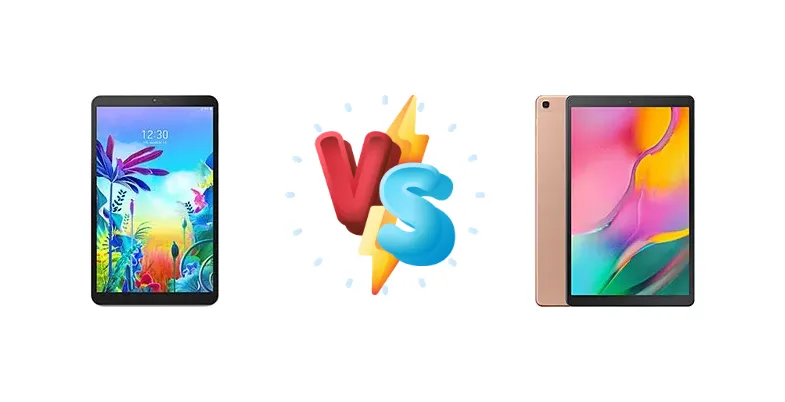
The 10-inch Android tablet market offers a sweet spot for media consumption and light productivity. The LG G Pad 5 10.1, powered by a Snapdragon 821, and the Samsung Galaxy Tab A 10.1 (2019), featuring an Exynos 7904, both aim to deliver a compelling experience. This comparison dissects their core components to determine which tablet best suits your needs, particularly focusing on the performance implications of their respective chipsets.
🏆 Quick Verdict
For users prioritizing sustained performance and responsiveness, the LG G Pad 5 10.1 emerges as the winner. Its Snapdragon 821, despite its age, offers a more powerful CPU and generally smoother experience than the Exynos 7904 in the Tab A 10.1. However, the Tab A 10.1 remains a viable option for casual users on a tighter budget.
| Network |
|---|
| 2G bands | GSM 850 / 900 / 1800 / 1900 | GSM 850 / 900 / 1800 / 1900 |
| 3G bands | HSDPA 850 / 900 / 2100 | HSDPA 850 / 900 / 1700(AWS) / 1900 / 2100 |
| 4G bands | LTE | 1, 2, 3, 4, 5, 7, 8, 12, 17, 20, 28, 38, 40, 66 |
| Speed | HSPA, LTE | HSPA, LTE - cellular model only |
| Technology | GSM / HSPA / LTE | GSM / HSPA / LTE |
| Launch |
|---|
| Announced | 2019, October. Released 2019, November | 2019, February 15. Released 2019, April |
| Status | Discontinued | Discontinued |
| Body |
|---|
| Build | Glass front, aluminum back, aluminum frame | Glass front, aluminum back, aluminum frame |
| Dimensions | 247.2 x 150.7 x 8 mm (9.73 x 5.93 x 0.31 in) | 245.2 x 149.4 x 7.5 mm (9.65 x 5.88 x 0.30 in) |
| SIM | Nano-SIM | Nano-SIM (cellular model only) |
| Weight | 498 g (1.10 lb) | 469 g (1.03 lb) |
| Display |
|---|
| Resolution | 1200 x 1920 pixels, 16:10 ratio (~224 ppi density) | 1200 x 1920 pixels, 16:10 ratio (~224 ppi density) |
| Size | 10.1 inches, 295.8 cm2 (~79.4% screen-to-body ratio) | 10.1 inches, 295.8 cm2 (~80.7% screen-to-body ratio) |
| Type | IPS LCD | TFT LCD |
| Platform |
|---|
| CPU | Quad-core (2x2.15 GHz Kryo & 2x1.6 GHz Kryo) | Octa-core (2x1.8 GHz Cortex-A73 & 6x1.6 GHz Cortex-A53) |
| Chipset | Qualcomm MSM8996 Snapdragon 821 (14 nm) | Exynos 7904 (14 nm) |
| GPU | Adreno 530 | Mali-G71 MP2 |
| OS | Android 9.0 (Pie) | Android 9.0 (Pie), upgradable to Android 11, One UI 3.0 |
| Memory |
|---|
| Card slot | microSDXC (dedicated slot) | microSDXC (dedicated slot) |
| Internal | 32GB 4GB RAM | 16GB 2GB RAM, 32GB 2GB RAM, 32GB 3GB RAM, 64GB 3GB RAM, 128GB 3GB RAM |
| | UFS 2.0 | eMMC 5.1 |
| Main Camera |
|---|
| Features | - | Panorama |
| Single | 8 MP, AF | 8 MP, f/2.0, AF |
| Video | 4K@30fps, 1080p@30fps | 1080p@30fps |
| Selfie camera |
|---|
| Single | 5 MP | 5 MP, f/2.2 |
| Video | 1080p@30fps | 1080p@30fps |
| Sound |
|---|
| 3.5mm jack | Yes | Yes |
| 35mm jack | Yes | Yes |
| Loudspeaker | Yes, with stereo speakers | Yes, with stereo speakers |
| Comms |
|---|
| Bluetooth | 4.2, A2DP, LE | 5.0, A2DP, LE |
| NFC | No | No |
| Positioning | GPS | GPS, GLONASS, GALILEO, BDS - cellular model only |
| Radio | No | No |
| USB | USB Type-C 2.0 | USB Type-C 2.0 |
| WLAN | Wi-Fi 802.11 a/b/g/n/ac, dual-band, Wi-Fi Direct | Wi-Fi 802.11 a/b/g/n/ac, dual-band, Wi-Fi Direct |
| Features |
|---|
| Sensors | Fingerprint (side-mounted), accelerometer | Accelerometer, gyro, compass |
| | - | ANT+ |
| Battery |
|---|
| Charging | 18W wired | - |
| Type | Li-Po 8200 mAh, non-removable | Li-Po 6150 mAh, non-removable |
| Misc |
|---|
| Colors | Silver | Black, Gold, Silver |
| Models | LM-T600L, T600L | SM-T515, SM-T510 |
| Price | About 340 EUR | About 220 EUR |
| SAR | 1.10 W/kg (body) | 0.92 W/kg (body) |
| SAR EU | - | 1.36 W/kg (body) |
LG G Pad 5 10.1
- More powerful Snapdragon 821 processor
- Faster 18W wired charging
- Potentially smoother multitasking experience
- Older chipset architecture
- Potentially higher price point
Samsung Galaxy Tab A 10.1 (2019)
- More affordable price
- Octa-core processor for efficient background tasks
- Samsung’s brand recognition and software ecosystem
- Less powerful Exynos 7904 processor
- Slower charging speeds
- Potentially noticeable lag with demanding apps
Display Comparison
Both tablets feature 10.1-inch displays, but detailed display specs (resolution, panel type, brightness) are missing. Given the Tab A 10.1's market positioning, it likely utilizes a standard IPS LCD. The G Pad 5, while also likely IPS, may benefit from LG's display expertise, potentially offering slightly better color accuracy. The absence of high refresh rate or HDR support on either device suggests a focus on cost-effectiveness rather than visual fidelity. Bezels are expected to be comparable, typical of tablets in this price range.
Camera Comparison
Camera performance is unlikely to be a deciding factor for most buyers in this segment. Detailed camera specs are unavailable, but both tablets likely feature basic rear and front-facing cameras suitable for video calls and casual snapshots. The inclusion of a 2MP macro camera on the Tab A 10.1 is largely a marketing gimmick, offering minimal practical benefit due to its low resolution. Image processing will likely favor Samsung’s typically vibrant style, while the LG G Pad 5 may aim for more natural colors.
Performance
The core difference lies in the chipsets. The LG G Pad 5’s Snapdragon 821, a quad-core processor with a Kryo architecture, offers a performance advantage over the Samsung Galaxy Tab A 10.1’s Exynos 7904. The Exynos 7904 utilizes an octa-core configuration (2x1.8 GHz Cortex-A73 & 6x1.6 GHz Cortex-A53), but the individual core performance of the Kryo cores in the Snapdragon 821 is higher. This translates to faster app loading times and smoother multitasking on the LG G Pad 5. While the Exynos benefits from more cores, the Snapdragon’s architecture is more efficient for demanding tasks. Both are built on a 14nm process, suggesting similar thermal characteristics, but the Snapdragon’s superior performance may lead to slightly higher temperatures under sustained load.
Battery Life
Battery capacity details are missing for both devices. However, the LG G Pad 5 supports 18W wired charging, which is a notable advantage. The Tab A 10.1 likely supports slower charging speeds. While a larger battery capacity on the Tab A 10.1 could offset the slower charging, the Snapdragon 821’s efficiency may allow the G Pad 5 to achieve comparable or even better battery life despite a potentially smaller battery. Real-world usage will heavily influence battery performance, but the faster charging on the LG G Pad 5 provides a convenience factor.
Buying Guide
Buy the LG G Pad 5 10.1 if you need a tablet capable of handling demanding apps, multitasking, and occasional gaming without significant slowdown. Its superior processing power makes it ideal for users who value a responsive experience. Buy the Samsung Galaxy Tab A 10.1 (2019) if you prioritize affordability and primarily intend to use the tablet for basic tasks like web browsing, video streaming, and light social media – where the performance difference will be less noticeable.
Frequently Asked Questions
❓ Does the Exynos 7904 in the Galaxy Tab A 10.1 overheat during prolonged gaming sessions?
While the Exynos 7904 is a relatively efficient chip, it's not designed for sustained high performance. Expect some thermal throttling during extended gaming, potentially leading to frame rate drops and a less enjoyable experience. The Snapdragon 821 in the LG G Pad 5 is better equipped to handle heat, but will still experience some throttling.
❓ Is the LG G Pad 5 10.1 a good choice for running multiple apps simultaneously?
Yes, the Snapdragon 821's superior processing power and architecture make the LG G Pad 5 10.1 a better choice for multitasking. It can handle more apps running in the background without significant slowdown compared to the Exynos 7904 in the Tab A 10.1.
❓ What kind of storage options are available on each tablet?
Storage options are not specified in the provided data. However, based on market trends, both tablets likely offer configurations ranging from 32GB to 64GB, with microSD card support for expansion. Check retailer listings for specific configurations.
❓ Will either tablet receive significant software updates in the future?
Given the age of both devices, major Android version updates are unlikely. However, security patches may continue to be released for a limited time. Samsung generally provides longer software support than LG, but neither tablet is expected to receive updates for many years to come.