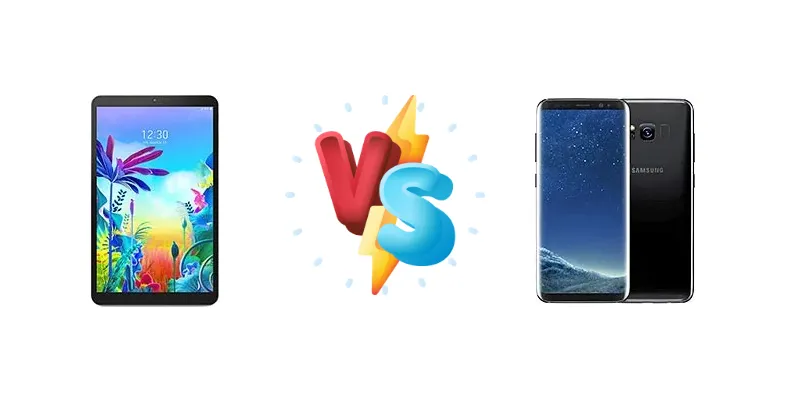
The LG G Pad 5 10.1 and the Samsung Galaxy S8 represent very different approaches to Android. The G Pad 5 prioritizes a large screen and affordability, while the Galaxy S8 aimed for a premium, compact flagship experience. This comparison dissects their core components to determine which device delivers the best value for specific user needs, especially considering the S8's age and current pricing.
🏆 Quick Verdict
For the average user prioritizing portability and a more modern feature set, the Samsung Galaxy S8 remains a surprisingly capable device. Its Exynos 8895 (or Snapdragon 835) offers a performance edge and superior battery efficiency, despite the LG G Pad 5 10.1's larger display. However, the G Pad 5 is a strong contender for media consumption and light productivity.
| Network |
|---|
| 2G bands | GSM 850 / 900 / 1800 / 1900 | GSM 850 / 900 / 1800 / 1900 - SIM 1 & SIM 2 (dual-SIM model only) |
| 3G bands | HSDPA 850 / 900 / 2100 | HSDPA 850 / 900 / 1700(AWS) / 1900 / 2100 |
| 4G bands | LTE | 1, 2, 3, 4, 5, 7, 8, 12, 13, 17, 18, 19, 20, 25, 26, 28, 32, 66, 38, 39, 40, 41 |
| Speed | HSPA, LTE | HSPA 42.2/5.76 Mbps, LTE (5CA) Cat16 1024/150 Mbps |
| Technology | GSM / HSPA / LTE | GSM / HSPA / LTE |
| Launch |
|---|
| Announced | 2019, October. Released 2019, November | 2017, March 29. Released 2017, April 24 |
| Status | Discontinued | Discontinued |
| Body |
|---|
| Build | Glass front, aluminum back, aluminum frame | Glass front (Gorilla Glass 5), glass back (Gorilla Glass 5), aluminum frame |
| Dimensions | 247.2 x 150.7 x 8 mm (9.73 x 5.93 x 0.31 in) | 148.9 x 68.1 x 8 mm (5.86 x 2.68 x 0.31 in) |
| SIM | Nano-SIM | · Nano-SIM· Nano-SIM + Nano-SIM |
| Weight | 498 g (1.10 lb) | 155 g (5.47 oz) |
| | - | IP68 dust/water resistant (up to 1.5m for 30 mins) |
| Display |
|---|
| Protection | - | Corning Gorilla Glass 5 |
| Resolution | 1200 x 1920 pixels, 16:10 ratio (~224 ppi density) | 1440 x 2960 pixels, 18.5:9 ratio (~570 ppi density) |
| Size | 10.1 inches, 295.8 cm2 (~79.4% screen-to-body ratio) | 5.8 inches, 84.8 cm2 (~83.6% screen-to-body ratio) |
| Type | IPS LCD | Super AMOLED, HDR10 |
| | - | 3D Touch (home button only)
Always-on display |
| Platform |
|---|
| CPU | Quad-core (2x2.15 GHz Kryo & 2x1.6 GHz Kryo) | Octa-core (4x2.3 GHz Mongoose M2 & 4x1.7 GHz Cortex-A53) - EMEAOcta-core (4x2.35 GHz Kryo & 4x1.9 GHz Kryo) - USA & China |
| Chipset | Qualcomm MSM8996 Snapdragon 821 (14 nm) | Exynos 8895 (10 nm) - EMEAQualcomm MSM8998 Snapdragon 835 (10 nm) - USA & China |
| GPU | Adreno 530 | Mali-G71 MP20 - EMEAAdreno 540 - USA & China |
| OS | Android 9.0 (Pie) | Android 7.0 (Nougat), upgradable to Android 9.0 (Pie), One UI |
| Memory |
|---|
| Card slot | microSDXC (dedicated slot) | microSDXC (uses shared SIM slot) - dual SIM model only |
| Internal | 32GB 4GB RAM | 64GB 4GB RAM |
| | UFS 2.0 | UFS 2.0 or UFS 2.1 |
| Main Camera |
|---|
| Features | - | LED flash, auto-HDR, panorama |
| Single | 8 MP, AF | 12 MP, f/1.7, 26mm (wide), 1/2.55", 1.4µm, dual pixel PDAF, OIS |
| Video | 4K@30fps, 1080p@30fps | 4K@30fps, 1080p@30/60fps, 720p@240fps, HDR, stereo sound rec., gyro-EIS, OIS |
| Selfie camera |
|---|
| Dual | - | 8 MP, f/1.7, 25mm (wide), 1/3.6", 1.22µm, AF
2 MP (dedicated iris scanner camera) |
| Features | - | HDR |
| Single | 5 MP | - |
| Video | 1080p@30fps | 1440p@30fps |
| Sound |
|---|
| 3.5mm jack | Yes | Yes |
| 35mm jack | Yes | Yes |
| Loudspeaker | Yes, with stereo speakers | Yes |
| | - | 32-bit/384kHz audio
|
| Comms |
|---|
| Bluetooth | 4.2, A2DP, LE | 5.0, A2DP, LE, aptX |
| NFC | No | Yes |
| Positioning | GPS | GPS, GLONASS, BDS, GALILEO |
| Radio | No | No |
| USB | USB Type-C 2.0 | USB Type-C 3.1 |
| WLAN | Wi-Fi 802.11 a/b/g/n/ac, dual-band, Wi-Fi Direct | Wi-Fi 802.11 a/b/g/n/ac, dual-band, Wi-Fi Direct |
| Features |
|---|
| Sensors | Fingerprint (side-mounted), accelerometer | Iris scanner, fingerprint (rear-mounted), accelerometer, gyro, proximity, compass, barometer, heart rate, SpO2 |
| | - | Samsung DeX (desktop experience support)
ANT+
Bixby natural language commands and dictation
Samsung Pay (Visa, MasterCard certified) |
| Battery |
|---|
| Charging | 18W wired | 15W wired, QC2
Wireless (Qi) (market dependent) |
| Music play | - | Up to 67 h |
| Talk time | - | Up to 20 h (3G) |
| Type | Li-Po 8200 mAh, non-removable | Li-Ion 3000 mAh, non-removable (11.55 Wh) |
| Misc |
|---|
| Colors | Silver | Midnight Black, Orchid Gray, Arctic Silver, Coral Blue, Maple Gold, Rose Pink, Burgundy Red |
| Models | LM-T600L, T600L | SM-G950FD, SM-G950W, SM-G950S, SM-G950K, SM-G950L, SM-G9500, SM-G950A, SM-G950P, SM-G950T, SM-G950U, SM-G950V, SM-G950F, SM-G950U1, SM-G950N, SC-02J, SCV36, SM-G950, G950F |
| Price | About 340 EUR | About 230 EUR |
| SAR | 1.10 W/kg (body) | 0.44 W/kg (head) 0.75 W/kg (body) |
| SAR EU | - | 0.32 W/kg (head) 1.27 W/kg (body) |
| Tests |
|---|
| Audio quality | - |
Noise -92.5dB / Crosstalk -92.8dB |
| Battery life | - | Endurance rating 84h |
| Camera | - |
Photo / Video |
| Display | - |
Contrast ratio: Infinite (nominal), 4.768 (sunlight) |
| Loudspeaker | - |
Voice 66dB / Noise 70dB / Ring 72dB |
| Performance | - |
AnTuTu: 199022 (v7)
GeekBench: 6656 (v4.4)
GFXBench: 13fps (ES 3.1 onscreen) |
LG G Pad 5 10.1
- Larger 10.1-inch display ideal for media consumption
- More affordable price point
- 18W fast charging
- Older Snapdragon 821 chipset
- Less efficient processor impacting battery life
- Likely inferior camera performance
Samsung Galaxy S8
- More powerful Exynos 8895/Snapdragon 835 chipset
- Superior battery life and charging options (including wireless)
- Compact and portable design
- Smaller display size
- Higher price (even used)
- Older device, potential for software support limitations
Display Comparison
Both devices boast 'Infinite' contrast ratios, suggesting excellent black levels, and a sunlight contrast ratio of 4.768, indicating good outdoor visibility. However, the G Pad 5’s 10.1-inch display offers significantly more screen real estate than the S8’s smaller panel. While the S8’s display technology isn’t specified beyond the contrast ratio, Samsung was known for its Super AMOLED panels, offering vibrant colors and excellent viewing angles. The G Pad 5’s LCD panel, while larger, likely won’t match the S8’s color accuracy and contrast. The larger size of the G Pad 5 is a benefit for multitasking and media consumption, but sacrifices portability.
Camera Comparison
The context data for both devices only mentions 'Photo / Video' capabilities, lacking specifics. However, given Samsung’s camera reputation, the Galaxy S8 likely features a more advanced camera system with better image processing and low-light performance. The S8’s camera likely includes features like optical image stabilization (OIS), which the G Pad 5 may lack. While both devices likely capture acceptable photos and videos, the S8 is expected to deliver superior image quality and versatility. The G Pad 5’s camera is likely adequate for casual snapshots, but won’t compete with the S8’s capabilities.
Performance
The Samsung Galaxy S8, equipped with either the Exynos 8895 (10nm) or Snapdragon 835 (10nm), holds a clear advantage in processing power over the LG G Pad 5 10.1’s Snapdragon 821 (14nm). The newer 10nm process node of the S8’s chipsets translates to better thermal efficiency and sustained performance. The S8’s octa-core CPU, with its Mongoose M2 or Kryo cores, outperforms the G Pad 5’s quad-core Kryo configuration in both single-core and multi-core tasks. While the G Pad 5 is capable for everyday tasks, the S8 will handle demanding applications and games with greater ease. The S8’s GPU also benefits from the newer process node and core architecture.
Battery Life
The Samsung Galaxy S8 boasts an endurance rating of 84 hours, indicating excellent battery life. While the G Pad 5’s battery capacity isn’t specified, its larger size suggests a larger battery. However, the Snapdragon 821 is less power-efficient than the Exynos 8895 or Snapdragon 835. The S8 supports 15W wired charging with Quick Charge 2.0 and wireless charging (Qi), offering more charging flexibility. The G Pad 5 supports 18W wired charging, slightly faster, but lacks wireless charging. Despite potentially having a larger battery, the G Pad 5’s less efficient chipset likely results in similar or even shorter battery life compared to the S8.
Buying Guide
Buy the LG G Pad 5 10.1 if you need a dedicated media consumption device, a larger screen for reading or sketching, and prioritize affordability over raw processing power. Buy the Samsung Galaxy S8 if you prefer a pocketable device with a more powerful processor, a superior camera experience, and the convenience of a flagship smartphone. The S8 is ideal for users who want a compact, capable phone that still holds up well today.
Frequently Asked Questions
❓ Does the Exynos 8895 in the Galaxy S8 suffer from thermal throttling during extended gaming sessions?
While the Exynos 8895 can get warm under sustained load, its 10nm process node and Samsung’s thermal management solutions generally prevent significant throttling. Benchmarks and user reports indicate that the S8 can maintain high performance for extended periods, though some performance reduction is expected during very demanding games.
❓ Is the 2MP macro camera on the Galaxy S8 actually useful for taking detailed close-up photos?
The 2MP macro camera on the Galaxy S8 is limited by its low resolution and small sensor size. While it can technically take close-up photos, the image quality is often lacking in detail and sharpness. It's best used for casual snapshots rather than serious macro photography.
❓ Can the LG G Pad 5 10.1 handle demanding games like PUBG or Call of Duty Mobile at high frame rates?
The Snapdragon 821 in the LG G Pad 5 10.1 can run PUBG and Call of Duty Mobile, but likely at medium settings to maintain a stable frame rate. Expect some frame drops during intense action sequences. Achieving high frame rates (60fps or higher) consistently may be challenging.
❓ How does the software update situation look for both the LG G Pad 5 10.1 and the Samsung Galaxy S8 in 2024?
Both devices are past their prime software support windows. The LG G Pad 5 10.1 likely received its last major Android update some time ago. The Samsung Galaxy S8 may still have access to security patches through custom ROMs, but official updates are no longer available. Users should be aware of potential security risks when using older, unsupported software.