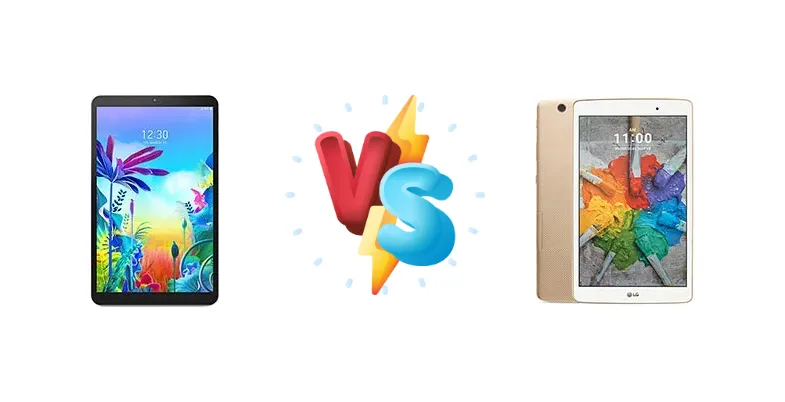
The LG G Pad 5 10.1 and G Pad X 8.0 represent different approaches to the Android tablet market. The G Pad 5, with its older-but-powerful Snapdragon 821, aims for a smoother experience, while the G Pad X 8.0 focuses on affordability with the Snapdragon 615. This comparison dissects the key differences to help you determine which tablet best suits your needs.
🏆 Quick Verdict
For users prioritizing performance and multitasking, the LG G Pad 5 10.1 is the clear winner. Its Snapdragon 821 offers a significantly faster experience than the G Pad X 8.0’s Snapdragon 615. However, the G Pad X 8.0 remains a viable option for basic tasks and media consumption on a tighter budget.
| Network |
|---|
| 2G bands | GSM 850 / 900 / 1800 / 1900 | GSM 850 / 900 / 1800 / 1900 |
| 3G bands | HSDPA 850 / 900 / 2100 | HSDPA 850 / 900 / 1700(AWS) / 1900 / 2100 |
| 4G bands | LTE | 2, 3, 4, 7, 12 |
| Speed | HSPA, LTE | HSPA, LTE |
| Technology | GSM / HSPA / LTE | GSM / HSPA / LTE |
| Launch |
|---|
| Announced | 2019, October. Released 2019, November | 2016, June. Released 2016, June |
| Status | Discontinued | Discontinued |
| Body |
|---|
| Build | Glass front, aluminum back, aluminum frame | - |
| Dimensions | 247.2 x 150.7 x 8 mm (9.73 x 5.93 x 0.31 in) | 210.8 x 121.9 x 7.9 mm (8.30 x 4.80 x 0.31 in) |
| SIM | Nano-SIM | Nano-SIM |
| Weight | 498 g (1.10 lb) | 309 g (10.90 oz) |
| Display |
|---|
| Resolution | 1200 x 1920 pixels, 16:10 ratio (~224 ppi density) | 1200 x 1920 pixels, 16:10 ratio (~283 ppi density) |
| Size | 10.1 inches, 295.8 cm2 (~79.4% screen-to-body ratio) | 8.0 inches, 185.6 cm2 (~72.2% screen-to-body ratio) |
| Type | IPS LCD | IPS LCD |
| Platform |
|---|
| CPU | Quad-core (2x2.15 GHz Kryo & 2x1.6 GHz Kryo) | Octa-core (4x1.5 GHz Cortex-A53 & 4x1.0 GHz Cortex-A53) |
| Chipset | Qualcomm MSM8996 Snapdragon 821 (14 nm) | Qualcomm MSM8939 Snapdragon 615 (28 nm) |
| GPU | Adreno 530 | Adreno 405 |
| OS | Android 9.0 (Pie) | Android 6.0.1 (Marshmallow) |
| Memory |
|---|
| Card slot | microSDXC (dedicated slot) | microSDXC (dedicated slot) |
| Internal | 32GB 4GB RAM | 16GB 2GB RAM, 32GB 2GB RAM |
| | UFS 2.0 | eMMC 4.5 |
| Main Camera |
|---|
| Features | - | Panorama |
| Single | 8 MP, AF | 5 MP, AF |
| Video | 4K@30fps, 1080p@30fps | 1080p@30fps |
| Selfie camera |
|---|
| Single | 5 MP | 5 MP |
| Video | 1080p@30fps | - |
| Sound |
|---|
| 3.5mm jack | Yes | Yes |
| 35mm jack | Yes | Yes |
| Loudspeaker | Yes, with stereo speakers | Yes |
| Comms |
|---|
| Bluetooth | 4.2, A2DP, LE | 4.2, A2DP, LE |
| NFC | No | No |
| Positioning | GPS | GPS, GLONASS |
| Radio | No | No |
| USB | USB Type-C 2.0 | microUSB 2.0 |
| WLAN | Wi-Fi 802.11 a/b/g/n/ac, dual-band, Wi-Fi Direct | Wi-Fi 802.11 a/b/g/n/ac, dual-band, Wi-Fi Direct, DLNA |
| Features |
|---|
| Sensors | Fingerprint (side-mounted), accelerometer | Accelerometer, compass |
| Battery |
|---|
| Charging | 18W wired | - |
| Type | Li-Po 8200 mAh, non-removable | Li-Ion 4800 mAh, non-removable |
| Misc |
|---|
| Colors | Silver | White/Gold |
| Models | LM-T600L, T600L | V520, V521 |
| Price | About 340 EUR | About 220 EUR |
| SAR | 1.10 W/kg (body) | - |
LG G Pad 5 10.1
- Significantly faster processor (Snapdragon 821)
- Larger 10.1-inch display for immersive viewing
- Faster 18W charging support
- Potentially lower battery life due to larger screen
- Larger size makes it less portable
LG G Pad X 8.0
- More affordable price point
- Compact 8-inch size for enhanced portability
- Potentially longer battery life for basic tasks
- Slower processor (Snapdragon 615)
- Less responsive user interface
- Limited multitasking capabilities
Display Comparison
The LG G Pad 5 10.1 boasts a larger 10.1-inch display, offering a more immersive viewing experience compared to the G Pad X 8.0’s 8-inch screen. While specific display technologies aren't provided, the larger size of the G Pad 5 is a significant advantage for media consumption and productivity. The G Pad X 8.0’s smaller form factor enhances portability, making it easier to carry and use on the go. The difference in screen size directly impacts usability for tasks like split-screen multitasking, where the G Pad 5 provides more usable space.
Camera Comparison
Given the context data, a detailed camera comparison is limited. Both tablets likely feature modest camera setups geared towards casual use. Without specific sensor details, it’s reasonable to assume the G Pad 5, being the higher-tier device, may have a slightly better camera module, but the difference is unlikely to be substantial. Focusing on the chipset, the Snapdragon 821’s image signal processor (ISP) is more advanced, potentially leading to better image processing and low-light performance, though this is speculative without further data.
Performance
The core difference lies in the chipsets. The LG G Pad 5 10.1’s Snapdragon 821, built on a 14nm process, features a quad-core CPU with a Kryo architecture, delivering significantly higher single-core and multi-core performance than the G Pad X 8.0’s Snapdragon 615. The 615, fabricated on a less efficient 28nm node, utilizes an octa-core configuration of Cortex-A53 cores, prioritizing power efficiency over raw speed. This translates to noticeably faster app loading times, smoother multitasking, and a more responsive user interface on the G Pad 5. The 821’s superior GPU also provides a better gaming experience. The larger process node of the 615 also suggests potentially higher heat output under sustained load.
Battery Life
Battery capacity isn’t specified, making a direct comparison difficult. However, the G Pad 5 10.1 supports 18W wired charging, which is faster than what the G Pad X 8.0 likely offers. The Snapdragon 615’s lower power consumption may partially offset the G Pad 5’s faster charging, but the larger screen of the G Pad 5 will likely draw more power during use. Real-world battery life will depend heavily on usage patterns, but the G Pad X 8.0 may offer slightly longer runtimes for basic tasks due to its more efficient chipset.
Buying Guide
Buy the LG G Pad 5 10.1 if you need a tablet capable of handling demanding applications, moderate gaming, and multitasking without significant slowdowns. Buy the LG G Pad X 8.0 if you prioritize portability, affordability, and primarily intend to use the tablet for basic tasks like web browsing, video streaming, and light productivity.
Frequently Asked Questions
❓ Will the Snapdragon 615 in the G Pad X 8.0 struggle with modern Android apps?
Yes, the Snapdragon 615 is a relatively old chipset and may exhibit noticeable slowdowns when running demanding apps or multitasking with several applications open simultaneously. It's best suited for basic tasks like web browsing, video streaming, and light productivity.
❓ Is the Snapdragon 821 in the G Pad 5 10.1 still capable of playing modern mobile games?
The Snapdragon 821 is still a capable processor and can handle many modern mobile games, though you may need to lower graphics settings for more demanding titles. It offers a significantly better gaming experience than the Snapdragon 615 in the G Pad X 8.0.
❓ What kind of storage options are available on each tablet, and can it be expanded?
The context data doesn't specify storage options. However, based on LG's tablet offerings at the time, both likely came with options for 32GB or 64GB of internal storage, and both almost certainly include a microSD card slot for expandable storage. Checking retailer listings for specific models is recommended.