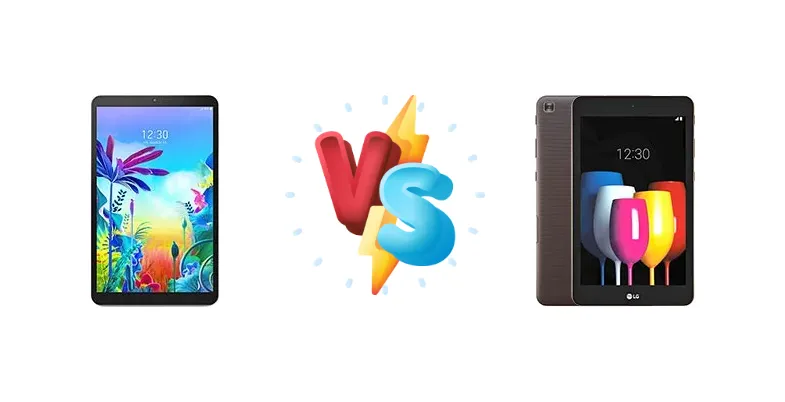
LG's tablet lineup, while now discontinued, still offers compelling value on the used market. The G Pad 5 10.1, with its older-but-capable Snapdragon 821, represents a significant step up in processing power compared to the more affordable G Pad IV 8.0 FHD, powered by the Snapdragon 435. This comparison dissects the key differences to help you determine which tablet best suits your needs and budget.
🏆 Quick Verdict
For users prioritizing performance and a larger display for media consumption, the LG G Pad 5 10.1 is the clear winner. Its Snapdragon 821 offers a substantially smoother experience. However, the G Pad IV 8.0 FHD remains a viable option for basic tasks and portability, especially for budget-conscious buyers.
| Network |
|---|
| 2G bands | GSM 850 / 900 / 1800 / 1900 | GSM 850 / 900 / 1800 / 1900 |
| 3G bands | HSDPA 850 / 900 / 2100 | HSDPA 850 / 1700(AWS) / 1900 / 2100 |
| 4G bands | LTE | 2, 4, 5, 12, 66 |
| Speed | HSPA, LTE | HSPA, LTE |
| Technology | GSM / HSPA / LTE | GSM / HSPA / LTE |
| Launch |
|---|
| Announced | 2019, October. Released 2019, November | 2017, July. Released 2017, August |
| Status | Discontinued | Discontinued |
| Body |
|---|
| Build | Glass front, aluminum back, aluminum frame | - |
| Dimensions | 247.2 x 150.7 x 8 mm (9.73 x 5.93 x 0.31 in) | 216.2 x 127 x 6.9 mm (8.51 x 5.0 x 0.27 in) |
| SIM | Nano-SIM | Nano-SIM |
| Weight | 498 g (1.10 lb) | 290 g (10.23 oz) |
| Display |
|---|
| Resolution | 1200 x 1920 pixels, 16:10 ratio (~224 ppi density) | 1200 x 1920 pixels, 16:10 ratio (~283 ppi density) |
| Size | 10.1 inches, 295.8 cm2 (~79.4% screen-to-body ratio) | 8.0 inches, 185.6 cm2 (~67.6% screen-to-body ratio) |
| Type | IPS LCD | IPS LCD |
| Platform |
|---|
| CPU | Quad-core (2x2.15 GHz Kryo & 2x1.6 GHz Kryo) | Octa-core 1.4 GHz Cortex-A53 |
| Chipset | Qualcomm MSM8996 Snapdragon 821 (14 nm) | Qualcomm MSM8940 Snapdragon 435 (28 nm) |
| GPU | Adreno 530 | Adreno 505 |
| OS | Android 9.0 (Pie) | Android 7.0 (Nougat), upgradable to Android 8.1 (Oreo) |
| Memory |
|---|
| Card slot | microSDXC (dedicated slot) | microSDXC (dedicated slot) |
| Internal | 32GB 4GB RAM | 32GB 2GB RAM |
| | UFS 2.0 | eMMC 5.1 |
| Main Camera |
|---|
| Features | - | Panorama |
| Single | 8 MP, AF | 5 MP, AF |
| Video | 4K@30fps, 1080p@30fps | 1080p@30fps |
| Selfie camera |
|---|
| Single | 5 MP | 5 MP |
| Video | 1080p@30fps | - |
| Sound |
|---|
| 3.5mm jack | Yes | Yes |
| 35mm jack | Yes | Yes |
| Loudspeaker | Yes, with stereo speakers | Yes |
| Comms |
|---|
| Bluetooth | 4.2, A2DP, LE | 4.2, A2DP, LE |
| NFC | No | No |
| Positioning | GPS | GPS, GLONASS |
| Radio | No | No |
| USB | USB Type-C 2.0 | microUSB 2.0, magnetic connector |
| WLAN | Wi-Fi 802.11 a/b/g/n/ac, dual-band, Wi-Fi Direct | Wi-Fi 802.11 a/b/g/n/ac, dual-band, Wi-Fi Direct |
| Features |
|---|
| Sensors | Fingerprint (side-mounted), accelerometer | Accelerometer, compass |
| Battery |
|---|
| Charging | 18W wired | - |
| Type | Li-Po 8200 mAh, non-removable | Li-Ion 3000 mAh, non-removable |
| Misc |
|---|
| Colors | Silver | Dark Brown |
| Models | LM-T600L, T600L | V533, LK460, V530, P530 |
| Price | About 340 EUR | About 300 EUR |
| SAR | 1.10 W/kg (body) | - |
LG G Pad 5 10.1
- Significantly faster processor (Snapdragon 821)
- Larger 10.1-inch display for immersive viewing
- Faster 18W charging
- Better multitasking capabilities
- Likely larger and heavier than the G Pad IV
- May be harder to find in good condition due to age
LG G Pad IV 8.0 FHD
- More portable 8-inch form factor
- More affordable price point
- Lighter weight for comfortable handling
- Good for basic tasks and content consumption
- Significantly slower processor (Snapdragon 435)
- Limited performance for demanding applications
- Slower charging speeds
- Smaller screen size
Display Comparison
The LG G Pad 5 10.1 boasts a larger 10.1-inch display, offering a more expansive viewing experience compared to the G Pad IV 8.0 FHD’s 8-inch panel. While specific display specs like resolution and panel type are not provided, the larger size of the G Pad 5 is a significant advantage for media consumption and productivity. The G Pad IV’s smaller form factor enhances portability, making it easier to hold and carry for extended periods. Both tablets likely utilize IPS LCD panels, common for this price segment, but the G Pad 5’s larger canvas will provide a more immersive visual experience.
Camera Comparison
Given the context data, a detailed camera comparison is limited. Both tablets likely feature modest camera setups geared towards casual use. The absence of specific sensor details suggests neither device prioritizes photography. The G Pad 5, being the higher-end model, *may* have a slightly better camera module, but the difference is unlikely to be substantial. Users should not expect flagship-level image quality from either device.
Performance
The core difference lies in the chipsets. The LG G Pad 5 10.1’s Snapdragon 821, built on a 14nm process, significantly outperforms the G Pad IV 8.0 FHD’s Snapdragon 435 (28nm). The 821’s quad-core Kryo architecture (2x2.15 GHz & 2x1.6 GHz) delivers superior single-core and multi-core performance compared to the 435’s octa-core 1.4 GHz Cortex-A53. The 28nm process of the 435 is less efficient, meaning it will generate more heat and consume more power under load. This translates to noticeable lag and slower app loading times on the G Pad IV, especially when multitasking or running demanding applications. The G Pad 5 will handle more complex tasks with greater ease.
Battery Life
Battery capacity details are missing for both devices. However, the Snapdragon 821 in the G Pad 5, despite being more powerful, benefits from a 14nm manufacturing process, potentially offering better power efficiency than the 28nm Snapdragon 435. The G Pad 5 also supports 18W wired charging, which will significantly reduce charging times compared to the likely slower charging speeds of the G Pad IV. While the G Pad IV’s smaller size might accommodate a smaller battery, the G Pad 5’s combination of efficient chipset and faster charging provides a more convenient user experience.
Buying Guide
Buy the LG G Pad 5 10.1 if you need a tablet capable of handling demanding applications, multitasking, and occasional gaming, and value a larger 10.1-inch screen for immersive media viewing. Buy the LG G Pad IV 8.0 FHD if you prioritize portability, affordability, and only require a tablet for basic tasks like web browsing, email, and light content consumption.
Frequently Asked Questions
❓ Will the Snapdragon 435 in the G Pad IV 8.0 FHD struggle with modern web browsing?
Yes, the Snapdragon 435 is a relatively low-end chipset. While it can handle basic web browsing, you may experience noticeable lag when loading complex websites with many images or scripts. Expect slower page rendering times compared to the G Pad 5.
❓ Is the Snapdragon 821 in the G Pad 5 10.1 still capable of running current Android apps?
While the Snapdragon 821 is an older processor, it remains surprisingly capable. It can run most current Android apps, though you may encounter occasional slowdowns with the most demanding games or applications. It's a significant step up from the 435 in this regard.
❓ Given both tablets are discontinued, what should I consider regarding software updates?
Neither tablet is likely to receive further software updates from LG. Security updates are a concern, so be cautious about connecting to public Wi-Fi networks and consider using a reputable mobile security app. The G Pad 5, being a higher-end model, *might* have received more updates in the past, but both are now running older versions of Android.