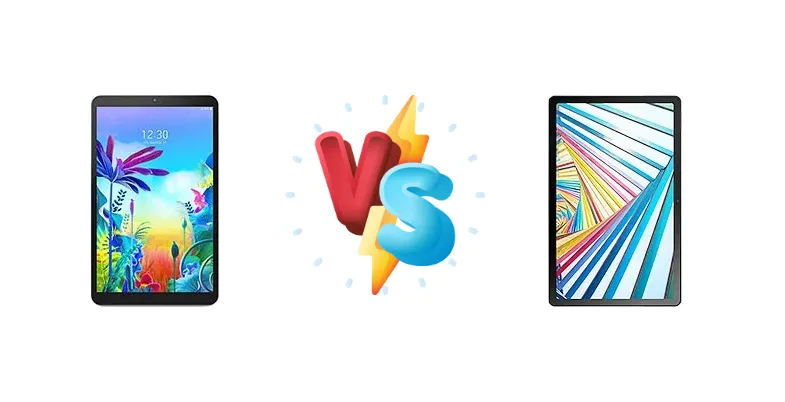
The tablet market offers a wide range of options, but finding the right balance between performance, features, and price can be challenging. We're pitting the LG G Pad 5 10.1, powered by the older but still capable Snapdragon 821, against the Lenovo Tab M10 Plus (3rd Gen), which offers a choice between the Snapdragon 680 and Helio G80 depending on the model. This comparison will dissect the key differences to help you determine which tablet best suits your needs.
🏆 Quick Verdict
For users prioritizing raw performance and a smoother experience with demanding applications, the LG G Pad 5 10.1 edges out the Lenovo Tab M10 Plus (3rd Gen). However, the Lenovo tablet’s newer 6nm Snapdragon 680 (LTE model) offers improved efficiency and 20W charging, making it a compelling choice for everyday tasks and media consumption.
| Network |
|---|
| 2G bands | GSM 850 / 900 / 1800 / 1900 | GSM 850 / 900 / 1800 / 1900 |
| 3G bands | HSDPA 850 / 900 / 2100 | HSDPA 800 / 850 / 900 / 1900 / 2100 |
| 4G bands | LTE | 1, 2, 3, 4, 5, 7, 8, 19, 20, 26, 28, 28, 38, 40, 41 |
| Speed | HSPA, LTE | HSPA 42.2/5.76 Mbps, LTE Cat13 390/75 Mbps - cellular model only |
| Technology | GSM / HSPA / LTE | GSM / HSPA / LTE |
| Launch |
|---|
| Announced | 2019, October. Released 2019, November | 2022, May |
| Status | Discontinued | Available. Released 2022, May |
| Body |
|---|
| Build | Glass front, aluminum back, aluminum frame | - |
| Dimensions | 247.2 x 150.7 x 8 mm (9.73 x 5.93 x 0.31 in) | 251.2 x 158.8 x 7.5 mm (9.89 x 6.25 x 0.30 in) |
| SIM | Nano-SIM | Nano-SIM (cellular model only) |
| Weight | 498 g (1.10 lb) | 465 g (1.03 lb) |
| | - | Stylus support |
| Display |
|---|
| Resolution | 1200 x 1920 pixels, 16:10 ratio (~224 ppi density) | 1200 x 2000 pixels, 5:3 ratio (~220 ppi density) |
| Size | 10.1 inches, 295.8 cm2 (~79.4% screen-to-body ratio) | 10.61 inches, 320.4 cm2 (~80.3% screen-to-body ratio) |
| Type | IPS LCD | IPS LCD, 400 nits (typ) |
| Platform |
|---|
| CPU | Quad-core (2x2.15 GHz Kryo & 2x1.6 GHz Kryo) | Octa-core (4x2.4 GHz Kryo 265 Gold & 4x1.9 GHz Kryo 265 Silver) - LTE model Octa-core (2x2.0 GHz Cortex-A75 & 6x1.8 GHz Cortex-A55) - Wi-Fi only model |
| Chipset | Qualcomm MSM8996 Snapdragon 821 (14 nm) | Qualcomm SM6225 Snapdragon 680 4G (6 nm) - LTE model Mediatek MT6769V/CU Helio G80 (12 nm) - Wi-Fi only model |
| GPU | Adreno 530 | Adreno 610 - LTE model Mali-G52 MC2 - Wi-Fi only model |
| OS | Android 9.0 (Pie) | Android 12 |
| Memory |
|---|
| Card slot | microSDXC (dedicated slot) | microSDXC (dedicated slot) |
| Internal | 32GB 4GB RAM | 32GB 3GB RAM, 64GB 4GB RAM, 128GB 4GB RAM, 128GB 6GB RAM |
| | UFS 2.0 | eMCP/uMCP |
| Main Camera |
|---|
| Single | 8 MP, AF | 8 MP, AF |
| Video | 4K@30fps, 1080p@30fps | 1080p |
| Selfie camera |
|---|
| Single | 5 MP | 8 MP |
| Video | 1080p@30fps | - |
| Sound |
|---|
| 3.5mm jack | Yes | Yes |
| 35mm jack | Yes | Yes |
| Loudspeaker | Yes, with stereo speakers | Yes, with stereo speakers (4 speakers) |
| Comms |
|---|
| Bluetooth | 4.2, A2DP, LE | 5.0, A2DP, LE |
| NFC | No | No |
| Positioning | GPS | GPS, GLONASS, BDS - cellular model only |
| Radio | No | FM Radio |
| USB | USB Type-C 2.0 | USB Type-C 2.0 |
| WLAN | Wi-Fi 802.11 a/b/g/n/ac, dual-band, Wi-Fi Direct | Wi-Fi 802.11 a/b/g/n/ac, dual-band, Wi-Fi Direct |
| Features |
|---|
| Sensors | Fingerprint (side-mounted), accelerometer | Accelerometer, proximity, gyro |
| Battery |
|---|
| Charging | 18W wired | 20W wired |
| Type | Li-Po 8200 mAh, non-removable | Li-Po 7700 mAh |
| Misc |
|---|
| Colors | Silver | Storm Grey, Frost Blue |
| Models | LM-T600L, T600L | - |
| Price | About 340 EUR | About 260 EUR |
| SAR | 1.10 W/kg (body) | - |
LG G Pad 5 10.1
- Stronger single-core performance with Snapdragon 821
- Potentially smoother experience with demanding apps
- Established brand reputation (though LG has exited the mobile market)
- Older chipset architecture (14nm)
- Slower charging speed (18W)
- Potentially shorter battery life due to less efficient chipset
Lenovo Tab M10 Plus (3rd Gen)
- More efficient chipset (Snapdragon 680 - 6nm)
- Faster charging (20W)
- Modern chipset architecture
- Lower single-core performance compared to Snapdragon 821
- Wi-Fi model uses less powerful Helio G80
- May struggle with very demanding applications
Display Comparison
Neither LG nor Lenovo specify display details beyond size. However, the age of the LG G Pad 5 suggests it likely uses an IPS LCD panel. The Lenovo Tab M10 Plus, being newer, *may* benefit from slight improvements in color accuracy. The real difference lies under the hood; the LG's older chipset will have a harder time driving a high-resolution, high-refresh-rate display, should one be paired. Both tablets likely target similar brightness levels for their respective price points.
Camera Comparison
Camera performance is unlikely to be a deciding factor for either tablet. Both are positioned as budget-friendly options, and detailed camera specs are scarce. It’s safe to assume both feature basic camera setups suitable for casual snapshots and video calls. Focusing on the chipsets' image signal processors (ISPs), the newer Snapdragon 680 likely offers improved image processing capabilities, potentially resulting in slightly better image quality in favorable lighting conditions. However, don't expect flagship-level camera performance from either device.
Performance
The core of the difference lies in the chipsets. The LG G Pad 5’s Snapdragon 821, built on a 14nm process, features a quad-core CPU with a focus on performance with its Kryo cores. The Lenovo Tab M10 Plus offers two chipset options: the Snapdragon 680 (6nm) in the LTE model and the Helio G80 (12nm) in the Wi-Fi only model. The Snapdragon 680’s 6nm process provides a significant efficiency advantage over the 14nm Snapdragon 821, translating to less heat and potentially longer sustained performance. The 680’s octa-core configuration (4x2.4 GHz Kryo 265 Gold & 4x1.9 GHz Kryo 265 Silver) also offers more cores for multitasking, while the Helio G80 (2x2.0 GHz Cortex-A75 & 6x1.8 GHz Cortex-A55) is a step down in performance. The Snapdragon 821, despite its age, still holds a performance edge in single-core tasks, but the 680’s efficiency and multi-core capabilities make it a strong contender.
Battery Life
The Lenovo Tab M10 Plus (3rd Gen) gains an advantage with its 20W wired charging, compared to the LG G Pad 5’s 18W charging. While neither tablet boasts an exceptionally large battery, the faster charging speed on the Lenovo will reduce downtime. The Snapdragon 680’s 6nm process also contributes to better power efficiency, potentially extending battery life during typical usage scenarios. The LG G Pad 5’s older chipset will likely consume more power under load, impacting overall battery endurance.
Buying Guide
Buy the LG G Pad 5 10.1 if you need a tablet capable of handling more intensive tasks like light gaming or multitasking with several apps open simultaneously. Buy the Lenovo Tab M10 Plus (3rd Gen) if you prioritize battery life, faster charging, and a more modern chipset architecture for everyday use like streaming, browsing, and light productivity.
Frequently Asked Questions
❓ Will the Snapdragon 680 in the Lenovo Tab M10 Plus handle multitasking with several apps open?
The Snapdragon 680’s octa-core configuration is well-suited for multitasking. While it won’t match the performance of a flagship chipset, it should comfortably handle several apps running simultaneously, especially for common tasks like browsing, streaming, and document editing. The 680’s efficiency also means less performance throttling under sustained load.
❓ Is the Helio G80 version of the Lenovo Tab M10 Plus significantly worse than the Snapdragon 680 version?
Yes, the Helio G80 is noticeably less powerful than the Snapdragon 680. The G80 uses a less efficient 12nm process and has a different CPU architecture. While still capable for basic tasks, the G80 version will struggle more with demanding applications and multitasking compared to the Snapdragon 680 model. If performance is a priority, opt for the Snapdragon 680 variant.
❓ Given the LG G Pad 5 is an older model, are software updates still available?
LG has largely exited the mobile market, meaning long-term software support for the G Pad 5 is uncertain. While it launched with Android 11, future updates are unlikely. This is a significant consideration, as lack of updates can lead to security vulnerabilities and compatibility issues with newer apps.