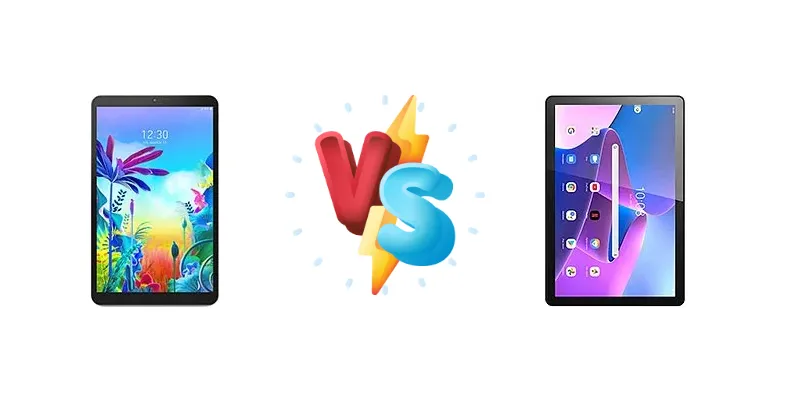
The 10-inch Android tablet space is fiercely competitive, offering a range of options for media consumption, light productivity, and casual gaming. The LG G Pad 5 10.1, powered by the older but still capable Snapdragon 821, faces off against the Lenovo Tab M10 Gen 3, utilizing the newer, more power-efficient Unisoc T610. This comparison dissects the key differences to determine which tablet delivers the best experience for your needs.
🏆 Quick Verdict
For users prioritizing sustained performance and smoother multitasking, the LG G Pad 5 10.1 emerges as the winner. While the Lenovo Tab M10 Gen 3 offers a more modern chipset fabrication process, the Snapdragon 821’s superior CPU architecture translates to a more responsive user experience, despite its age. However, the Tab M10 Gen 3 is a viable option for basic tasks and budget-conscious buyers.
| Network |
|---|
| 2G bands | GSM 850 / 900 / 1800 / 1900 | GSM 850 / 900 / 1800 / 1900 |
| 3G bands | HSDPA 850 / 900 / 2100 | HSDPA 800 / 850 / 900 / 1900 / 2100 |
| 4G bands | LTE | 1, 2, 3, 4, 5, 7, 8, 19, 20, 28, 38, 40, 41 |
| Speed | HSPA, LTE | HSPA, LTE - cellular model only |
| Technology | GSM / HSPA / LTE | GSM / HSPA / LTE |
| Launch |
|---|
| Announced | 2019, October. Released 2019, November | 2022, September |
| Status | Discontinued | Available. Released 2022, September |
| Body |
|---|
| Build | Glass front, aluminum back, aluminum frame | - |
| Dimensions | 247.2 x 150.7 x 8 mm (9.73 x 5.93 x 0.31 in) | 239.8 x 158.6 x 8.5 mm (9.44 x 6.24 x 0.33 in) |
| SIM | Nano-SIM | Nano-SIM (cellular model only) |
| Weight | 498 g (1.10 lb) | 460 g (1.01 lb) |
| Display |
|---|
| Resolution | 1200 x 1920 pixels, 16:10 ratio (~224 ppi density) | 1200 x 1920 pixels, 16:10 ratio (~224 ppi density) |
| Size | 10.1 inches, 295.8 cm2 (~79.4% screen-to-body ratio) | 10.1 inches, 295.8 cm2 (~77.8% screen-to-body ratio) |
| Type | IPS LCD | IPS LCD, 320 nits (typ) |
| Platform |
|---|
| CPU | Quad-core (2x2.15 GHz Kryo & 2x1.6 GHz Kryo) | Octa-core (2x1.8 GHz Cortex-A75 & 6x1.8 GHz Cortex-A55) |
| Chipset | Qualcomm MSM8996 Snapdragon 821 (14 nm) | Unisoc T610 (12 nm) |
| GPU | Adreno 530 | Mali-G52 MP2 |
| OS | Android 9.0 (Pie) | Android 11, upgradable to Android 12 |
| Memory |
|---|
| Card slot | microSDXC (dedicated slot) | microSDXC (dedicated slot) |
| Internal | 32GB 4GB RAM | 32GB 3GB RAM, 64GB 4GB RAM |
| | UFS 2.0 | eMCP or eMMC 5.1 |
| Main Camera |
|---|
| Single | 8 MP, AF | 8 MP, AF |
| Video | 4K@30fps, 1080p@30fps | 1080p@30fps |
| Selfie camera |
|---|
| Single | 5 MP | 5 MP |
| Video | 1080p@30fps | Yes |
| Sound |
|---|
| 3.5mm jack | Yes | Yes |
| 35mm jack | Yes | Yes |
| Loudspeaker | Yes, with stereo speakers | Yes, with stereo speakers (with Dolby Atmos) |
| Comms |
|---|
| Bluetooth | 4.2, A2DP, LE | 5.0, LE |
| NFC | No | No |
| Positioning | GPS | GPS - cellular model only |
| Radio | No | No |
| USB | USB Type-C 2.0 | USB Type-C 2.0, OTG, magnetic connector |
| WLAN | Wi-Fi 802.11 a/b/g/n/ac, dual-band, Wi-Fi Direct | Wi-Fi 802.11 a/b/g/n/ac, dual-band, Wi-Fi Direct |
| Features |
|---|
| Sensors | Fingerprint (side-mounted), accelerometer | Accelerometer, proximity |
| Battery |
|---|
| Charging | 18W wired | 10W wired |
| Type | Li-Po 8200 mAh, non-removable | Li-Po 5100 mAh |
| Misc |
|---|
| Colors | Silver | Storm Grey |
| Models | LM-T600L, T600L | - |
| Price | About 340 EUR | About 200 EUR |
| SAR | 1.10 W/kg (body) | - |
LG G Pad 5 10.1
- Superior CPU performance for multitasking and demanding apps
- Faster 18W charging for quicker power-ups
- Potentially better display quality based on LG’s brand reputation
- Older 14nm fabrication process may lead to higher power consumption
- Potentially shorter battery life compared to the Lenovo Tab M10 Gen 3
Lenovo Tab M10 Gen 3
- More power-efficient Unisoc T610 chipset
- Likely longer battery life for extended media consumption
- Lower price point, making it a more accessible option
- Slower CPU performance compared to the Snapdragon 821
- Slower 10W charging
Display Comparison
Neither LG nor Lenovo provide detailed display specifications beyond the 10.1-inch size. However, the choice of panel technology and quality likely differs. Given LG’s history with high-quality displays, it’s reasonable to assume the G Pad 5 10.1 may offer slightly better color accuracy and viewing angles. The absence of information on refresh rates suggests both tablets operate at standard 60Hz. Bezels are likely comparable, typical of tablets in this price range.
Camera Comparison
Camera performance is unlikely to be a deciding factor for either tablet. Both are positioned as budget-friendly options, and detailed camera specs are unavailable. It’s safe to assume both feature basic camera setups suitable for casual snapshots and video calls, but not for serious photography. Without specific sensor details, it’s difficult to assess image quality beyond general expectations for tablets in this segment.
Performance
The core difference lies in the chipsets. The LG G Pad 5 10.1’s Snapdragon 821, fabricated on a 14nm process, features a quad-core CPU with a Kryo architecture designed for performance. This contrasts with the Lenovo Tab M10 Gen 3’s Unisoc T610, built on a more efficient 12nm process, boasting an octa-core configuration (2x Cortex-A75 & 6x Cortex-A55). While the T610 has more cores, the Snapdragon 821’s Kryo cores offer higher single-core performance, crucial for responsiveness. The 821’s Adreno 510 GPU also provides a significant advantage in graphics-intensive tasks. The Unisoc T610 prioritizes efficiency, potentially leading to longer battery life during less demanding tasks, but will struggle with sustained loads.
Battery Life
Battery capacity details are missing for both devices. However, the Unisoc T610’s 12nm fabrication process and octa-core design, while not as powerful, are more power-efficient than the Snapdragon 821’s 14nm process. This suggests the Lenovo Tab M10 Gen 3 will likely offer longer battery life during typical usage. The LG G Pad 5 10.1 supports 18W wired charging, significantly faster than the Lenovo Tab M10 Gen 3’s 10W charging, meaning quicker top-ups when needed.
Buying Guide
Buy the LG G Pad 5 10.1 if you need a tablet capable of handling more demanding applications, enjoy occasional gaming, and value a snappier overall experience. Buy the Lenovo Tab M10 Gen 3 if you prioritize battery life for extended media consumption, require a tablet for basic tasks like web browsing and video calls, and are on a tight budget.
Frequently Asked Questions
❓ Will the Unisoc T610 in the Lenovo Tab M10 Gen 3 struggle with graphically intensive games?
Yes, the Unisoc T610 is designed for efficiency rather than raw power. While it can handle casual games, demanding titles will likely require reduced graphics settings and may still experience frame rate drops. The Snapdragon 821 in the LG G Pad 5 10.1 offers a significantly better gaming experience.
❓ How much faster is the 18W charging on the LG G Pad 5 10.1 compared to the 10W charging on the Lenovo Tab M10 Gen 3?
The 18W charging on the LG G Pad 5 10.1 will significantly reduce charging times. While exact 0-100% times are unavailable, expect a noticeably quicker top-up compared to the Lenovo Tab M10 Gen 3, which will take considerably longer to fully charge.
❓ Is the Snapdragon 821 still a relevant processor in 2024?
While not the latest and greatest, the Snapdragon 821 remains a capable processor for everyday tasks and light to moderate gaming. It offers a performance advantage over newer, lower-end chipsets like the Unisoc T610, making it a viable option for users who prioritize responsiveness.