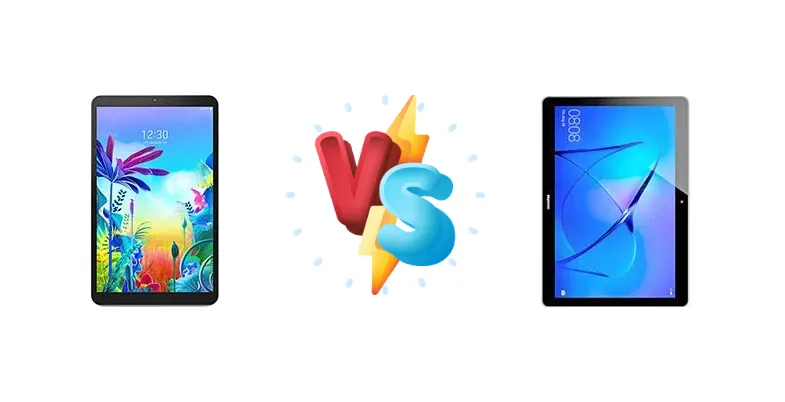
The tablet market offers a wide spectrum of choices, from budget-friendly options to high-performance devices. The LG G Pad 5 10.1 and Huawei MediaPad T3 10 represent opposite ends of this spectrum, offering distinct experiences tailored to different user needs. This comparison dissects their core components to determine which tablet delivers the best value for your money.
🏆 Quick Verdict
For users prioritizing performance and future-proofing, the LG G Pad 5 10.1 is the clear winner. Its Snapdragon 821 chipset provides a significantly smoother experience for multitasking, gaming, and demanding applications. While the MediaPad T3 10 offers a lower entry price, its Snapdragon 425 struggles with anything beyond basic tasks.
| Network |
|---|
| 2G bands | GSM 850 / 900 / 1800 / 1900 | GSM 850 / 900 / 1800 / 1900 |
| 3G bands | HSDPA 850 / 900 / 2100 | HSDPA 850 / 900 / 1900 / 2100 & TD-SCDMA |
| 4G bands | LTE | 1, 3, 5, 7, 8, 19, 20, 38, 39, 40, 41 |
| Speed | HSPA, LTE | HSPA 42.2/5.76 Mbps, LTE Cat4 150/50 Mbps - cellular model only |
| Technology | GSM / HSPA / LTE | GSM / HSPA / LTE |
| Launch |
|---|
| Announced | 2019, October. Released 2019, November | 2017, May. Released 2017, June |
| Status | Discontinued | Discontinued |
| Body |
|---|
| Build | Glass front, aluminum back, aluminum frame | - |
| Dimensions | 247.2 x 150.7 x 8 mm (9.73 x 5.93 x 0.31 in) | 229.8 x 159.8 x 8 mm (9.05 x 6.29 x 0.31 in) |
| SIM | Nano-SIM | Micro-SIM - cellular model only |
| Weight | 498 g (1.10 lb) | 460 g (1.01 lb) |
| Display |
|---|
| Resolution | 1200 x 1920 pixels, 16:10 ratio (~224 ppi density) | 800 x 1280 pixels, 16:10 ratio (~157 ppi density) |
| Size | 10.1 inches, 295.8 cm2 (~79.4% screen-to-body ratio) | 9.6 inches, 9.6, 267.2 cm2 (~72.8% screen-to-body ratio) |
| Type | IPS LCD | IPS LCD |
| Platform |
|---|
| CPU | Quad-core (2x2.15 GHz Kryo & 2x1.6 GHz Kryo) | Quad-core 1.4 GHz Cortex-A53 |
| Chipset | Qualcomm MSM8996 Snapdragon 821 (14 nm) | Qualcomm MSM8917 Snapdragon 425 (28 nm) |
| GPU | Adreno 530 | Adreno 308 |
| OS | Android 9.0 (Pie) | Android 7.0 (Nougat), EMUI 5.1 |
| Memory |
|---|
| Card slot | microSDXC (dedicated slot) | microSDXC (dedicated slot) |
| Internal | 32GB 4GB RAM | 16GB 1GB RAM, 16GB 2GB RAM, 32GB 2GB RAM, 32GB 3GB RAM |
| | UFS 2.0 | eMMC 5.1 |
| Main Camera |
|---|
| Single | 8 MP, AF | 5 MP, AF |
| Video | 4K@30fps, 1080p@30fps | 1080p@30fps |
| Selfie camera |
|---|
| Single | 5 MP | 2 MP |
| Video | 1080p@30fps | - |
| Sound |
|---|
| 3.5mm jack | Yes | Yes |
| 35mm jack | Yes | Yes |
| Loudspeaker | Yes, with stereo speakers | Yes |
| Comms |
|---|
| Bluetooth | 4.2, A2DP, LE | 4.0, A2DP |
| NFC | No | No |
| Positioning | GPS | GPS, GLONASS, BDS - cellular model only |
| Radio | No | FM radio |
| USB | USB Type-C 2.0 | microUSB 2.0 |
| WLAN | Wi-Fi 802.11 a/b/g/n/ac, dual-band, Wi-Fi Direct | Wi-Fi 802.11 a/b/g/n, dual-band, Wi-Fi Direct |
| Features |
|---|
| Sensors | Fingerprint (side-mounted), accelerometer | Accelerometer |
| Battery |
|---|
| Charging | 18W wired | - |
| Type | Li-Po 8200 mAh, non-removable | Li-Ion 4800 mAh, non-removable |
| Misc |
|---|
| Colors | Silver | Space Gray, Luxurious Gold |
| Models | LM-T600L, T600L | AGS-W09, AGS-L09, AGS-L03 |
| Price | About 340 EUR | About 180 EUR |
| SAR | 1.10 W/kg (body) | - |
LG G Pad 5 10.1
- Significantly faster processor for smooth performance
- More efficient chipset for better battery life
- Faster charging with 18W support
- Likely higher price point
- May be discontinued, impacting software updates
Huawei MediaPad T3 10
- Extremely affordable price
- Simple and easy-to-use interface
- Lightweight and portable
- Slow processor struggles with demanding tasks
- Inefficient chipset leads to shorter battery life
- Limited software support and updates
Display Comparison
While both tablets feature 10.1-inch displays, the underlying technology and performance likely differ. The LG G Pad 5, positioned as a mid-range device, likely utilizes an IPS LCD panel with decent color accuracy. The MediaPad T3 10, being a budget offering, likely employs a simpler panel. The absence of detailed display specs necessitates a focus on performance impact; the G Pad 5’s superior processing power will render graphically intensive content more smoothly, regardless of minor display differences. Bezels are expected to be larger on the MediaPad T3 10, reflecting its lower price point.
Camera Comparison
Given the target market of both devices, camera quality isn't a primary focus. Detailed camera specs are unavailable, but it's safe to assume both tablets feature basic camera setups suitable for casual snapshots. The LG G Pad 5, being the higher-end device, likely has a slightly better sensor and image processing capabilities, but neither tablet will compete with smartphone cameras. Expect adequate performance in well-lit conditions, but poor low-light performance from both.
Performance
The performance disparity is the most significant difference between these tablets. The LG G Pad 5 10.1’s Qualcomm MSM8996 Snapdragon 821 (14 nm) is a flagship-class chipset from 2016, featuring a quad-core CPU with Kryo cores clocked up to 2.15 GHz. This architecture provides a substantial performance advantage over the Huawei MediaPad T3 10’s Qualcomm MSM8917 Snapdragon 425 (28 nm) and its quad-core 1.4 GHz Cortex-A53 CPU. The 14nm manufacturing process of the Snapdragon 821 is also more efficient than the 28nm process of the 425, leading to better thermal management and sustained performance. The G Pad 5 will handle multitasking, demanding apps, and even some gaming with relative ease, while the T3 10 will struggle with even moderate workloads.
Battery Life
Battery capacity isn't specified for either device. However, the Snapdragon 821 in the LG G Pad 5, despite being more powerful, benefits from a more efficient 14nm process. The MediaPad T3 10’s Snapdragon 425, while less powerful, is hampered by the less efficient 28nm process. The LG G Pad 5 supports 18W wired charging, suggesting faster charging speeds compared to the MediaPad T3 10, which likely supports a lower wattage. The combination of efficient processing and faster charging gives the G Pad 5 an edge in real-world battery usability.
Buying Guide
Buy the LG G Pad 5 10.1 if you need a tablet capable of handling demanding applications, streaming high-resolution content, and light gaming without lag. It’s ideal for students, professionals, and entertainment enthusiasts. Buy the Huawei MediaPad T3 10 if you prioritize extreme affordability and only require a tablet for basic tasks like web browsing, email, and light document editing. It’s best suited for casual users with minimal performance expectations.
Frequently Asked Questions
❓ Will the Snapdragon 425 in the MediaPad T3 10 struggle with multiple apps open simultaneously?
Yes, the Snapdragon 425 is a low-end processor and will exhibit noticeable lag and slowdown when multitasking with more than a few apps. It's best suited for running one app at a time.
❓ Is the LG G Pad 5 10.1 a good choice for playing graphically intensive games like PUBG Mobile?
The Snapdragon 821 in the LG G Pad 5 10.1 can handle PUBG Mobile, but not at the highest settings. Expect to play at medium settings for a smoother experience. It won't match the performance of newer, more powerful chipsets, but it's a significant step up from the MediaPad T3 10.
❓ How long will software updates be supported on the LG G Pad 5 10.1, given its age?
The LG G Pad 5 10.1 is an older device, and official software updates may be limited or discontinued. However, the Android ecosystem allows for custom ROMs, potentially extending its usability.
❓ Is the Huawei MediaPad T3 10 suitable for video conferencing?
The MediaPad T3 10 can handle basic video conferencing, but the limited processing power may result in occasional lag or dropped frames, especially with multiple participants or background noise.