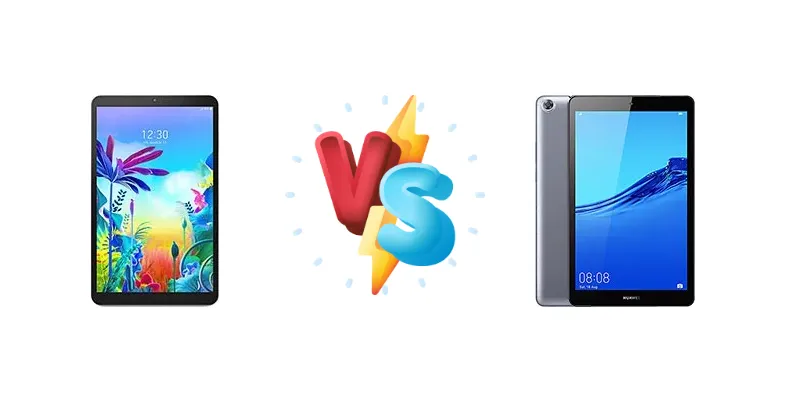
The tablet market offers a diverse range of options, but finding the right balance between performance, portability, and price can be challenging. We pit the LG G Pad 5 10.1, powered by a Snapdragon 821, against the Huawei MediaPad M5 Lite 8, featuring a Kirin 710 chipset, to determine which device delivers the best overall experience for everyday users.
🏆 Quick Verdict
For users prioritizing sustained performance and a larger display for multitasking, the LG G Pad 5 10.1 emerges as the stronger choice. While the Huawei MediaPad M5 Lite 8 offers a more compact form factor, the Snapdragon 821’s architecture provides a noticeable edge in demanding applications and gaming.
| Network |
|---|
| 2G bands | GSM 850 / 900 / 1800 / 1900 | GSM 850 / 900 / 1800 / 1900 |
| 3G bands | HSDPA 850 / 900 / 2100 | HSDPA 850 / 900 / 1900 / 2100 |
| 4G bands | LTE | 1, 3, 5, 7, 8, 20, 40, 41 |
| Speed | HSPA, LTE | HSPA, LTE (2CA) - cellular model only |
| Technology | GSM / HSPA / LTE | GSM / HSPA / LTE |
| Launch |
|---|
| Announced | 2019, October. Released 2019, November | 2019, March. Released 2019, March |
| Status | Discontinued | Discontinued |
| Body |
|---|
| Build | Glass front, aluminum back, aluminum frame | - |
| Dimensions | 247.2 x 150.7 x 8 mm (9.73 x 5.93 x 0.31 in) | 204.2 x 122.2 x 8.2 mm (8.04 x 4.81 x 0.32 in) |
| SIM | Nano-SIM | Nano-SIM (cellular model only) |
| Weight | 498 g (1.10 lb) | 310 g (10.93 oz) |
| Display |
|---|
| Resolution | 1200 x 1920 pixels, 16:10 ratio (~224 ppi density) | 1920 x 1200 pixels, 16:10 ratio (~283 ppi density) |
| Size | 10.1 inches, 295.8 cm2 (~79.4% screen-to-body ratio) | 8.0 inches, 185.6 cm2 (~74.4% screen-to-body ratio) |
| Type | IPS LCD | IPS LCD |
| Platform |
|---|
| CPU | Quad-core (2x2.15 GHz Kryo & 2x1.6 GHz Kryo) | Octa-core (4x2.2 GHz Cortex-A73 & 4x1.7 GHz Cortex-A53) |
| Chipset | Qualcomm MSM8996 Snapdragon 821 (14 nm) | Kirin 710 (12 nm) |
| GPU | Adreno 530 | Mali-G51 MP4 |
| OS | Android 9.0 (Pie) | Android 9.0 (Pie), EMUI 9.0 |
| Memory |
|---|
| Card slot | microSDXC (dedicated slot) | microSDXC (dedicated slot) |
| Internal | 32GB 4GB RAM | 32GB 3GB RAM, 64GB 4GB RAM, 128GB 4GB RAM |
| | UFS 2.0 | - |
| Main Camera |
|---|
| Single | 8 MP, AF | 13 MP, f/2.2, AF |
| Video | 4K@30fps, 1080p@30fps | 1080p@30fps |
| Selfie camera |
|---|
| Single | 5 MP | 8 MP, f/2.0 |
| Video | 1080p@30fps | - |
| Sound |
|---|
| 3.5mm jack | Yes | Yes |
| 35mm jack | Yes | Yes |
| Loudspeaker | Yes, with stereo speakers | Yes, with stereo speakers |
| Comms |
|---|
| Bluetooth | 4.2, A2DP, LE | 4.2, A2DP, LE |
| NFC | No | No |
| Positioning | GPS | GPS - cellular model only |
| Radio | No | No |
| USB | USB Type-C 2.0 | microUSB 2.0 |
| WLAN | Wi-Fi 802.11 a/b/g/n/ac, dual-band, Wi-Fi Direct | Wi-Fi 802.11 a/b/g/n/ac, dual-band, Wi-Fi Direct |
| Features |
|---|
| Sensors | Fingerprint (side-mounted), accelerometer | Accelerometer, proximity |
| Battery |
|---|
| Charging | 18W wired | - |
| Type | Li-Po 8200 mAh, non-removable | Li-Po 5100 mAh, non-removable |
| Misc |
|---|
| Colors | Silver | Champagne Gold, Space Gray |
| Models | LM-T600L, T600L | JDN2-L09 |
| Price | About 340 EUR | About 160 EUR |
| SAR | 1.10 W/kg (body) | - |
LG G Pad 5 10.1
- More powerful Snapdragon 821 processor
- Larger 10.1-inch display for multitasking
- Faster 18W charging
- Larger size may be less portable
- Older chipset architecture
Huawei MediaPad M5 Lite 8
- More compact 8-inch form factor
- Potentially lower price point
- Efficient Kirin 710 chipset for basic tasks
- Less powerful processor for demanding apps
- Smaller display may hinder multitasking
Display Comparison
The LG G Pad 5 10.1’s larger 10.1-inch display immediately differentiates it from the MediaPad M5 Lite 8’s 8-inch panel. While specific display specs like brightness and color accuracy are unavailable, the larger screen real estate on the LG G Pad 5 is advantageous for split-screen multitasking and viewing media. The MediaPad M5 Lite’s smaller size, however, enhances portability, making it easier to hold and carry for extended periods. The difference in screen size fundamentally alters the use case; the LG is geared towards home use, while the Huawei is better for travel.
Camera Comparison
Given the tablet segment, camera performance isn't a primary focus. However, analyzing available information, it's likely both devices feature modest camera setups. Without specific sensor details, it’s difficult to make a definitive judgment. We can assume both tablets prioritize basic photography for quick snapshots and video calls, rather than high-quality image capture. The absence of detailed camera specs suggests neither device is positioned as a photography powerhouse.
Performance
The core of the performance difference lies in the chipsets. The LG G Pad 5 10.1 utilizes the Qualcomm MSM8996 Snapdragon 821, a 14nm processor with a quad-core configuration (2x2.15 GHz Kryo & 2x1.6 GHz Kryo). This older, but still capable, chip was a flagship processor in its time. Conversely, the Huawei MediaPad M5 Lite 8 features the Kirin 710, a 12nm chip with an octa-core setup (4x2.2 GHz Cortex-A73 & 4x1.7 GHz Cortex-A53). While the Kirin 710 boasts more cores, the Snapdragon 821’s Kryo cores, designed by Qualcomm, offer superior single-core performance, crucial for responsive app launches and smoother UI navigation. The 14nm process of the Snapdragon 821, while older, is offset by its architectural advantages, potentially leading to comparable, or even better, sustained performance under load.
Battery Life
Battery life will depend heavily on usage patterns. The LG G Pad 5 10.1 supports 18W wired charging, a reasonable speed for a tablet. The MediaPad M5 Lite 8’s battery capacity and charging speed are not specified, but given its smaller size, it likely has a smaller battery. The Snapdragon 821’s power efficiency, combined with the larger battery capacity potentially available in the LG G Pad 5, could translate to longer runtimes, especially during demanding tasks. However, the Kirin 710’s 12nm process may offer some efficiency gains during lighter workloads.
Buying Guide
Buy the LG G Pad 5 10.1 if you need a larger screen for productivity tasks like document editing and video conferencing, and value a more powerful processor for smoother multitasking and gaming. Buy the Huawei MediaPad M5 Lite 8 if you prefer a more portable 8-inch form factor for on-the-go media consumption and casual use, and prioritize a lower price point.
Frequently Asked Questions
❓ Will the Snapdragon 821 in the LG G Pad 5 10.1 struggle with modern Android updates?
While the Snapdragon 821 is an older chip, it's still capable of running modern Android versions. However, future updates may be less optimized, potentially leading to some performance slowdowns over time. The LG G Pad 5's software support lifespan is a key consideration.
❓ Is the Kirin 710 in the Huawei MediaPad M5 Lite 8 sufficient for streaming video and browsing the web?
Yes, the Kirin 710 is perfectly adequate for everyday tasks like streaming video (Netflix, YouTube) and web browsing. It's designed for efficient performance in these scenarios, and the 8-inch display is well-suited for portable media consumption.
❓ Can either tablet handle demanding games like PUBG Mobile or Call of Duty Mobile?
The LG G Pad 5 10.1, with its Snapdragon 821, will provide a smoother gaming experience at higher settings compared to the Huawei MediaPad M5 Lite 8. The Kirin 710 may require lower graphics settings to maintain playable frame rates in these demanding titles.