
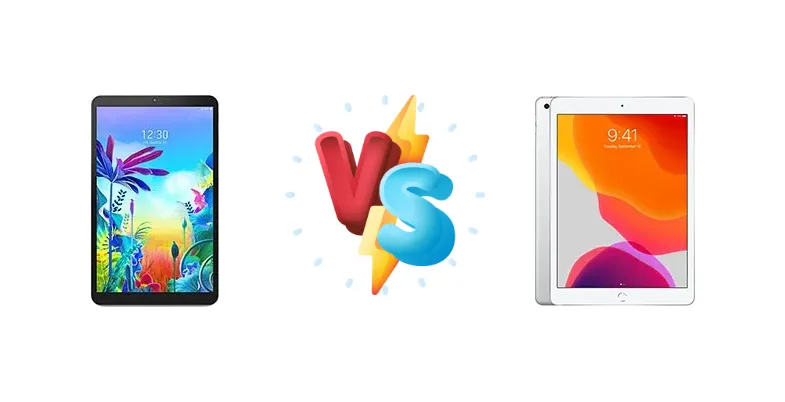
LG G Pad 5 10.1 vs Apple iPad 10.2 (2019): A Detailed Performance and Value Comparison
| Phones Images | |||||
|---|---|---|---|---|---|
|
🏆 Quick Verdict
For the average user prioritizing a polished ecosystem and sustained performance, the Apple iPad 10.2 (2019) is the better choice. Its A10 Fusion chip, while older, benefits from Apple’s software optimization, delivering a smoother experience than the LG G Pad 5 10.1’s Snapdragon 821, despite the latter’s higher clock speeds.
| PHONES | ||
|---|---|---|
| Phone Names | LG G Pad 5 10.1 | Apple iPad 10.2 (2019) |
| Network | ||
|---|---|---|
| 2G bands | GSM 850 / 900 / 1800 / 1900 | GSM 850 / 900 / 1800 / 1900 |
| 3G bands | HSDPA 850 / 900 / 2100 | HSDPA 800 / 850 / 900 / 1700(AWS) / 1900 / 2100 |
| 4G bands | LTE | 1, 2, 3, 4, 5, 7, 8, 11, 12, 13, 14, 17, 18, 19, 20, 21, 25, 26, 29, 30, 34, 38, 39, 40, 41, 66, 71 - A2200 |
| Speed | HSPA, LTE | HSPA 42.2/5.76 Mbps, LTE Cat16 1024/150 Mbps, EV-DO Rev.A 3.1 Mbps |
| Technology | GSM / HSPA / LTE | GSM / CDMA / HSPA / EVDO / LTE |
| - | 1, 2, 3, 4, 5, 7, 8, 11, 12, 13, 14, 17, 18, 19, 20, 21, 25, 26, 28, 29, 30, 34, 38, 39, 40, 41, 66 - A2198 | |
| Launch | ||
|---|---|---|
| Announced | 2019, October. Released 2019, November | 2019, September 12. Released 2019, September 21 |
| Status | Discontinued | Discontinued |
| Body | ||
|---|---|---|
| Build | Glass front, aluminum back, aluminum frame | Glass front, aluminum back, aluminum frame |
| Dimensions | 247.2 x 150.7 x 8 mm (9.73 x 5.93 x 0.31 in) | 250.6 x 174.1 x 7.5 mm (9.87 x 6.85 x 0.30 in) |
| Keyboard | - | QWERTY |
| SIM | Nano-SIM | Nano-SIM + eSIM |
| Weight | 498 g (1.10 lb) | 483 g (Wi-Fi) / 493 g (LTE) (1.06 lb) |
| - | Stylus support (1st gen only) | |
| Display | ||
|---|---|---|
| Protection | - | Scratch-resistant glass, oleophobic coating |
| Resolution | 1200 x 1920 pixels, 16:10 ratio (~224 ppi density) | 1620 x 2160 pixels, 4:3 ratio (~264 ppi density) |
| Size | 10.1 inches, 295.8 cm2 (~79.4% screen-to-body ratio) | 10.2 inches, 324.6 cm2 (~74.4% screen-to-body ratio) |
| Type | IPS LCD | IPS LCD |
| Platform | ||
|---|---|---|
| CPU | Quad-core (2x2.15 GHz Kryo & 2x1.6 GHz Kryo) | Quad-core 2.34 GHz (2x Hurricane + 2x Zephyr) |
| Chipset | Qualcomm MSM8996 Snapdragon 821 (14 nm) | Apple A10 Fusion (16 nm) |
| GPU | Adreno 530 | PowerVR Series7XT Plus (six-core graphics) |
| OS | Android 9.0 (Pie) | iOS 13, upgradable to iPadOS 18.7 |
| Memory | ||
|---|---|---|
| Call records | - | 20 dialed, 20 received, 20 missed calls |
| Card slot | microSDXC (dedicated slot) | No |
| Internal | 32GB 4GB RAM | 32GB 3GB RAM, 128GB 3GB RAM |
| Phonebook | - | 3000 entries |
| UFS 2.0 | - | |
| Main Camera | ||
|---|---|---|
| Features | - | HDR |
| Single | 8 MP, AF | 8 MP, f/2.4, 31mm (standard), 1.12µm, AF |
| Video | 4K@30fps, 1080p@30fps | 1080p@30fps, 720p@120fps, HDR |
| Selfie camera | ||
|---|---|---|
| Features | - | HDR |
| Single | 5 MP | 1.2 MP, f/2.2, 31mm (standard) |
| Video | 1080p@30fps | 720p@30fps |
| Sound | ||
|---|---|---|
| 3.5mm jack | Yes | Yes |
| 35mm jack | Yes | Yes |
| Loudspeaker | Yes, with stereo speakers | Yes, with stereo speakers |
| Comms | ||
|---|---|---|
| Bluetooth | 4.2, A2DP, LE | 4.2, A2DP, EDR, LE |
| NFC | No | No |
| Positioning | GPS | GPS, GLONASS (Wi‑Fi + Cellular model only) |
| Radio | No | No |
| USB | USB Type-C 2.0 | Lightning, USB 2.0; magnetic connector |
| WLAN | Wi-Fi 802.11 a/b/g/n/ac, dual-band, Wi-Fi Direct | Wi-Fi 802.11 a/b/g/n/ac, dual-band, hotspot |
| Features | ||
|---|---|---|
| Browser | - | WAP 2.0/xHTML |
| Games | - | Downloadable |
| Java | - | Yes |
| Messaging | - | SMS, MMS, Email |
| Sensors | Fingerprint (side-mounted), accelerometer | Fingerprint (front-mounted), accelerometer, gyro, compass, barometer |
| Battery | ||
|---|---|---|
| Charging | 18W wired | - |
| Stand-by | - | Up to 400 h (2G) / Up to 150 h (3G) |
| Talk time | - | Up to 10 h (multimedia) |
| Type | Li-Po 8200 mAh, non-removable | Li-Po 8827 mAh, non-removable (32.9 Wh) |
| Misc | ||
|---|---|---|
| Colors | Silver | Silver, Gold, Space Gray |
| Models | LM-T600L, T600L | A2197, A2200, A2198, iPad7,11, iPad7,12 |
| Price | About 340 EUR | About 350 EUR |
| SAR | 1.10 W/kg (body) | - |
LG G Pad 5 10.1
- Potentially more affordable price point.
- Open Android ecosystem allows for greater customization.
- Likely supports expandable storage via microSD (not confirmed).
- Snapdragon 821 may exhibit throttling under sustained load.
- Software updates may be less frequent and slower to arrive.
- Potentially lower build quality compared to the iPad.
Apple iPad 10.2 (2019)
- Smooth and responsive performance thanks to A10 Fusion and iOS.
- Long-term software support and updates from Apple.
- Access to a vast and optimized app ecosystem.
- Locked-down iOS ecosystem limits customization.
- May require adapters for certain accessories.
- Potentially higher initial cost.
Display Comparison
Neither device’s display specifications are provided, but based on market positioning, the iPad 10.2 (2019) likely features a laminated IPS LCD panel with good color accuracy. The LG G Pad 5 10.1, being a more budget-oriented device, may utilize a non-laminated panel with wider viewing angles but potentially lower peak brightness. The absence of details like resolution and refresh rate makes a direct comparison difficult, but Apple’s display calibration generally provides a more visually refined experience.
Camera Comparison
Camera performance is unlikely to be a deciding factor for either tablet. Given the context of these devices, both likely feature modest camera setups. Without specific sensor details, it’s safe to assume both offer adequate image quality for casual snapshots and video calls, but neither will compete with dedicated cameras or flagship smartphones. The absence of OIS or advanced image processing features on either device further reinforces this point.
Performance
The core of the difference lies in the chipsets. The LG G Pad 5 10.1 utilizes the Qualcomm Snapdragon 821, a 14nm chip with a quad-core CPU configuration peaking at 2.15 GHz. Conversely, the iPad 10.2 (2019) employs Apple’s A10 Fusion, a 16nm chip also with a quad-core CPU reaching 2.34 GHz. While the Snapdragon 821 boasts higher clock speeds, the A10 Fusion’s architecture – combining Hurricane and Zephyr cores – and Apple’s tight software integration provide superior sustained performance and efficiency. The A10 Fusion’s optimized memory controller and GPU will likely translate to smoother multitasking and gaming, despite the Snapdragon 821’s theoretical processing power.
Battery Life
Battery life will depend heavily on usage patterns. The LG G Pad 5 10.1 supports 18W wired charging, which is relatively standard. The iPad 10.2 (2019)’s battery capacity and charging speed are unspecified, but Apple’s power management is typically efficient. The A10 Fusion’s efficiency, combined with Apple’s software optimizations, likely results in comparable or even better real-world battery life despite potentially having a smaller battery capacity than the LG G Pad 5 10.1. The 18W charging on the LG G Pad 5 10.1 will provide a reasonable charge time, but Apple’s optimized charging algorithms may offer a more consistent experience.
Buying Guide
Buy the LG G Pad 5 10.1 if you need a more open Android ecosystem, prioritize expandable storage (assuming a microSD slot, not specified in data but common for LG tablets), and are comfortable with potentially more software maintenance. Buy the Apple iPad 10.2 (2019) if you prefer a seamless user experience, long-term software support, and a robust app ecosystem, even if it means being locked into Apple’s walled garden.