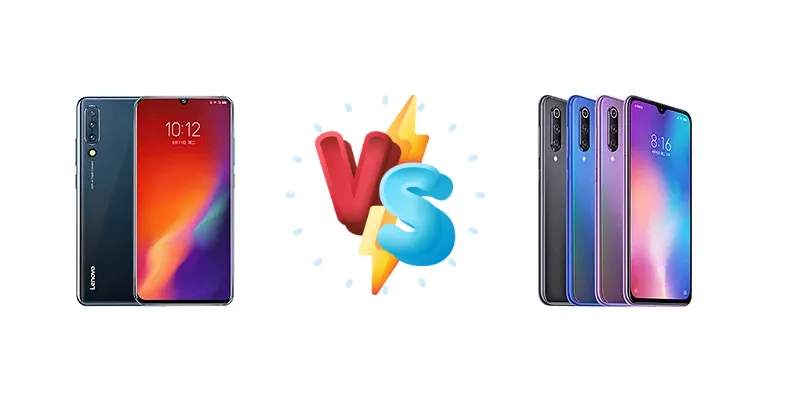
The Lenovo Z6 and Xiaomi Mi 9 SE represent a fascinating intersection of value and performance from 2019. Both devices aimed to deliver a compelling experience without breaking the bank, but they took slightly different approaches. The Z6 prioritized a newer chipset, while the Mi 9 SE focused on a refined user experience and a bright display. This comparison dissects their strengths and weaknesses to help you determine which remains a viable option today.
🏆 Quick Verdict
For the average user seeking a balance of performance and affordability, the Lenovo Z6 edges out the Xiaomi Mi 9 SE. The Snapdragon 730 offers a noticeable performance uplift over the 712, making it better suited for demanding tasks and future-proofing. While the Mi 9 SE boasts a brighter display, the Z6’s chipset advantage is more impactful overall.
| Network |
|---|
| 2G bands | GSM 850 / 900 / 1800 / 1900 | GSM 850 / 900 / 1800 / 1900 |
| 3G bands | HSDPA 850 / 900 / 1900 / 2100 | HSDPA 850 / 900 / 1900 / 2100 |
| 4G bands | 1, 2, 3, 5, 7, 8, 20, 34, 38, 39, 40, 41 | 1, 3, 4, 5, 7, 8, 20, 38, 40 - Global |
| Speed | HSPA, LTE | HSPA, LTE |
| Technology | GSM / CDMA / HSPA / LTE | GSM / CDMA / HSPA / LTE |
| | CDMA 800 & TD-SCDMA | 1, 3, 5, 7, 8, 34, 38, 39, 40, 41 - China |
| Launch |
|---|
| Announced | 2019, July 04. Released 2019, July 09 | 2019, February 20. Released 2019, March |
| Status | Discontinued | Discontinued |
| Body |
|---|
| Build | Glass front (Gorilla Glass), glass back, aluminum frame | Glass front (Gorilla Glass 5), glass back, aluminum frame |
| Dimensions | 157 x 74.5 x 8 mm (6.18 x 2.93 x 0.31 in) | 147.5 x 70.5 x 7.5 mm (5.81 x 2.78 x 0.30 in) |
| SIM | Nano-SIM + Nano-SIM | Nano-SIM + Nano-SIM |
| Weight | 159 g (5.61 oz) | 155 g (5.47 oz) |
| Display |
|---|
| Protection | Corning Gorilla Glass (unspecified) | Corning Gorilla Glass 5 |
| Resolution | 1080 x 2340 pixels, 19.5:9 ratio (~403 ppi density) | 1080 x 2340 pixels, 19.5:9 ratio (~432 ppi density) |
| Size | 6.39 inches, 100.2 cm2 (~85.7% screen-to-body ratio) | 5.97 inches, 87.5 cm2 (~84.1% screen-to-body ratio) |
| Type | Super AMOLED, 120Hz, HDR10 | Super AMOLED, HDR |
| Platform |
|---|
| CPU | Octa-core (2x2.2 GHz Kryo 470 Gold & 6x1.8 GHz Kryo 470 Silver) | Octa-core (2x2.3 GHz Kryo 360 Gold & 6x1.7 GHz Kryo 360 Silver) |
| Chipset | Qualcomm SDM730 Snapdragon 730 (8 nm) | Qualcomm SDM712 Snapdragon 712 (10 nm) |
| GPU | Adreno 618 | Adreno 616 |
| OS | Android 9.0 (Pie), ZUI 11 | Android 9.0 (Pie), upgradable to Android 11, MIUI 12.5 |
| Memory |
|---|
| Card slot | microSDXC (uses shared SIM slot) | No |
| Internal | 64GB 6GB RAM, 128GB 6GB RAM, 128GB 8GB RAM | 64GB 6GB RAM, 128GB 6GB RAM |
| | UFS 2.1 | UFS 2.0 |
| Main Camera |
|---|
| Features | Dual-LED flash, panorama, HDR | Dual-LED flash, HDR, panorama |
| Triple | 24 MP, f/1.8, (wide), 1/2.8", 0.9µm, PDAF
8 MP, f/2.4, (telephoto), PDAF, 2x optical zoom
Auxiliary lens | 48 MP, f/1.8, (wide), 1/2.0", 0.8µm, PDAF
8 MP, f/2.4, (telephoto), 1/4.0", 1.12µm, PDAF
13 MP, f/2.4, (ultrawide), 1/3.1", 1.12µm |
| Video | 4K@30fps, 1080p@30fps | 4K@30fps, 1080p@30/60/120fps, 720p@960fps, gyro-EIS |
| Selfie camera |
|---|
| Features | HDR | HDR |
| Single | 16 MP, f/2.0, 26mm (wide), 1/3.06", 1.0µm | 20 MP, f/2.0, (wide), 1/3", 0.9µm |
| Video | 1080p@30fps | 1080p@30fps |
| Sound |
|---|
| 3.5mm jack | Yes | No |
| 35mm jack | Yes | No |
| Loudspeaker | Yes | Yes |
| Comms |
|---|
| Bluetooth | 5.0, A2DP, EDR, LE, aptX HD | 5.0, A2DP, LE, aptX HD |
| Infrared port | - | Yes |
| NFC | No | Yes |
| Positioning | GPS, GLONASS, BDS | GPS, GLONASS, GALILEO, BDS |
| Radio | No | No |
| USB | USB Type-C 2.0, OTG | USB Type-C 2.0, OTG |
| WLAN | Wi-Fi 802.11 a/b/g/n/ac, dual-band, Wi-Fi Direct | Wi-Fi 802.11 a/b/g/n/ac, dual-band, Wi-Fi Direct, DLNA |
| Features |
|---|
| Sensors | Fingerprint (under display, optical), accelerometer, proximity, compass | Fingerprint (under display, optical), accelerometer, gyro, compass |
| | - | Virtual proximity sensing |
| Battery |
|---|
| Charging | 15W wired | 18W wired |
| Type | Li-Po 4000 mAh, non-removable | Li-Po 3070 mAh, non-removable |
| Misc |
|---|
| Colors | Blue | Violet, Blue, Gray |
| Models | L78121 | M1903F2G |
| Price | About 250 EUR | About 460 EUR |
| SAR | - | 1.39 W/kg (head) 1.39 W/kg (body) |
| SAR EU | - | 1.19 W/kg (head) 1.17 W/kg (body) |
| Tests |
|---|
| Audio quality | - |
Noise -93.5dB / Crosstalk -93.5dB |
| Battery life | - |
Endurance rating 73h
|
| Camera | - |
Photo / Video |
| Display | - |
Contrast ratio: Infinite (nominal) |
| Loudspeaker | - |
Voice 86dB / Noise 79dB / Ring 87dB
|
| Performance | - |
AnTuTu: 180057 (v7)
GeekBench: 6017 (v4.4)
GFXBench: 14fps (ES 3.1 onscreen) |
Lenovo Z6
- More powerful Snapdragon 730 chipset
- Potentially better thermal management due to 8nm process
- Likely smoother performance in demanding apps
- Charging speed is slower at 15W
- Display specifications are unknown, potentially inferior to Mi 9 SE
Xiaomi Mi 9 SE
- Brighter display (637 nits peak brightness)
- Faster 18W wired charging
- Potentially more refined software experience
- Less powerful Snapdragon 712 chipset
- May exhibit more thermal throttling under heavy load
Display Comparison
The Xiaomi Mi 9 SE features a display capable of reaching 637 nits of peak brightness, a significant advantage for outdoor visibility. While the Lenovo Z6’s display specifications are not provided, the Mi 9 SE’s brightness level suggests a superior viewing experience in bright conditions. Both devices have an 'infinite' (nominal) contrast ratio, typical for AMOLED panels, offering deep blacks and vibrant colors. However, without knowing the Z6’s panel technology or color accuracy, the Mi 9 SE’s measured brightness gives it a clear edge for users who frequently use their phones outdoors.
Camera Comparison
Both the Lenovo Z6 and Xiaomi Mi 9 SE offer photo and video capabilities, but detailed camera specifications are limited. Without sensor size or aperture information, a direct comparison is difficult. However, the market positioning of both phones suggests similar camera performance, focusing on everyday photography rather than professional-grade results. The absence of details regarding OIS or advanced image processing features implies that image quality will largely depend on software optimization and lighting conditions. It's safe to assume both phones will struggle in low-light scenarios without significant software intervention.
Performance
The Lenovo Z6’s Qualcomm Snapdragon 730 (8nm) represents a step up from the Xiaomi Mi 9 SE’s Snapdragon 712 (10nm). The 8nm process node on the 730 generally translates to better power efficiency and potentially lower thermal throttling under sustained load. The Z6’s CPU configuration – 2x2.2 GHz Kryo 470 Gold & 6x1.8 GHz Kryo 470 Silver – is slightly faster than the Mi 9 SE’s 2x2.3 GHz Kryo 360 Gold & 6x1.7 GHz Kryo 360 Silver. While the Mi 9 SE’s CPU clock speeds are marginally higher, the architectural improvements and process node of the Snapdragon 730 in the Z6 will likely result in smoother performance in real-world scenarios, particularly in graphically intensive applications.
Battery Life
Both devices share an endurance rating of 73 hours, indicating comparable battery life under similar usage patterns. However, the Xiaomi Mi 9 SE supports 18W wired charging, while the Lenovo Z6 is limited to 15W. This means the Mi 9 SE will recharge slightly faster, potentially offsetting the impact of any minor differences in battery capacity. The 3W difference in charging speed isn’t massive, but it could be noticeable for users who frequently top up their phones throughout the day.
Buying Guide
Buy the Lenovo Z6 if you prioritize raw processing power for gaming or multitasking and want a phone that feels more responsive. Buy the Xiaomi Mi 9 SE if you value a brighter, more visible display in direct sunlight and prefer a potentially more polished software experience, understanding that performance will be slightly less potent.
Frequently Asked Questions
❓ Will the Snapdragon 730 in the Lenovo Z6 handle demanding games like PUBG Mobile smoothly?
Yes, the Snapdragon 730 is capable of running PUBG Mobile at medium to high settings with stable frame rates. While it won't match the performance of flagship chipsets, it provides a significantly better gaming experience than the Snapdragon 712 in the Mi 9 SE, especially during prolonged gaming sessions due to its more efficient thermal characteristics.
❓ How much faster is the 18W charging on the Xiaomi Mi 9 SE compared to the 15W charging on the Lenovo Z6?
The difference in charging speed isn't dramatic, but the Mi 9 SE will likely charge approximately 20-30% faster. This translates to roughly 15-20 minutes saved for a full charge, which can be convenient for users who need to quickly top up their battery.
❓ Is the camera on either phone good enough for casual social media photography?
Both phones are adequate for casual social media photography in good lighting conditions. However, don't expect exceptional image quality, especially in low light. The lack of OIS and detailed camera specs suggests that both phones rely heavily on software processing, which can sometimes result in over-sharpened or artificial-looking images.